01 June 2007

Life in Recovery: Nature Abhors a Vacuum

Several of the neighbors along my walking route have small dogs with furry feet. And, in a less than perfect tracking medium, even house cat's prints can look very fox like. I should have known better, though, since the tracks were in such a neat, straight line. Also, there seemed to be a regular route from day to day.

That regular route makes the red fox fairly easy to trap, IF you are clever in hiding the set and keeping it free of human scent. Gramps taught me to make a red fox set when I was about 10-years old. We had seen the big dog (male) fox a few times, and it followed a regular route across a ridge through a cluster of house-sized boulders. Although he pumped an oil lease on the New York State side of the line where there was no bounty, we lived in Pennsylvania and I had learned that the commonwealth paid the princely sum of FIVE DOLLARS. Wow, a lot of money to a kid who got a nickel for running errands for neighbors, and a quarter for clearing their sidewalk (front, side, and steps) of heavy snow.

Gramps fished a #2 jump (flat spring) trap out of a corner of the powerhouse, then told me to dip it in the crude oil separator and hang it in a hemlock tree for several days. In the meantime, I found and shot a porcupine, and buried it in a protected location where it could ripen. I watched carefully as Gramps carefully placed the set in a small depression of earth and covered it with dry grit from an anthill. He wired the end of the chain to a chunk of fallen tree as a drag, and hung a few grouse feathers over the trap. The trap was a bit off-center in a narrow dead-end slot at the base of a boulder. The stinking half-rotten porcupine he placed at the end of the slot.

The next morning, we had our fox. Gramps dispatched it with a club, cased (skinned) it carefully, and put it atop the chains and wrenches in the narrow box of the F-2 Willys. He showed the pelt, received the bounty, and handed it to me; he sold the hide -- for about two dollars, as I recall -- and he kept that money.

Thrilled by the thick and beautiful fur (and the five dollars), I was also inexplicably sad. Years later I came to terms with this sadness and decided it was better not to kill red fox for their hide. This realizaton came as I was "walking down" a trapped fox -- i.e. standing on its chest until its life expired, a method taught to me a friend in order to avoid bloodying or damaging the pelt. I looked into the eyes of the terrified, gasping animal and that was that. No more fox.

Since that time I formed something of a bond with red foxes. I watched them in the areas I routinely bowhunted, and followed the seasons with a fox and pups from a den near my wife and my first house near Rew, Pennsylvania.

As EcoRover reported earlier [Why I Hate ATVs, May 07, 2007], fox have been colonizing Butte's recovering ecosystem. The grassy mining restoration areas and the fencing around Big Butte have aided this process. [As I write this, RTD is lying at my feet, barking softly and twitching her feet--no doubt deep in a foxy dream--she loves their scent like nothing else.] As sad and angry as I was to discover my red fox acquaintance murdered by the ATV kids, I was equally ecstatic to meet a new friend this morning:


I first noticed her this morning as she stood at the top of the ridge in the shaded rocks, watching RTD head down the trail in front of me. Once RTD was a safe distance away, she approached the trail but immediately halted and looked at me as I pulled the camera from its pouch on my shoulder strap. But -- unlike several previous mornings when I have seen her -- she did not bolt. Instead, she sat down, perhaps wondering if I had spotted her. I slowly backed off, and she came a bit closer (perhaps to get into the brush along the edge of the trail):

It was clear that she badly wanted to cross that path. I say "she" because the fox routinely crosses in this area, and I believe she was on her way back to the den after a night of hunting. I am usually on the trail much earlier (c. 7 am) when I have glimpsed her (or her fresh tracks), and I think she was out hunting a bit late (c. 8 am) this morning.

Speaking softly, I walked on by and then turned and walked backwards. When I was about a hundred yards down the trail, she crossed and entered the gully area where I believe the den lies.

Our habitat is, it seems, ideal for fox. Plenty of mice and an increasing rabbit population, plus the occasional apple tree and chokecherry patch, provide all the major food groups for my little friend. In arguing the impossibility of "empty" space and the way air rushes in behind a moving object in order to sustain that movement, Aristotle said, "Nature abhors a vacuum." Similarly, animals and plants and life in general quickly move into a "vacuum" created by hunting, poisoning, predation, or other causes. That assumes, of course, that there are other critters out there to replace those that die. Though the individual red fox dies, the species goes on.

I'm not vouching for the correctness of Aristotle's reasoning. More importantly, just as he fundamentally misunderstood the nature of momentum, we today probably misunderstand much about the nature of ecological restoration. Though we try harder to devise experimental tests of our science than did Aristotle, there is still an important lesson to be learned. We should be humble about our ability to capture, predict, or control natural processes. And we should not fail to appreciate the profound beauty of such processes, either.

30 May 2007

Lakes are Opening Up

With the unusually warm weather this spring, our mountain lakes are opening up a little early. Some years, I have found ice-out in early July. The fish feed greedily at ice-out, but it's also the time of the first big mosquitoe hatches. I've never quite appreciated the woodsy song of the little blood suckers buzzing around my ears, as Thoreau said he did.

Many of our lakes are stocked (air dropped) periodically with fingerling trout, but some of them also have good naturally reproducing populations. Virtually all of our alpine lakes were originally devoid of fish, though they must have had plenty of other native species. It is unfortunate that some native species in these lakes must have been displaced or impacted by the great trout planting movement of 50 to 100 years ago. But for those of us who like to hike in the mountains and eat fresh trout, the lakes do provide a wonderful experience.

Here are a few Yellowstone (?) cutthroat trout from a nearby mountain lake. Mabye they are westslope cutts, but for some reason the lakes were usually planted with Yellowstones. Beautiful fish, they'll be spawning at the lake inlet in a few weeks or so.

And it's nice to have a patch of snow near the trailhead as a place to stash a beer for the drive home:

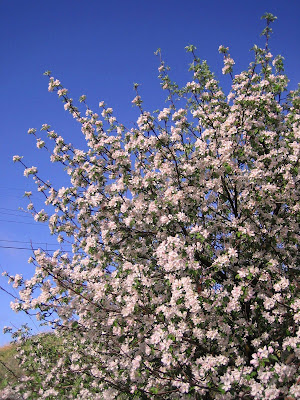
Last week's snowstorm dropped some much needed moisture, and we are well above average for the year. It will be interesting to see how this plays out for Big Hole River flows (which is dewatered even in average precipitation years, of late). At any rate, it was a "warm" snow and did not seem to harm the apple blossoms on Butte's few but hardy trees:

And the on-average warm spring has the bitterroots ready to bloom:

29 May 2007

Endangered Friendship

I ran into a Big Hole River rancher this past weekend. It was someone that I worked with on various committees for about 10 years, and I considered them a friend. He no longer felt that way, and simply glared at me when we met.

I am sure it is because of my recent public stance for placing Big Hole River grayling on the Endangered Species List. How many Big Hole Watershed Committee meetings did I sit through where the agricultural representatives said things like, "We need to keep grayling off the endangered species list." Seldom was the rhetoric about recovering grayling, ensuring that there were more grayling in the river, or enhancing habitat and river flows to maximize grayling survival.

It was as if the Endangered Species Act and groups that supported a grayling ESA listing were the enemy. And grayling? They were just a proxy for how people felt about nature--nature that could be reduced to a simple matter of profit, property rights, and power.

How to explain to such people?

"Look, my friend, it's like a sick child. If your child has a mild ear infection, what would you do to help them? Maybe sacrifice half-a-day's work to take them to the clinic, maybe even pay out $50 for an antibiotic. You certainly wouldn't take a doctor to court who refused to help your child, nor would you demonstrate in front of a pharmacy that wouldn't provide the medicine.

"But what if your child were dying of a deadly disease that could be cured? Would you publicly criticize doctors and the medical establishment that refused care? Hell, you'd probably take a doctor at gunpoint or rob a pharmacy if you thought it would help!"

Big Hole River grayling are a dying child. Without help, they may well perish from the face of the earth. Can my rancher friend understand this?

Probably not. Take the Watershed Committee. There is endless talk, talk, talk about collaboration. It's a sort of meet-in-the-middle approach like Solomon's infamous decision regarding the baby disputed over by two mothers. Sadly, the Big Hole Watershed Committee is perfectly willing to split the baby -- i.e. grayling -- down the middle. The Watershed Committee would allow grayling to perish rather than to question water rights or demand economic sacrifice.

Another former friend, a conservationist no less, argued that, "An ESA listing will not put more grayling in the river!"

Well, I have to ask, how many more grayling are in the river after more than ten years of Big Hole Watershed Committee collaboration? Hell, let's face it: There are FAR FEWER Big Hole River grayling than we had before the Watershed Committee was formed.

I have no doubt that an ESA listing for Big Hole River grayling will come. But it may well come too late. I fully expect that, ten years from now, we will be doing with fluvial Arctic grayling very much like what we did with gray wolves: we will be importing grayling from Canadian rivers to re-establish populations throughout the upper Missouri River basin. And, just as ranchers learned to cope with wolf recovery and the required changes in agricultural management, so will they learn to cope with grayling recovery and the required changes in water management.

23 May 2007

Big Hole River Grayling, Image Events, and Mind Bombs

Environmental groups and other activists face a real challenge in capturing media attention and garnering public support. The problem is not that people do not care, but that they are distracted by the countless details of their own personal lives, the beating of drums for national issues such as imperialist wars against foreign nations, and the constant din of ringing phones and text messages and email etc. Add to this the deluge of media messages to buy more Big Macs, lose weight, and take a new boner drug and we're left with an attention span just wide enough to bridge a gnat's ass.

No wonder, then, that no one wants to understand the subtleties of what a "Distinct Population Segment" means for the Endangered Species Act or of how few motorized areas will actually be closed in a new Forest Management Plan.

The fact is, we live in a sound (and sight) byte world. If you can't get your message across quickly and in an entertaining fashion, then no one is going to care.

This is why "image events," or "mind bombs" if you prefer, are so useful. An image event is a brief narrative with a powerful psychological effect that changes the way people think. The classic image event, as described by visual rhetoric scholar Kevin DeLuca, was the Greenpeace "save the whales" news clip.

The year was 1975. The war against Vietnam was over. Greenpeace had just begun. Star Wars was soon to debut. Presidential candidate Reagan was hyping up public fear of the USSR--the Evil Empire. Americans were beginning to think of whales as an oversize but lovable and super-intelligent pet--like the dolphin star of the popular 1960s TV series "Flipper."

So there they were, a couple of harmless, peacable, hippie-next-door kids in a little inflatable boat. The Zodiac is a tiny boat dwarfed by the dark, looming Russian whaling ships. The kids next door are putting their lives in danger for our friend the whale. The little rubber raft positions itself between a harpoon ship and a lovable whale and then BLAM! the cannon-fired harpoon whooshes over their head, the poor whale is murdered, and the steel harpoon cable tightens just a few feet from the raft. [photo below from Greenpeace.org]

The Greenpeace activists get it all on video, and within a few days the clip is broadcast again and again by TV network news. Millions of Americans view it. They are outraged by the cruel Russians and sympathetic to the gentle hippie kids next door. Soon, American politicians caved to public pressure and supported an international ban on whaling.

How ideal it would be if we lived in ancient Athens, where Socrates, his students, and others would spend hours just talking, talking, talking about the issues of the day. Imagine a world where people had the time and patience to think deeply about a particular issue, and to follow a train of thought from beginning to end. What luxury!

Instead, we live in a world where politics can twist law and science into a pretzel because most Americans are simply too busy to give it much thought. And so to save a whale -- or a grayling -- we need to thrust a powerful image through the eye and down into the limbic brain. A good image will evoke love and outrage, support for and oppostion against.

The image must tap into extant culture types, ideologies, associated images/discourse, and other popular symbolic structures. While words/text are important, the image carries the main message. And yes, McLuhan got it write: the medium is the message.

The less people have to think about what they see (when they see it), the more they will think about what they see (after they see it). If the image event meshes with other efforts -- such as political campaigns or legal challenges -- the image event can aid greatly the support for and hence the effectiveness of such efforts. Image events build a participatory style of democracy that will not leave decisions in the hands of political sycophants or the technocratic elite.


----------------------------------------------------
Sources
Kevin DeLuca (1999). Image politics: the new rhetoric of environmental activism.
Robert Hunter and R Wheyler (1978). To save a whale: the voyages of Greenpeace.

22 May 2007

Warm Springs Ponds: the future of a Superfund site

Warm Springs Ponds and the 3 Rs (adapted from a KUFM radio commentary)

The three Rs of Superfund : “Reclamation, Remediation, and Restoration.”

If we go by the book, the three Rs have distinct definitions. Reclamation is the broadest term—something like a genus in biology. You know, like the genus “Canis,” which takes in wolves, dogs, and coyotes. Reclamation is a fuzzy notion.

Mining engineers define reclamation as “returning damaged land to a beneficial use.” British Petroleum-ARCO likes to call itself a “partner in responsible reclamation.” As the legally responsible party in the Clark Fork Superfund mess, BP-ARCO is responsible for a lot more than reclamation! But if BP-ARCO can pull off a cheap reclamation job that masquerades as remedy, it will do that. Look at the golf course or all those ball fields built on mine dumps.

Remedy is defined under federal Superfund law as the “removal or treatment of hazardous material to protect human and environmental health.” The removal of toxic mine waste along Silver Bow Creek is remedy. EPA oversees remedy, and the decision that makes it official is called a Record of Decision.

Restoration is a legal term defined under the state version of Superfund law as “returning injured natural resources to baseline conditions or otherwise accelerating the natural recovery process.” The construction of a functioning streambed and planting native vegetation along Silver Bow Creek is restoration. Montana oversees restoration.

My student, Michelle Sullivan, recently completed an undergraduate research project about the three Rs. Michelle interviewed federal, state, industry, and academic experts.. Surprisingly, half of these experts were as confused about the three Rs as were members of a lay audience.

Well, the real world is a complex place that simply does not easily conform to the language we invent in order to describe it. The intentional obfuscation of terms by BP-ARCO doesn’t help, either. Nor does the complicity of the EPA in allowing BP-ARCO sometimes to count superficial reclamation – i.e. cover-up – as remedy.

Still, the world is a complex place. Consider Warm Springs Ponds—2500 acres of beautiful, lush habitat along I-90. Despite appearances, the area is an industrial waste treatment facility for the polluted waters of Silver Bow Creek. Construction began in 1911, and work continues to this day. For example, in the early 1990s, ARCO removed more than 500,000 tons of contaminated sediments. And there are millions and millions of tons still in place—an amount probably exceeding what’s at Milltown. Furthermore, the concentrations of arsenic and other toxic metals are far higher than at Milltown.

Warm Springs Ponds faces an uncertain future. EPA, Montana, and BP-ARCO all have their fingers in the pie. EPA has not specified a remedy – or Record of Decision – for the area. In part, this is because remedy and restoration of Silver Bow Creek will take another decade or so.

Should remedy and restoration on Silver Bow Creek exceed all reasonable expectations and should the creek actually meet water quality standards, Warm Springs Ponds might no longer be needed for waste treatment. One could imagine a radical solution such as bulldozing the ponds back to the hillside in a vast dry-closure waste repository. Or, a trickle of water could be maintained over the ponds as a wet waste repository. Or, the ponds could be maintained very much as they are today.

Consider this last option—maintaining Warm Springs Ponds in perpetuity. There’s a good argument for this. Hundreds of resident and migratory birds depend upon the area; and it’s home to upland game and trophy trout. On a walk around the ponds last weekend, my family and I thrilled at the site of osprey snatching fish, sandhill cranes dancing and hooting, and Canada geese guarding their fuzzy yellow offspring. The area provides important recreational opportunities for bird watchers, anglers, waterfowl hunters, and dog trainers.
[below: eared grebe at the ponds, from www.gobirdmontana.com]
Warm Springs Ponds will not take care of themselves. Maintaining the natural resources and recreational opportunities will cost money. Toxic muck will need to be dredged periodically and hauled to a repository, the ponds’ dikes will need to be monitored and kept safe against erosion, and trails and signage will need to be maintained. For these reasons and others, the future of the area must be secured--perhaps with an operations and management trust fund, something like the $50 million stash that Butte received from BP-ARCO for assuming oversight of the Butte Priority Soils remedy.

Recently, a diverse group of conservationists came together to deliberate this issue. Citizens included representatives from groups such as Trout Unlimited and the Montana Wildlife Federation as well as interested local folks. We do not yet know what the future will bring, but we do want to play an active role in shaping it. We don’t want reclamation masquerading as remedy.

For more news about Warm Springs Ponds and other Superfund issues, please check out CFRTAC’s website at hyperlink www.cfrtac.org.


21 May 2007

Springtime Rambling

Today we are enjoying a blizzard, and a few days ago it was 80 deg F. Ahhh, springtime at 6,000 feet. Despite or maybe because of the extremes, it is a wonderful time of year.

On my mile and a half walk from home to work, I pass a great old apple trees. Now, I liked apple trees in Pennsylvania, where every abandoned farmstead and pasture is littered with them. Even on treks across seemingly remote places, it is common to come across a fine old hundred year old tree still bearing fruit thanks to regular pruning by bears.

Around Butte, though, apple trees are a little harder to come by. Most are stunted and in many years they do not even bloom. But there is a tree near Montana Tech that is sheltered from the harsh West winds and the cold North air. Last week I watched the flower buds develop:

And then the first few flowers opened--a real treat for our native humble bees:
And today, just before the blizzard blew it, it stood in all its full-flowered glory:
Like the apple trees and bees, the ants too are busy. I'm no E.O. Wilson entomologist, but I share his fascination for ants. There is an especially large old mound near my house, and they were swarming as the morning warmed (photo at right, below). The red colored soldier ants among them are fiercely aggressive. Several were nipping away on my bare ankles and legs as I poked a straw at the two in the righthand photo.


A fishing trip easily turns into an excuse to check out the latest wildflowers, like this prarie smoke, buttercup, phlox (two different kinds, I think):


The mule deer are feeding eagerly now on the new green forbs, putting on a little weight in preparation for fawning time:

And there were a few trout to be caught for the evening's supper:

And an elk on a ridge at dusk to wish me good riddance:

16 May 2007

More About President Bush the Grayling Killer

For local newspaper coverage and a great photo, see Justin Post, "Grilling the Administration," The Montana Standard (16May2007) at http://www.mtstandard.com/articles/2007/05/16/butte_top/20070516_butte_top.txt .

And for local KXLF-TV station coverage (you have to watch a commercial first), see http://www.montanasnewsstation.com/Global/story.asp?S=6524196 .

And, most importantly of all, the Center for Biological Diversity announcement of its lawsuit: http://www.biologicaldiversity.org/swcbd/press/grayling-05-15-2007.html

15 May 2007

Bush Kills Endangered Fish: Big Hole River Grayling Funeral

A somber day, this, with a funeral ceremony commemorating the Big Hole River's late, great, fluvial Arctic grayling.

It began with a Montana grandpa and granddaughter out for a day of fishing.

"Grandpa, were there a lot of grayling in the Big Hole River when you were a kid?"

Sure were. We’d catch and release a bunch of them in a day’s fishing."

"Grandpa, do you think we'll catch and release a grayling today?"

"Well, honey, there might be one or two left. But not for long, because the Bush administration doesn’t care about endangered species."

Look, Grandpa! There's a grayling! It's beautiful."


Well, let's try to catch and release it."

Suddenly, an evil man with a terrible sneer, evil laugh, and a big cowboy hat came running onto the scene. What did he want? What would he do?


Grabbing the poor stunned creature, the crazed man screamed, "No grayling for you! Hah, hah, hah..." Then, he picked up the grayling and ran off, sneering and shouting, " No grayling left behind! NO GRAYLING LEFT BEHIND!" Then, he thrust the rare and endangered fish onto a pyre.


Grandpa, that nutcase killed the grayling! Who is he?"

"The worst President in the history of our country. "

President Dubya was followed by two sychphants wearing "FWS" t-shirts.

"Grandpa, who are those people following grayling killer Bush and begging for their jobs?"

"Those are the US Fish and Wildlife Service professionals who think job security is more important than scientific integrity and protecting your heritage.


But maybe it's NOT too late: The Endangered Species Act was designed to save our natural heritage—rare native species such as the Big the grayling a death sentence. We must appeal this ruling, and save the grayling for our children and grandchildren.

The Center for Biological Diversity has not given up on grayling, and will announce today (May 15) its 60-day Notice of Intent to sue the US Fish & Wildlife Service regarding its grayling decision. Some other groups are also deliberating a legal challenge of the agency decision.

Stay tuned for more information about a legal challenge from the Center for Biological Diversity
http://www.biologicaldiversity.org/swcbd/ of the recent Fish & Wildlife Service decision to let Big Hole River grayling become extinct.


------------------------------------------------
Credits:
Thank you to Wayne Hadley as Grandpa, Michelle Schahczenski as Granddaughter, Jeff Schahczenski as President Dubya, Hue-Chu Tu as FWS employee one, and AJ Puckett as FWS employee two.
Thank you to the Big Hole River grayling prop construction crew of Andrea & Don Stierle, Hwe-Chu Tu, Frank Ackerman, Celia & Jeff Schahczenski, Chad Okrusch, David Hobbs, AJ Puckett, and Wayne Hadley.
Thank you to Justin Ringsak, Brittany McEwen Rauch, and Justin's friend who filmed the event and who are working on the YouTube post.
And thank you to the many folks who showed up today to bear witness to the sad plight of our beautiful and endangered native fish, the Big Hole River grayling.


14 May 2007

Big Hole River Grayling: Funeral Tomorrow

Big Hole River grayling, aka Thymallus arcticus montanus, are getting some well deserved local press coverage. Tomorrow, we (the Grayling Restoration Alliance) hosts a media event--a grayling funeral:

Grayling ‘funeral’ protest Tuesday
By Justin Post of The Montana Standard - 05/14/2007
It won’t be a routine fishing trip. Not if you consider a 6-foot-long grayling and a mock funeral with President Bush your average day on the Big Hole River. A group opposed to the federal government’s recent decision not to protect the fluvial arctic grayling as an endangered species has organized a protest at 2 p.m. Tuesday at the Divide public fishing access. In conjunction with the protest, the Center for Biological Diversity is expected Tuesday to file a 60-day notice that it intends to sue the federal government over its April 24 decision, said Noah Greenwald, a biologist with the non-profit group. The notice is the required first step in challenging the decision not to place grayling on the Endangered Species List under the Endangered Species Act, he said.— Justin Post may be reached at justin.post@lee.net.


Also, The Montana Standard printed a nice political cartoon yesterday:


07 May 2007

Why I Hate ATVs [revised]

I hate ATVs ("All Terrain Vehicles"). I know, I know: ATVs don't ruin the landscape, irresponsible ATV riders do. Problem is, the 10% of law abiding ATV riders get a bad name from the 90% who break all the rules.

For the past two nights, I've been dreaming of fox pups. Not cute fox pups cavorting on green grass around the den, endlessly pestering their dam, greeting each new mouse brought home for dinner... Rather, I'm dreaming of wimpering, worried pups slowly starving to death in a cold and lonely world.

You see, the sons-of-bitches who ride ATVs near my house killed the mother fox that, for several years in a row, has whelped her pups in a den that seemed well hidden in a washed out gully. It was a senseless murder. She was not killed for her beautiful winter-prime pelt, by some boy who had studied her habits, who made a well-hidden trap set, and who carefully skinned her carcass. From the appearance of the carcass and the tire tracks, the ATV sons-of-bitches shot and wounded her, and then ran her down and ran her over several times as she tried to seek refuge in the den. Even RTD seemed saddened and mystified by this senseless murder; when it lived, RTD enjoyed seeing and smelling her little canine cousin, and even giving it a brief 100-yard dash for the sheer pleasure of the race.

ATVs promote and enable evil. Kids who would otherwise walk the hills (and yes, perhaps shoot things up with their .22s) can easily cover miles and miles of ground. A passing fox is just another target in the video screen like landscape, and not something that they have any intimate and animal connection to.


ATVs are a tool of destruction. As a machine that cheapens our relationship to nature, ATVs carry a politics all their own. Emblematic of the lazy, fast-paced, superficial outdoors "experience," they transform quiet trails and mountain meadows into a BMX course.

Here is another photo, by Paul Olsen, of a once pristine meadow in the Pioneer Mountains--an area with all the values of a wilderness. Until the ATVs came along.
This is why I hate ATVs.
[Well, after I wrote this I had a nice encounter with a young man. After talking with him, I realized how dogmatic is my opinion, and how I need to revise it. This young man, who is also a father, rides with his kids and parents. They are respectful riders, and they stay on designated trails. They enjoy their submergence into nature -- albeit a motorized encounter -- fully as much as I enjoy my passive recreational experience.
You see, this young man has a physical disability that makes it inordinately difficult to clamber for miles over rocky, steep trails. He is healthy, fit, and strong. He wants his children to know nature, and he wants to experience it with them. Just as my hearing aids and glasses make it possible for me to have a more intimate and genuine relationship with nature, so does his ATV.
While this in no way diminishes the evil that irresponsible ATV riders cause, it does mean that there is a place for motorized trails (and law-abiding riders) in pristine and remote areas.
I apologize to all whom I might have offended and left out by my dogmatic pursuit of nature as a "natural" (unmotorized) experience. Live and learn. - EcoRover]