01 December 2011

Hunting Ends, Skiing Begins: life in southwest Montana

[caution: dead critters ahead]

I thought hunting season had ended, but there were a few more days in celebration of friendship, family, and nature. I enjoyed a wonderful, long, strenuous day climbing a mountain in search of elk with my friend Matt and his partner Jennifer:

You know you are in elk cover when you see the 5-needled boughs of whitebark pine:

As we reached the ridge top, the sky cleared, and the climb was totally worth it elk or no:

When Emily was home with her partner Evan over the holiday, we went out for just one more deer--most of which went into a huge batch jerky. As always, we promised the mulie doe that we would honor her spirit and use her flesh well. Here are Evan and Emily, skinning the deer (its hide will be used for buckskin gloves for the two of them):

My friend Frank still had a "Deer A" tag, so went out one morning (home by 11). Frank & Hwe will honor his spirit and use his flesh well:

Just in time for Emily & Evan's visit, we picked up enough snow for good skiing on the cross country trails near Mill Creek Pass (aka "Mt Haggin"):

The St Bernard from a nearby lodge joined us for free--but you have to supply your own brandy for him to carry:

Happy Winter, Everyone!

18 November 2011

Skywatch Friday: Big Sky Montana indeed

A few pics from the season's adventures for my non-hunting friends who wouldn't like the dead-animal pics on the next post.

Prairie bench country along the Madison River "(buffalo jump, where First Peoples ran bison over the cliffs), where the land meets the sky:

A ranch along the Big Hole River, ready for feeding cattle through the long winter with those many bales of hay:


 A view of the Boulder Batholith (white granite outcrops) just south of Butte Montana:

 And skies clearing over Big Butte (view from my home in Walkerville):


We've picked up a good bit of snow since these photos were taken, but the snow pics can wait until next week. Happy Evacuation Day and Thanksgiving to my American friends and readers!

17 November 2011

Friendship, Hunting, and Knowing Nature: Elk, Mule Deer, Pronghorn Antelope, and White-tailed Deer in the Big Hole Country of SW Montana

[Warning: photos of dead animals ahead.]

Gathering and hunting (and scavenging) go back a long way in human evolution. The desire to roam the prairie, forests, and mountains in search of food is in our bones. It is also a deeply spiritual way of knowing nature--an important aspect of human fulfillment whether we are the Ju/'hoansi [!Kung] of the Kalahari, contemporary Americans on the North American continent, or the fictional Na'vi people of the planet Pandora. ( Ju/'hoansi photo below from http://www.discoverimages.com/ )


These activities are also a social practice--a way of bonding with other people and of affirming the values we believe important to our tribe. When a small group of Ju/'hoansi drive a pride of lions from their kill in order to scavenge a share of meat, they affirm group solidarity as well as an ancient relationship with other, larger predators. When a Na'vi woman leads a child (or an alien Avatar) to observe the affection between a fierce predator mother and her offspring, she is teaching the child to understand the close parallel between non-human and human animals. (Na'vi photo below from http://avatarmovieclub.com/ ):


In past years I've sometimes come to think of hunting as a solitary activity, an intensely spiritual quest where I could pass hours in walking meditation without ascribing words to what I saw, heard, smelled, felt, or otherwise sensed. Our culture is crammed with spoken and written information, and the inability to turn that off for awhile results in a sort of logocentric insanity. Meditative practices such as hunting or other engagement with non-human nature will help keep you sane. And there's nothing like a hot cup of tea in mountain solitude:

This year's hunting has been a lesson in social collaboration, a reminder of how we nurture the human bond through engagement with nature. While I still cherish days alone atop a mountain, huddled over a little fire waiting for my cup of tea before taking up the sweet, musky trail of an elk, this year fed the social dimensions of my human animal.

Don and I met at a new graduate student reception at Rensselaer Polytechnic Institute in 1978. Presented with apples, we each pulled a jackknife from the back pocket of our Levis and cut our apples into slices as well-bred, tool-using human animals will. We embodied a common set of rural northeastern U.S. values that included shooting ruffed grouse on the wing and sharing those delectable treasures with family and friends. This year Don applied for and received from the State of Montana a doe mule deer and a doe pronghorn antelope permit and so come the first week of November we hunted in a few places along the Big Hole River near Butte, my home for the past 20+ years:
Hunting mule deer is not difficult if you have studied their habits, know a place with a good population that is relatively undisturbed (i.e. out of sight from roads and relatively inaccessible), and are a well-practiced marksman who can shoot confidently at ranges of 200 to 300 yards. While there are people who drive around and shoot mule deer from their truck, this sort of killing should not be confused with hunting. Deer tend to be predictable animals, and on this particular day they were feeding at their accustomed place on a slope thick with mountain mahogany. The wind was in our face as Don belly-crawled through the cactus strewn sagebrush to get within range for a sure, clean kill:

We will honor your spirit and use your flesh well. 

My young friend AJ, now a student with the University of Montana at Missoula -- 120 miles downstream of Butte -- also drew a mule deer doe tag and joined me for a hunt. I taught AJ about hunting and shooting years ago, and he's matured into an ethical, sharp-eyed hunter.  He had just a few hours free and so we hunted early, he killed a deer at first light and dragged it back to the truck by 10 a.m., and we had it cut & wrapped and in the freezer by 2 p.m.--ready for his bus trip back to college later that day:

We will honor your spirit and use your flesh well. 

Pronghorn antelope are, to put it mildly, not so predictable as deer. They range widely over high desert prairie that at first glance looks as if it doesn't have enough vegetation to support a mouse. Fleet feet carry them a mile or more away in less than two minutes at the first sign of danger. Once aware of the danger from hunters, they have a knack for seeking out rugged corners of the breaks along the river. These areas cannot be seen from any road, so you need to hike into them, taking care to keep the wind in your face and use the terrain in ways that allow you to spot the antelope before they see you. Oftentimes, you hike into a hidden area only to find neither hide nor hair of an antelope. My friend Dave Carter, a now-retired professor who showed me the lay of the land when I first came to Montana in March of 1990, reads terrain like the former Army infantry officer that he is. Though Dave no longer hunts, he does hike the hills with me, encouraging me to hunt places where I have to pack a dead antelope a mile or more back to the truck. Thanks Dave:

We will honor your spirit and use your flesh well. 

Here's a pic of Dave on an elk hunt with me this year--note how he is leaning into that 40+ mph wind!:

Hunting is a legacy passed on from human-to-human over the past 10,000 or so generations. I have tried to insure that a few younger others will carry on what Dave and I learned about pronghorn antelope in our years of hunting together. Matt Hamon taught in my department some years ago and is now at the "mother ship"--the University of Montana in Missoula. He came into the Big Hole country to camp a night or two, and kindly let me know so I could share a hunt with him. Though we did a lot of spot and stalk -- some from high spots that we could drive to and some via a good hike -- we never came within range of a pronghorn:


Happy to say, though, that a few wandered past Matt's camp after I left that afternoon, and come that night he was enjoying antelope steaks. Also while hunting with Matt, we came upon this nice herd of prairie elk--it's the kind of thing you file away since elk season did not open for two weeks (note bull in center--you'll see him again later):

Sure enough, during Don's visit and while antelope hunting, we cut elk tracks in a dusting of fresh snow. We followed them for a half-mile or so and also cut the tracks of a large herd of pronghorns and a gang of mule deer--all, apparently, headed the same direction. Alas two other eager hunters dove in ahead of us. "No matter," I muttered, "I think I know where they're going." And so we drove around, parked near what I believe is an old caldera, and began a spot-and-stalk hike. Sure enough, in a steep coulee running from a cinder cone on edge of the caldera, we found the antelope herd, waited for what seemed forever as they fed away from us and then back into range, and Don touched off an excellent shot:

We will honor your spirit and use your flesh well. And then the work began. It was a long, steep hike for Don to pack the antelope a mile back to the truck, a big workout for his lungs at this mile-high altitude. The cinder cone in the above photo marked our destination, plus another quarter-mile or so to the truck.

Once atop the caldera, we looked back in our tracks to see three mule deer does--no doubt authors of the tracks we had seen earlier. Hoping that a mulie buck might be following, we watched and waited. Sure enough, antler tines appeared over the edge, followed by a critter I now felt familiar with--having seen him two weeks prior and his tracks earlier that day:

We will honor your spirit and use your flesh well.

I remember well each one of the 20 or so elk I have killed since coming to Montana. But this one will be particularly special given Don's good companionship, the long day and effort that went into the hunt, and the combined success on both antelope and elk:

Season ended (at least for now--daughter Emily might want to join me for a deer hunt over the Thanksgiving holiday) on an evening white-tailed deer hunt with my friend and colleague Frank Ackerman. A retired Bell Labs scientist and now a computer science prof at Montana Tech, Frank took up hunting just a few years ago and has come to appreciate patience, feeling at home in nature, excellent marksmanship, and yummy venison:

We will honor your spirit and use your flesh well.

Back at home, MollyTheDog greets me when I return from hunting. She likes to demonstrate that she, too, is a great hunter of big game such as moose:

She also deeply appreciates the gift of the land--in this case the bones from the bull elk's hindquarter:

 We've picked up a few inches of snow in town over the past week, and a little more snow at elevation. Good thing: meat's in the freezer, let's go skiin'!


14 October 2011

SkyWatchFriday: Things to do in October

Things to do in October, in and around Butte America (southwest Montana).

Feel the Earth tilt away from the sun: the Beauty of Early Snow
The snowline begins high up on the ridges of the Continental Divide that ring our little city. Here, on the Highland Mountains:

Or, seen a recent hunt in the sagebrush hills of the Big Hole River area, high on the ridges of the Pioneer Mountains:

Soon, the snowline is below 8,000 feet on the East Ridge:

Soon it will be in our front yard!

Feel the Earth turn on its axis: Sunrise, Sunset
The sky glows in the pre-dawn:

And, while hiking back to the truck after a late afternoon hunt, the full moon rises over the sagebrush hills:

Hunting Scenes: Hunting is about more than filling the freezer with meat
I've seen and heard several rattlesnakes over the course of the year. Usually, they slither under a rock or into thick sagebrush before I can even pull my camera out. Walking along a rocky ridge in the late afternoon, with the air temperature c. 50 deg F, I thought it was too cold for snakes to be active. But a flash of color at my feet followed by a buzzing rattle proved me wrong. Though the Old One was safe in its den, I could see enough "skin" for this photo:

Near the rattler, I came upon this interesting monument--perhaps a cairn built by some Basque sheepherder a hundred years ago. Or maybe it marked the place where he was struck by a rattlesnake:

If the hunting is slow, there are often interesting rock formations:

Water is scarce on the high desert. Groves of aspen are a sign of moisture:

Let's hike over that way. Sure enough, local ranchers have corralled some of that water in stock tanks for cattle (and also as a benefit to the wild critters):

A river does run through it--the Big Hole River, fed by high-country snow melt, lined with cottonwood trees and ranchers' hayfields:

My view was from atop these sloping cliffs:

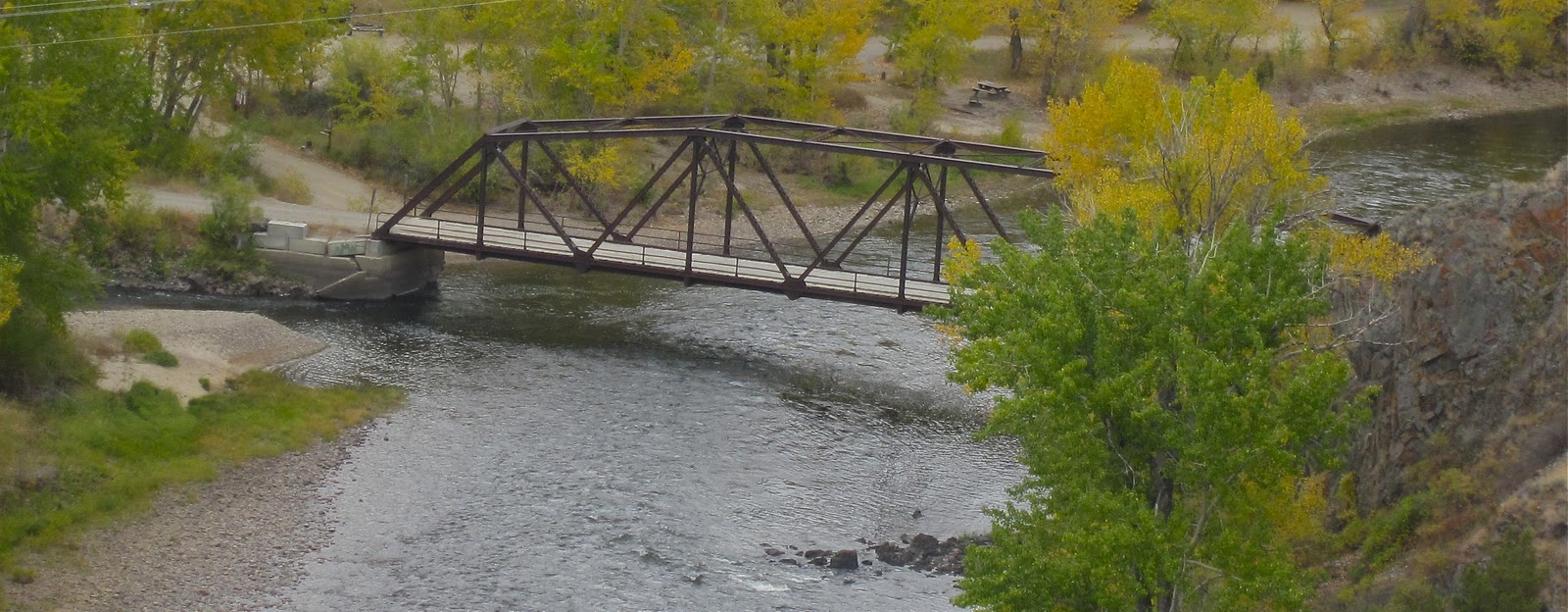
Just downriver I could see Browne's Bridge, the historic first commercial crossing, originally a wood structure but replaced in the early 20th century with this marvelous iron truss bridge:

While hunting pronghorn antelope with my friend Matt Hamon, this herd of elk (bull w/ cows) rose up from "nowhere", watched us awhile, and left us wondering how elk could hide in the wide-open landscape:

Of course, while hunting elk, I have seen relatively few--and none were standing & looking back at me! Most often, I see elk "sign", such as these fresh droppings (we tell novice hunters, "You can tell how fresh they are by tasting them".):

Each year, deer and elk grow a new set of antlers in the spring and shed them in winter. In forested areas, mice and other rodents usually make quick work of shed antlers. On the dry prairie, however, they last much longer. I like to photograph them and leave them for the critters. Here's a shed from a young bull elk, a "spike":

And several more from young, fork-horned mule deer bucks:


When I come home from hunting, MollyTheDog always brings her moose, shaking it & growling, then setting it at my feet. What's worse than a dog that gloats? (She learned the name of this toy the first time Jan told her--probably because it looks like the real moose skull that decorates our parlor, and she has that Border Collie affinity for language.):

Visit Yellowstone National Park
We try to make a visit each year in early October. The crowds have thinned out, critters are in rut, and the wolves are active. On this trip we saw black bears and a grizzly (too far for photos) but alas no wolves. We did of course see lots of hoofed browsers, especially buffalo:

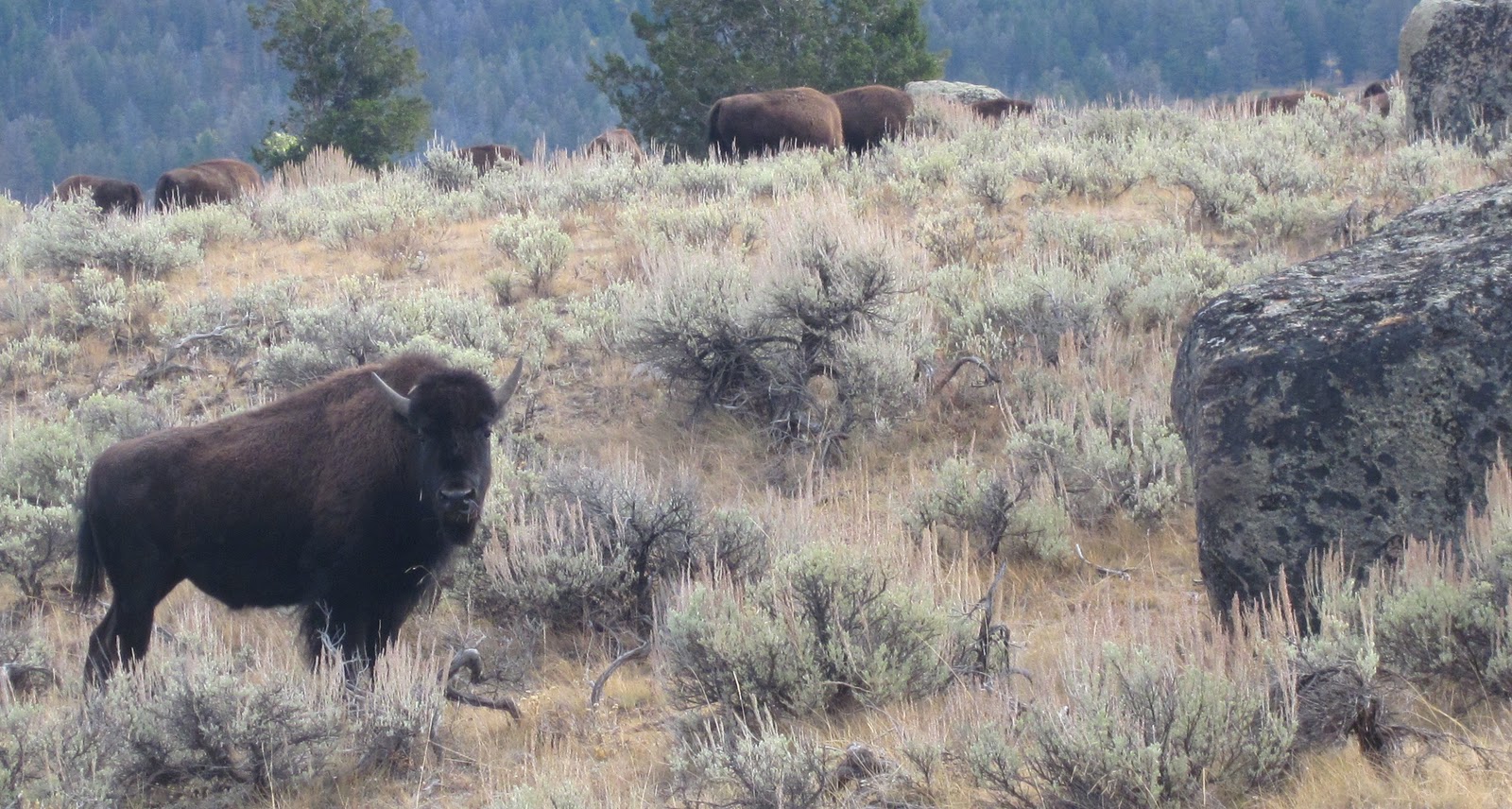
Buffalo, like much of the YNP experience, help us to slow down and be in the moment. Sometimes the buffalo do this forcefully--I think this herd was part of the "Occupy Yellowstone" movement:

Unlike the elk I hunt, those in the Park are habituated to humans. They're still "wild", they just don't see humans as predators. They were most common around the Mammoth Park Headquarters, probably because they are fairly safe from wolves there:

This young elk bull was all alone, probably driven off by a dominant herd bull. Note how his antlers and tawny hide blend into the sagebrush and dry grass:

Maybe we should introduce him to this elk cow and her two calves (one might be a yearling, her calf from 1&1/2 years ago). She seems lonely:

This raven seemed lonely too. Or, more likely, spotted as a "soft touch" for a handout:

YNP was originally set aside in 1872 as a "pleasuring ground" primarily for its geological wonders. Only later did Americans come to appreciate and enjoy wildlife watching. Each visit, we are awed by the geology of the Mammoth area, including the terraces:

Strange colors & textures:

Basalt columns along the Gardner River (aka "Sheepeater Cliffs"):

And waterfalls (Tower Falls shown here):

What's this I see through the steam rising from a hot spring along the Gardner River?:

Of course, it's the "Boiling River"--a must stop for a good, relaxing soak at the end of a happy day:

Happy Autumn! (and for our friends in the southern hemisphere, Happy Spring!)