24 February 2012

Everyday Life in China: Making the Strange Familiar and the Familiar Strange

One of the great pleasures of living in a foreign place is in figuring out how to do the simple, everyday tasks we take for granted at home. For me, this challenge is ramped up an order of magnitude by my total ignorance of spoken and written Mandarin. The painter Paul Klee was fond of saying that art's purpose is, "To make the strange familiar and the familiar strange." I like that as one of the things that makes life worth living. In locating the toilets nearest my classrooms, I found posted these signs that help make my point (I will spare the Germanic Sauberkeitsfanatiker among you a photo of the squat toilets!):


My office, except for the strange multiple deadbolt lock on the door, was immediately familiar. I spent a few hours moving in yesterday, setting up class files on my computer, and enjoying this comfortable and "clean, well-lighted space" (as Hemingway said):


I took a break to walk outside, find a place to sit with good feng shui, enjoy an orange, listen to the strumming guitar and folk singing of an aspiring student-artist, and watch these handsome birds (species, anyone?):

Later, I decided I needed some file folders, notecards, and a pair of scissors. The student books & dry goods store we take for granted on American universities do not exist here. A quick Google search for nearby office supplies/stationary stores proved fruitless. Time to walk!

I journeyed over to the commercial area near campus, remembered a side street where a colleague helped me buy a Chinese phone (turns out my iPhone is the only model every made without a sim card: thank you very much, Verizon), and -- after less than an hour of searching -- found the perfect little shop crowded with an impossible, jumbled, totally delightful array of office supplies. The proprietors, whom I took to be a married couple, waived away my awkward sign language with a friendly gesture that I took to mean, "Go find what you want!" After pawing around through stacks and bins, I found the requisite items (no one, it seems, uses hard copy file folders anymore, so these were in an especially obscure and buried place). My one successful effort at sign language, a scissoring action with my index and middle fingers, produced a box of diverse scissors from which I chose a mid-priced, older pair that might date to the Cultural Revolution. Acquisition in hand, I ventured back out to the street and at a busy intersection lingered to take in the scene and record some photographs:


The latter (above) is especially informative about my new home:

  • Bang-bang men and women are common (left in photo), carrying loads for hire using their strong shoulder poles. Some of the poles are simply bamboo stalks, and others are carefully crafted and wide to be as strong, light and comfortable as possible;
  • Older people tend to dress in dark and fairly drab styles;
  • Younger people tend to dress in bright, gay colors;
  • The streets and storefronts are often brightly decorated;
  • I sense that people do not like to have their photo taken (and generally avoid it); and
  • Everyone dresses in warm layers (note the down coats!) despite the low 50s deg F weather.

I had planned to hike on Jinyun Mountain -- a 3,000 foot high ridge that separates Beibei from Chongqing -- with a colleague today, but alas after a dry week a steady rain has settled in.

23 February 2012

Southwest University in Beibei (near Chongqing)

My stereotypes and second-hand ideas about what life would be like at a Chinese university have been shattered after just a week at Southwest University--and my classes have not even begun. Colleagues are friendly; administrators far more positive, knowledgeable and helpful than any in my experience; and everywhere there is a sense of building for the future. The streets are clean, children are spoiled (I mean that in the best way!), and -- at least here in the Sichuan area -- the vegetation is lush.

My positive impression began on day 1 when I met the Southwest University Waiban (the administrator who looks after foreign faculty, visitors, and guests), Mr. Wang "Frank" Yougui, at the Fulbright orientation last week in Xiamen:

Optimism for the future begins with the infrastructure. I'm moving into a beautifully refurbished apartment in a week or so, Frank showed me his new office in one of the many comfortable high-rise buildings on campus, and even the computer and printer in my office are new. This investment in education is at every level of detail even with the appearance of older buildings:

Dr. Wang Yong, a young instructor, showed me to my office in Teaching Building Number 9:

Here he is at my office door:

My two classes will be in Teaching Building Number 10, accessed via this pedestrian bridge:

The campus spans several kilometers and slowly I'm figuring out the lay of the steep, terraced land with no straight streets. Students tend to stick to the smooth, paved roads, but I like the by-paths with their often steep steps (It's not called "The Mountain City" for nothin'.):

A Montessori Kindergarten is next door to my temporary apartment (and immediately outside the window of my soon-to-be apartment):

It gets light here about 8 a.m., a weird artifact of the single time zone Mao established for China. Each morning I have my coffee and breakfast to song, as the kindergarten children gather in their courtyard for exercises and singing. It's really delightful and I hope I do not tire of it (or arise hungover some morning):

The college campus is dotted with statuary and stele. Here is some nice engraving at the little park near my apartment:

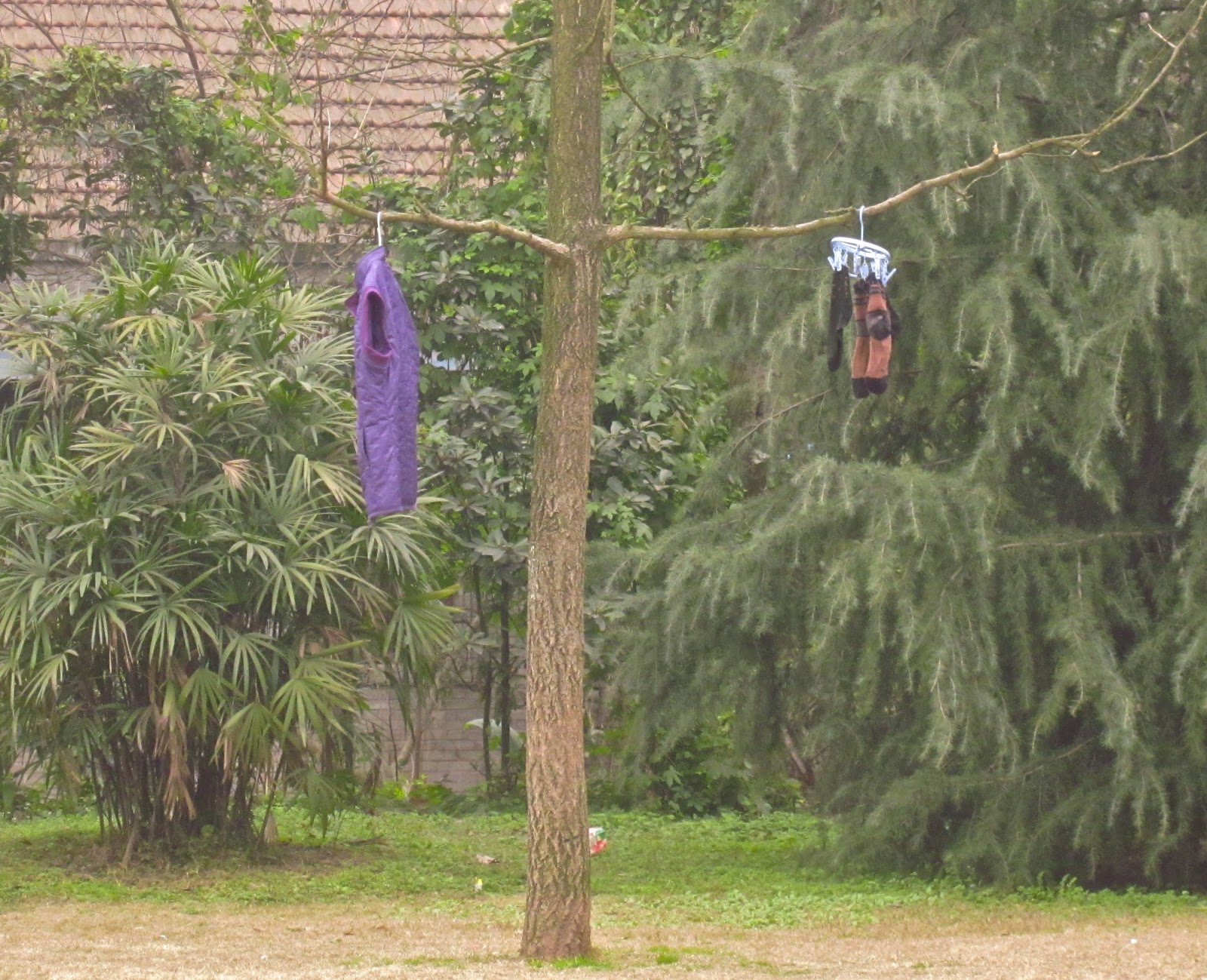
On a warm afternoon herw, a few students sat talking and reading on the benches while waiting for a few items of laundry to dry:

This professor was an important someone, once disparaged during the Cultural Revolution but now recognized as an intellectual hero:

Water and time smooth all things, and Chairman Mao welcomes students to campus at the main gate:

This old horse seems ready to succumb to the weight of time and the moss growing on its back:

Confucius, though he looks to be the eyes of age, never seems to tire. Like the good professor above, his reputation suffered during the cultural revolution when statues like this one were often toppled or beheaded. There are several statues of Master Kong around campus, but this is my favorite:

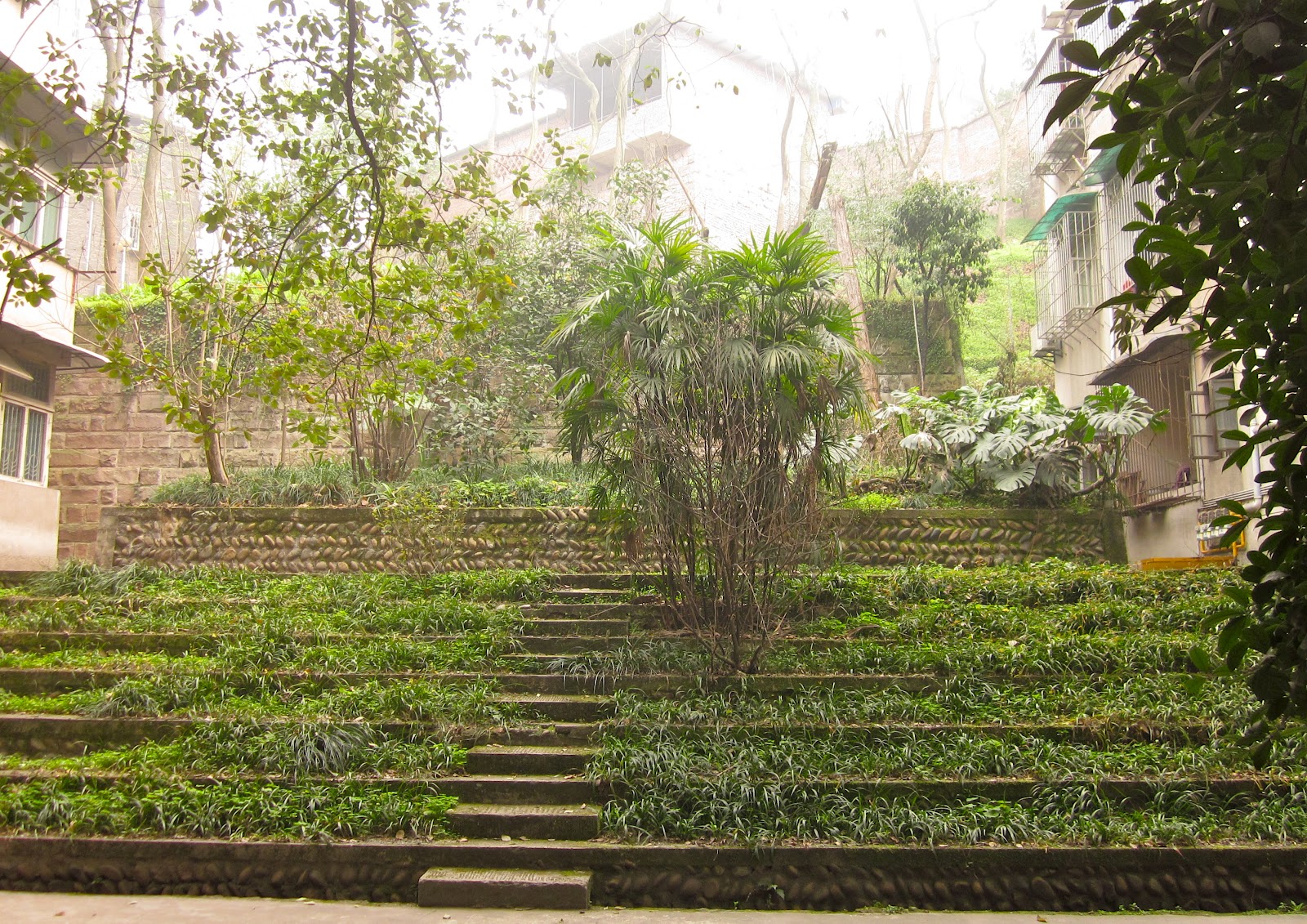
In unravelling the lay of this enfolded landscape, it's nice to have many pleasant places to rest. Places like this terraced garden:

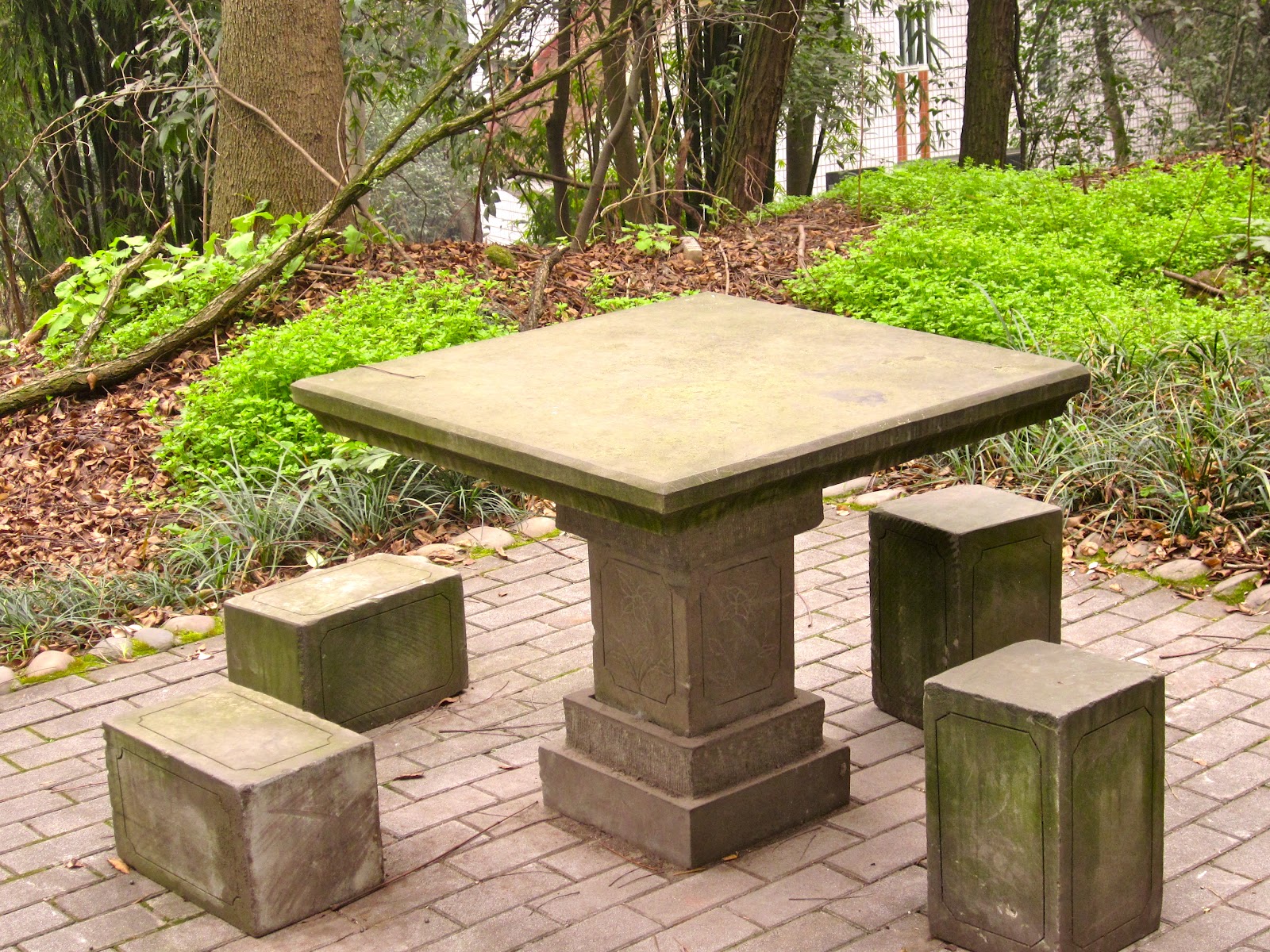
Or the many tables and stools/benches in the courtyards around most of the teaching buildings:

These I especially like as an example of art imitating nature:

A steep ravine with a creek runs through campus. There seems to be restoration work going on, I hope it doesn't disturb some of the old walkways and pavilions along the creek bed:

Alas, the old often gets tossed out for the new. A colleague showed me a shortcut to a pedestrian bridge leading to a market area. He told me there were recently homes here, but no one I've asked seems to know what became of the residents or what is to be built here:

Outside of young people on campus, very few local residents seem to have any knowledge of English. Sadly, my knowledge of Mandarin (spoken or written) is nil. This makes bargaining with street vendors an interesting experience. Despite my ignorance, an older woman was very kind in helping me buy a few kilos of her oranges at a very good price (9 oranges for 6 Yuan--about 1 dollar; this, after I gave up in frustration in dealing with several previous vendors). Positively the best oranges I have ever eaten. Unfortunately the Number One orange lady is on the right behind the two guys:

I eat breakfast and sometimes lunch in my apartment, but my main meals are at one of the excellent campus cafeterias. This one is close by and the 2nd floor dining room serves great stir fry selections and dim sum (dumplings) for around 7.50 Yuan. Thankfully, two students practicing their English skills helped me figure out to order, pay, and make the menu selections and I've managed with minimal help since then:

The one (and only) thing I don't like so far is the air quality. You can smell the coal and a fine layer of soot settles over everything outside. If China can solve this problem as it has so many others, it will be an even more amazing place.

Xiamen City, Orientation Week (2)

(continued from the preceding blog entry)
On a somewhat clear day, you can see the hills that dot the Xiamen skyline. All, it seems, have a monastery atop them:

Tianzhuyan Temple

I walked to this monastery a few miles from the hotel. At the entrance and attractive temples I found locals also out for a pleasant weekend stroll:


 Some also offer prayers at the various shrines, some benevolent looking and some quite fierce:


The bonsai dotting the courtyard walls were lovely, though surprisingly the crowds stuck to the temples and largely ignored the landscaping:


I was more interested in the "backcountry"-- trails leading from behind the temples and monks housing quarters to the hilltop. The monks went about their work and prayers, doing their best to ignore the Laowai intruder:

Many happy well-fed cats (that's probably redundant?) hung out near the monks' quarters, including CatBuddha:

And CatPeekaboo:

An entrance to the many paths of the Buddha began as a smooth, wide, well-developed walkway:

And soon narrowed to several forking paths:

Some leading through low, dark spaces:

And grottos full of little shrine figures:

Everywhere there were reminders of harmony with nature and the propensity for time to wear away all things:

This looked very much like a body bag, cached away off an obscure side trail in among some rocks. I did not investigate further:

Gulang Yu

Gulang Yu is "Walking Island," a smaller nearby island where cars were traditionally banned. Even today, only small electric tourist wagons operate. White dolphins are the totem animal, deriving from a legend that they once saved a child from drowning. The dolphins are now practically extinct though there are efforts to save them:

Gulang Yu was long controlled by colonial powers including Japan, England, and Germany. [Given the history of colonial efforts to subjugate China over the past 200 years, China's defensive posture in foreign policy is understandable!] This foreign occupation led to a strange mix of architecture, from very European (classical):

To European-Asian hybrid forms:

I'll suspend judgment about the Japanese compound and say that they did create a lovely Zen garden and walkway. Embedded in the walkway are contemplative geometric forms:

As a centerpiece, the garden has a naturally-sculpted limestone "dragon:"

Despite the ever-present new construction and sense of change, much of Chinese tradition remains, as I was reminded by this fishing boat we passed on our short trip back to the main island: