Chengdu Giant Panda Research Base
Mrs. Rover has been fascinated by Giant Pandas since we first saw them at the Smithsonian National Zoo in Washington D.C. many years ago:

Happily, my student and friend ZhongYan"Ava" could accompany Mrs. Rover on the trip:

Ava was an undergraduate at Sichuan University in Chengdu, and met some local friends who also joined the tour:

They arrived at the Panda Base in soft rain on a cool morning, a good thing because the pandas are much more active in such weather. Mrs Rover especially enjoyed two cubs clowning in the trees:

Like so many places in South China, the Panda Base is nicely landscaped with ponds and semi-domesticated animals such as these black swans:

The group capped off their visit by finding a bonanza of 4-leaf clovers:

Surprisingly little is known about the history of Giant Pandas. They appear only rarely in ancient Chinese literature or art. They are widespread throughout South China in the fossil record, but like many other once common Pleistocene species in China (such as Saiga antelope or water deer), the decline of the Giant Panda coincides with the rise of the human species. As I like to tell my students when they ask why pandas are now so rare: "Your ancestors ate them all."
Xi'an and the Terracotta Army
The city of Xi'an in the Shannxi province is less than 400 miles north of our home in Chongqing/Beibei, and yet it is culturally and geographically a different world. Separated by the divide of the Qinling Mountains, the south is hot and humid whereas the north is cooler and drier. The mountains were also a physical barrier that aided the development of ancient Chinese culture in Xi'an. Even today, it's a dividing line: noodles and tall people to the north; rice and short people to the south.
The formidable city wall was built c. 200 BCE shortly after the Qin Dynasty unified China for the first time:

Here is Mrs. Rover looking out through an archer's parapet at the moat:

As the eastern end of the Silk Road, Muslims were a well established part of the city by the 8th century:
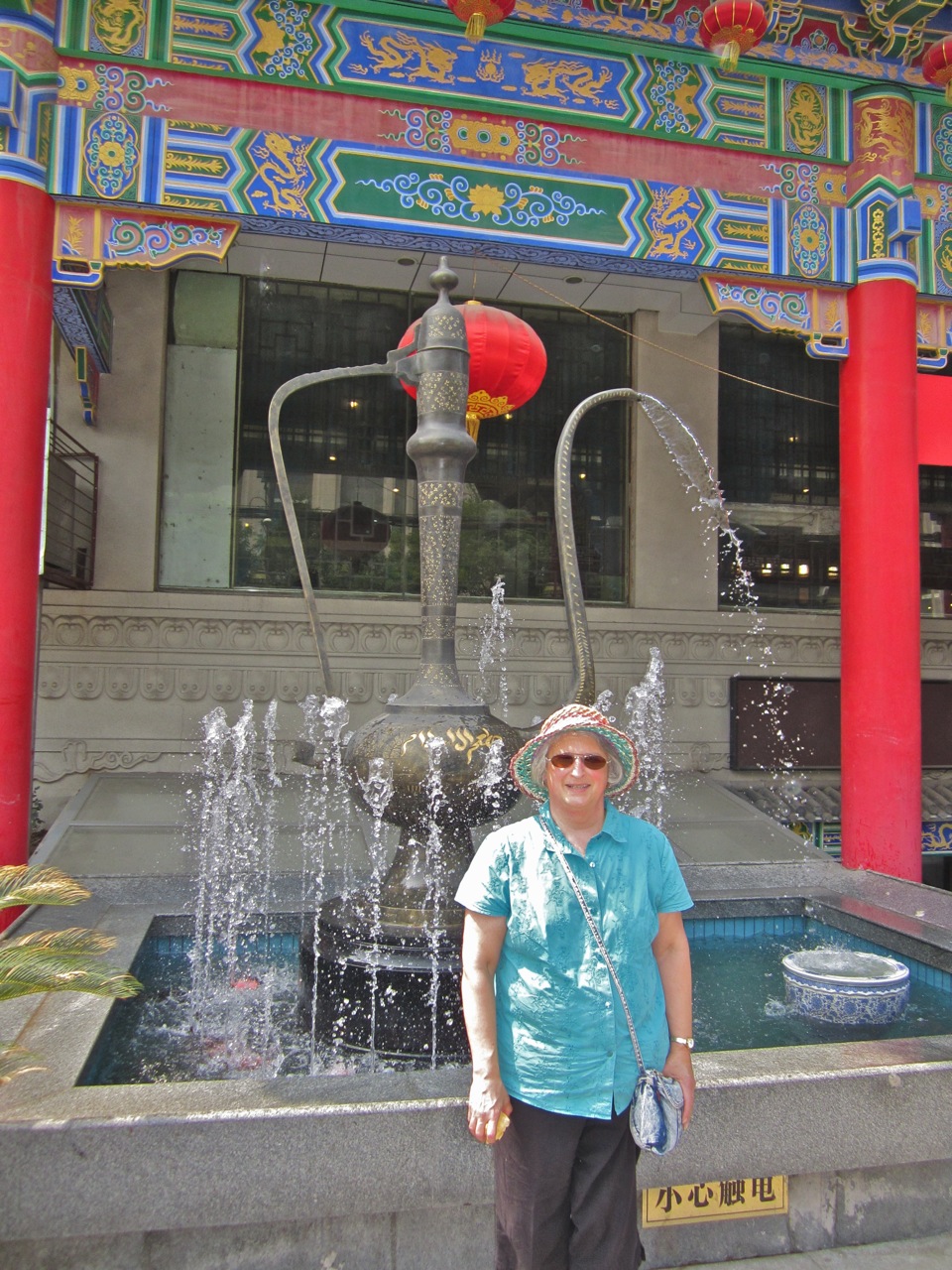
We found the food in the Muslim quarter particularly good (Mrs. Rover says it's also THE place for shopping!):

Unlike Chongqing/Beibei, Xi'an sees a lot of Western tourists, giving rise to some, ah, interesting translations for business signs:


Also, I love the counterfeit goods that make little effort to hide their nature, even when side-by-side the real article on the same table:


If you're in Xi'an, the Folkhouse Teahouse is not to be missed. There is tea, of course (this table is amazing):

But the Folkhouse is also dedicated to supporting art, both traditional Chinese painting:

And also modern variations:

The Terracotta Army, a major archaeological site discovered by a farmer in 1974, lies just east of Xi'an. The Chinese national government has done an outstanding job of presenting to the public the thousands of life-size clay soldiers and other artifacts. The buildings and artifacts are first rate (though see my note * below):

Ancient cultures were big on the idea that clay could be shaped into human beings. Think of the Judeo-Christian-Muslim creation story, or the Jewish folktales about the Golem. The 8,000+ warriors stand ready to defend Emperor Qin Shihuang in the afterlife, and presumably to help him conquer all the other cultures that might be found there:

It really is true that each soldier is an individual:

This soldier was clearly a longbow archer, I think (though nothing in the description clarified that):

The gift shops include a spectacular array of jade carvings (mined from the nearby mountains), both the traditional amulets worn for good luck and protection, but also large pieces such as this (and maybe not from the finest material):

* A major criticism: while the artifacts are presented very well, there is very little in the way of historical interpretation and context. Even our official government tour guide knew few details about the big or small historical/cultural picture: for example she was stymied by questions about the ways in which the Qin Dynasty ruthlessly conquered rival groups, and she was clueless about the difference between crossbows and longbows.
Mrs. Rover's Send-off
Students gathered for a several going away parties for Mrs. Rover. Her departure coincided with the last class for my pre-graduate minority students:

One group gathered for a walk in a Beibei park:

Followed by hotpot dinner:


I like this photo especially well, of Mrs. Rover with my graduate history teaching assistant, LaoXi"Jackie":

Football
Though long an avid baseball fan, I drifted away from spectator sports many years ago. My student WangAnAn"Andy" is captain (number 10) of an intramural team here at Southwest University, and so I joined other students in watching several of his games:

It was fun, and the team came within one game (a 0-0 tie) of taking the school championship:

In the near future, a group of students plan to take over my apartment (and the large screen TV that I seldom even turn on) for a middle-of-the-night football party. More on that later.
Jinyun Mountain Farewell
I've become fond of my regular weekend treks on Jinyun Mountain. On what is probably my final visit, we set off on a hot and humid morning, the ridge clouded in haze:

On a recent trip with another group of students, we had discovered a "secret" route to the peak that led through a hole in the fence. Unfortunately, park officials have discovered the route too, and they blocked our entry (I was amazed to hear my normally mild-mannered students yelling at and arguing with the guards!):

And so we paid full admission (15 RMB each, about $2.50). The students were NOT happy about it, and LaoXi even called a local government hotline to complain that the park refused to grant the student discount:

Frustration evaporated quickly, however, and they were back to the happy, chatty students that I like so well:

As usual, there were a few interesting critters to be seen along the way, such as this regal beetle:

And this enormous caterpillar (I can only imagine the moth or butterfly that results):

On the way back, some of us without other obligations had time to quaff a beer. Good news, LiShuying"Fiona" and LiuMin have been doing their homework and knew of a place with draft beer:

General Joseph W. Stilwell Museum--Chongqing
The KMT headquarters were in Chongqing after the Japanese conquered north and east China. We found the Stilwell Museum by following this quiet side street:

To look at Chongqing today, you would never know that it was one of the most heavily bombed cities in WWII, as acknowledged by this stone scroll from President FDRoosevelt:

General Stilwell had a wealth of experience with China and was fluent in Chinese. This made him the choice as commander of what became the China-Burma-India Theater in WWII :

Sadly for Stilwell and the Chinese people, he faced an impossible task for many reasons:
- The U.S. government recognized Chiang Kai-shek's Kuomintang as the official government of China, despite its horrible corruption, incompetence in fighting the Japanese, repressive tactics, and weakness in the face of the Communist Party of China led by Mao Zedong, Zhu De, Zhou Enlai, and others.
- Though Stilwell was technically in charge of Chinese troops, Kai-shek actively interfered with his own commanders, and tried to avoid the kind of decisive military engagements that Stilwell preferred.
- U.S. resources were stretched to support the Pacific and European theaters, and Stilwell could only obtain a fraction of whatever troops or arms he requested.
- U.S. policy in China was actively undermined by the British, who wanted to insure that China never became a powerful, modern nation that would threaten Britain's resumption of colonial rule after the war.
- Stilwell's command was actively undermined by Claire Lee Chennault (who was close to Kai-shek) who commanded the Flying Tigers and who believed that air power alone (no ground troops) could defeat the Japanese in China.
- His own personality: "Vinegar Joe" would not tolerate fools, and he was very outspoken about his opinions of others.

Ironically enough, the Flying Tigers museum is directly across the street:

Stilwell insisted that wounded Chinese soldiers receive the same care as wounded Americans (Kai-shek would have let them die), and he visited the field hospitals often to insure his policy was carried out:

"Chinese and American people fought shoulder to shoulder against the Japanese fascists." The Chinese remember, and I think this is part of the basis for the many friendly encounters I've had with older people in this area:

My students learned something at the museum, and if Oliver Uighur is any indication, they had a good time too:

Peace out!
-----------------
Note: I thank Ray over at TroutbirderII for recommending to me Barbara Tuchman, Stilwell and the American Experience in China, 1911-45 (Grove Press, 2001). Good read, it added immeasurably to my understanding of Stilwell, China, and WWII.


