06 April 2014

Montana Winter Survival: Eat, Drink, and Be Merry

Now that winter is about over, I ponder the question that friends from warmer climes often ask, "How do you survive the Montana winter?" They aren't talking about physical survival, of course (at least I hope they're not), but rather misconceptions about the psychological condition known as "cabin fever." The fact is, here in Montana, many of us don't simply "survive." Instead, we thrive. Partly it's a matter of active engagement with nature through activities such as cross-country skiing. And partly it's a matter of social engagement--i.e. partying! Well, or whatever counts as partying for folks our age.

You see, Montana -- or at least that island known as Butte America -- is an intensely social place. The community is welcoming and friendly, and there's always something going on. This is true in many American small cities and Butte is, I think, just a slice of a common experience. The winter kick-off begins with a solstice bonfire and potluck hosted by the Stierles at their cabin near The Moulton Cross Country Ski Area, just a few miles north of town. They've been clearing beetle-killed lodgepole pines from around the cabin, so we had lots of fuel:

The event even drew our friends Matt and Jenn, and their new baby Lur, from their home near Missoula a few hours downriver from Butte:

Daughter Emily came home for Christmas, so the first order of business: strap on snowshoes and bring home a tree. Butte is surrounded by public forest where tree cutting (whether for Christmas tress or firewood or fences etc) is allowed. We selected this nice Englemann spruce--though sharp needled, spruces have a nice shape and dense branches for hanging ornaments:

A few saw-strokes later:

Then it's on the sled and time to haul away. On the uphills, I told Emily, "I'll grunt and you pull":

Nice tree, and it didn't look bad with decorations, either (PhoebeTheCat approved):

Here's lesson in dendrochronology, based on a slice from the base of our tree.  As you can see by counting the rings, our  Christmas tree was about 27 years old. Yet the first c. 18 years of the tree's life were VERY different from the past c. 9 years. What do you think happened in the life of this tree that caused this abrupt change c. 2004. Hint: our spruce grew in a forest dominated by Lodgepole Pine:


 Answer: That's right! Pine beetles killed virtually all of the larger Lodgepole Pines, opening the forest canopy so our little tree received more light and water, and hence grew faster.

The Butte Christmas Stroll includes all the traditions such as free wine and snacks at local businesses,  musicians (Heather Lingle shown here) at the Butte-Silver Bow courthouse:

And, of course, belly dancing (everyone knows the Three Wise Men were really belly dancers):

New Years Eve found us at the Quarry brewpub for some lively music by the Red Mountain Band. The best part? The even started early and ended at 8 (with the clock set ahead 4 hours, hahaha), so Mrs Rover and our friends could all make our 10 o'clock bed times (I exaggerate but a little):

Next up? Chinese New Year (31 January this year). Given the rich history of Butte's Chinatown, it's a fitting way to honor our history and culture. We began the parade with a crowd at the courthouse, waiting for the dragon dance as the dragon comes roaring out, chasing the pearl:

Yes! It's the Year of the Horse:


Along the parade route on the Butte Hill, fireworks make this the loudest (if shortest) of Butte's parades:

It ends at the Wah Chong Tai Mercantile and Mai Wah Noodle Parlor (Mai Wah Museum):

Later that day, we joined Butte's Chinese-American community for a sumptuous feast catered at the Four Seasons Chinese Restaurant.

Each year in early February, a group of us share a house at Chico Hot Springs:

We share meals, spend hours soaking in the hot pools, and nearby are great back country ski trails:

Mid-afternoon, we pause of a warming fire and lunch, then make the run back to the trailhead:

Chico is also near Yellowstone National Park, with abundant wildlife viewing opportunities, including Buffalo:

Big Horn Sheep:

Elk (this herd is on a ranch next to Chico, not in the Park):

And Mule Deer:

Les bon temps roule! For late February, I was invited to New Orleans as part of a session on Superfund issues at Tulane Law School Summit on Environmental Law & Policy.  It was a great conference with sessions on managing ocean fisheries, dealing with post-Katrina issues, and oil well fracking. Environmental artist and adventurer Marcus Eriksen was a keynote speaker, highlighting the problem of the 5 Gyres -- those giant ocean swirls that collect the unfathomable amount of plastic trash generated by the "modern" world: 

Mrs Rover and I had a little extra time to enjoy NOLA's food: 

Mardi Gras Parades (Mrs Rover earned her beads, hahaha): 

And -- best of all -- to take in the great blues and jazz at our very favorite club, The Spotted Cat: 


There's lots of good music on the streets, too. Whether a lone blued harp: 

Or the outstanding, world renowned (yes, seriously) Tanya & Dorise:

Well, before you know it, winter came to an end, marked by our St Paddy's feast:

I spare you the scenes of happy "Irishmen" (and women) hoisting glasses and stuffing their faces, and end with this toast:

"He drank like a fish and ate like a savage,
The only thing he wouldn't eat was corned beef and cabbage."

28 February 2014

Montana Hunting: Mule Deer, Pronghorn Antelope, and Elk in the Butte Area

[Warning: Dead animal photos ahead.]

I generally hunt close to home. In part, this is because there is very good hunting in the Butte/Big Hole River watershed area; it's also because every minute spent driving is one less minute spent hunting.

Pronghorn antelope season begins in early October, two weeks before the general deer and elk season. It's generally a pleasant time to hike around the hills. At first glance, it seems that the sagebrush prairie is flat and monotonous, with no way to stalk such a sharp-eyed creature. The low hills and coulees, however, offer excellent cover so long as the antelope don't see you first:

They do tend to be shy of roads, though I try not to hunt more than a mile or so from the nearest two track. Otherwise, the get pretty heavy (it's usually easier to carry than drag on the barren, rocky, cactus-strewn ground):

My friend and colleague Keith, a pilgrim from the Midwest, became an antelope hunter this year. Here he is, creeping through the sagebrush to get within rifle range of a herd bedded in a coulee:

A glacial boulder makes for good cover and a steady rest:

Thank you. We will honor your spirit and use your flesh well:

My "Little Brother" AJ, then a student down at the University of Montana, joined me for a mule deer hunt. He has the sharp eyes of youth, and often spots deer that I can barely see with binoculars. He has also become an excellent judge of range and an accurate marksman (I killed a smaller buck with a much closer shot!):

Though a long haul back to the truck, it was worth it for this fine, heavy-bodied buck:

We use non-toxic all-copper Barnes bullets, partly to avoid poisoning eagles and other carrion feeders:

And partly to avoid poisoning ourselves. I found this lead fragment in some sausage a friend gave me:

We like the organic, free-range meat that comes with hunting, but the view is outstanding too. Here's my friend and colleague Frank taking a bead on a mule deer, with an interesting spiral cloud on the horizon:

Hunting deer and antelope can be a social affair, but I often myself in the solitary pursuit of elk. I cover a lot of miles. In an area where the timber was cut in the late 19th century, I found a sawyer's file on a stump. I'll bet the man who lost it had about $2.00 (a day's wages and the cost of a saw file c. 1900) deducted from his paycheck:

The triangular file's sides were made to fit the angle of teeth in a crosscut saw blade:

 One area I hunted was shared by another large predator, as evidenced by this partially eaten and cached mule deer:

I saw the other hunter's tracks (I estimate a 150-pound+ male) several times, and one evening while hiking back to the truck got a glimpse of the actual mountain lion. Big kitty:

The cougar's presence did not seem to noticeably reduce the deer or elk population, and in mid-November a new storm brought fresh snow that quieted the crusted snow from late-September and early-October storms. Circling a basin high above a road, I cut fresh tracks and followed them to where the elk were bedded. The lead cow and several others crashed away before I could even bring the rifle to my shoulder, but this fat young cow lingered for just a second:

It took two days to haul the meat out, thanks to the help of my friend Dave. With the freezer full, it was time to roast the Thanksgiving turkey, sharpen the ski edges, and give thanks to this beautiful land:

Bow Hunting for Elk in Southwest Montana

Heraclitus observed "You cannot step in the same river twice," and that's generally true of all experience with nature. Before hunting season began, lots of elk were showing up at my old Indian-pit blind near a prairie spring:


I bow hunted for elk a number of days and saw them almost every day--always well out of bow range, at 60 yards or so...A series of mid-September snowstorms made conditions difficult--the elk no longer sought water at the spring, and the crusty snow made stalking impossible:

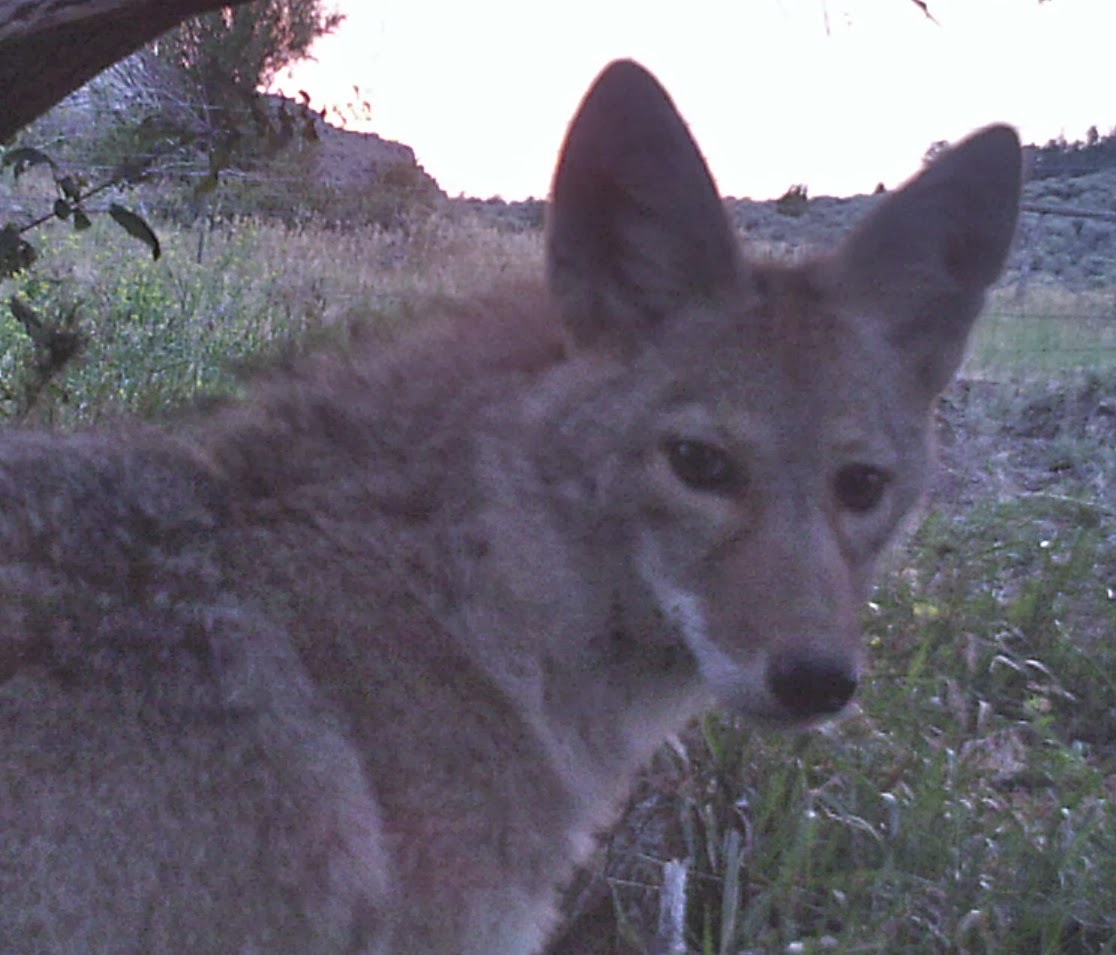
No complaints, mind you. September and early-October are glorious times to be afield. There is always something to observe, whether a young curious coyote:

or the ever-present pronghorn antelope herd: 

There also seemed to be more mule deer this year:

Given the conditions, I did a lot of "hiking" (bow in hand) in places I don't normally hunt. One day in on a north-facing ridge in a thick Douglass fir stand, I came upon moose:

and white-tailed deer. I was surprised both to see white-tails in this mule deer habitat and that they let me approach so closely. I was tempted to shoot one, but (1) I have sort of a personal rule against shooting deer while elk hunting; and (2) the thick woods would probably have deflected my arrow:

The wet weather brought a big fall crop of mushrooms. I'm familiar with and enjoyed eating tasty giant puffballs (they seem to grow from the elk scat!):

but most wild fungi are a strictly a matter of visual appreciation for me:

At first glance, this little caterpillar friend looks like a common "Wooly Bear," but I think it's a Spotted Tussock Moth:

I recall one sunset especially well. Though beautiful, it was followed by a hard rain storm that soaked me to the skin, chilled me to the bone, blinded me with lightning, and rattled my soul with thunder on the mile-long walk back to the truck: 

The road to and from my blind crosses an outcrop of weathered volcanic ash. When wet, this clay-like bentonite stuck to my tires and made driving across the ridge a dangerous proposition. To cross the few hundred feet of gumbo safely, I had to stop several times and scrape the tires:

As dangerous as the lightning storm and road was, I was even more concerned about the half-wild range cattle. Some of the bulls that visited the spring could be downright aggressive: 

When archery season ended, I laid up my bow and took down the rifle. I had put no meat in the freezer, but had harvested a season of happy memories.