This year, I was fortunate to make the hike with my Tech colleague Don Stierle. A chem prof, he also assists his Renaissance wife Andrea is pursuits such as finding cures for cancer from fungi that grow on yew trees or from microbes in Butte's infamous Berkeley Pit. With Don came Chooka The Dog, a 4-month old Golden Retriever:
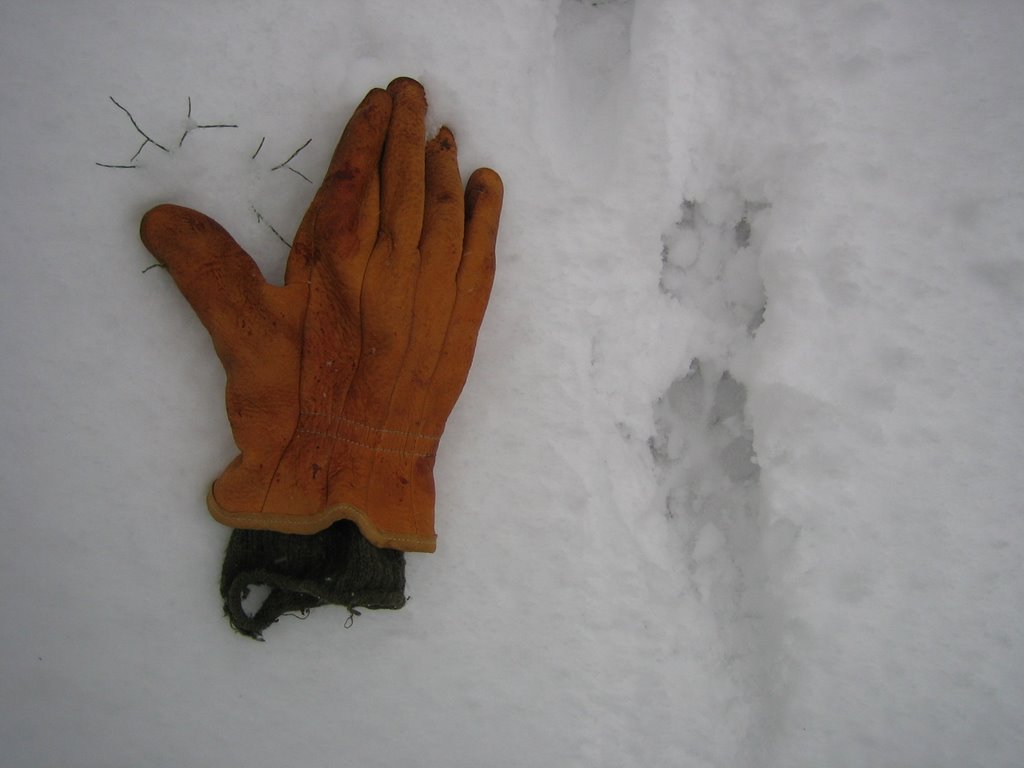
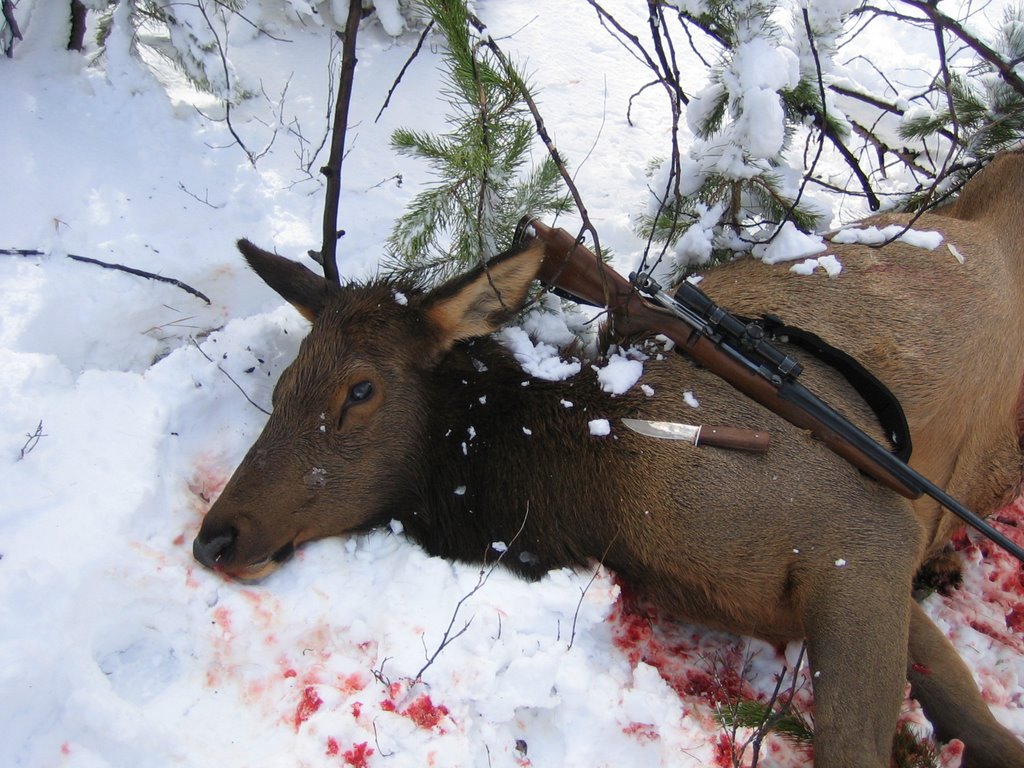
 Though the weather has been seasonal of late with 80 deg F days and 40 deg F nights at 6,000 feet elevation in Butte, we still opted for an early morning start. It's not a long (c. 8 miles) nor especially steep (c. 2500 foot elevation gain) hike, but it is nice to travel in the cool of the day. While stashing a few beers in the creek near the Fishtrap Creek trailhead for the ride home, I discovered this Pine Marten set constructed by some fur trapper:
 Mornings are also active critter time, and we busted some elk from where the trail crosses a big wet meadow, and the dogs nosed into several spruce grouse (aka fool hens, for their habit of sitting in a tree just a few feet away). The grouse were feeding on grouse whortleberry and grasshoppers--both are numerous this year:
 We also came across a lot of "doodlebug" or antlion pits, including this exceptional colony:
 If I were an ant living in this area, I'd want to be named Daniel. Even in the wilderness, there are some historical tracks of a working landscape, such as this irrigation ditch that moves water many miles from the headwater diversion:
 Our first day in, we rested through the heat of the afternoon and then hiked above treeline to Lost Lakes where Don spotted a group of 6 or 7 goats working their way along the ridge to the left of the lower lake, and we took in the fantastic view:
 The area's height and location help in capturing a lot of snow. Even in the driest and hottest of summers, the big snow cornice along Saddle Ridge lasts all summer long, as does the glacier along the upper lake. Yes, it is a true glacier, and the only one in the Pintler, according to Don Nyquist, a National Weather Service observer, meteorologist, and Anaconda resident. Don says a key characteristic that makes this a glacier is the formation of firn--"the metamorphic layer of dense, granular snow between the accumulation area (new snow) and glacial land ice." Here's a photo of the upper lake and its glacier (West Goat Peak is on the far right of the snow cornice just below the ridge):
 The approach to West Goat Peak is very pleasant with very little scree (as Pintler peak bagging goes). Here's Don picking his way along the ridge, with the fantastic vertical goat cliffs on his right:
 Chooka and RTD did a lot of goat- & pika-sniffing on the way up, and once on the summit they were content to rest. Here's the pup, with Warren Peak in the background (easily bagged from Edith Lake):
 The morning haze from our numerous local forest fires thickened throughout the day. With clear air, the distant views from W Goat are tremendous, but even the "close" view of the alpine meadow leading down to Lost Lakes is pretty sweet:
 Just as we finished supper that evening, a big thunderstorm swept through. This is why I prefer to camp down in the timber, and not on the barren ground around Lost Lakes. As RTD and I lay in the tent watching through the vestibule door as lightning flashed and crashed, I took a moment to appreciate the difference between Pink Mountain Heath (Phyllodoce empetriformis):
 And Merten's Mountain Heather (Cassiope mertensiana):
 These lovely evergreen species carpet much of the Pintler high country, along with other familiar species such as Alpine Gentians (Gentiana calycosa), the leaves of which make a tasty and mildly psychotropic tonic:
 Though the flowers have faded, I also like the Elk Thistle (Cirsium foliosum):
Don and Andrea (or "DnA") are naturlists, too. For years, I have simply taken Sky Pilot (Polemonium viscosum) as another pretty alpine flower. Don demonstrated why it has the nickname "Skunkweed," and explained how he and Andrea once tried to extract the essential oil that gives it this odor:
 From home today, I took a morning walk to Big Butte before spending a few hours laying rock on the new retaining wall in the backyard. The smoke was not too bad, and I could just make out East Goat Peak, Saddle Mountain, and West Goat Peak through the fire haze. Already, the good memory of West Goat Peak is getting me through another year.
 Note: You will hear some folks refer to the "Anaconda-Pintler." This is sure way to mark yourself as one from "away." For locals, it's simply "The Pintler." Even this name mystifies me, as the area's namesake -- the rancher/homesteader Charles Pintler -- lived in the area just one winter, and moved because he and his family found the climate too harsh.