12 July 2010

National Folk Festival: Three Days of Music & Dancing

This was Butte, Montana's third & last year to host the National Folk Festival. It's been a great run, and for all of you music lovers--don't miss a chance to enjoy this event if it comes near you (the next 3 years is in Nashville). For three days, about 100,000 people visited our little city in the Northern Rockies. Friday opening ceremony was at the Original Mine Yard stage where the threatening skies did not deter the crowd's enjoyment of incredible bluegrass fiddle of Michael Cleveland & Flamekeeper:

We closed out the first night at the dance tent with high-energy zydeco by Geno Delafose & French Rockin' Boogie (amazing button-box accordion!):

Saturday morning brought a festival highlight with the Cool Water Hula at the Bell Diamond mine--hundreds of local dancers flowing to Sons of the Pioneers classic tune, Cool Water:

Kristy Hager organized the performance as a way  of "Making waves to transform a greed culture into a green culture." Dancers took their cue from the giant 12-foot puppet of the Hawaiin goddess Synnøvei:


Beautiful:

Back at the Folk Festival, one of the themes I enjoy are events like "Accordion Traditions," "Fiddle Traditions," and (shown here) "Blues Legends & Legacies." Artists from different groups take the stage together to explain the style of their instrument and methods. That's the venerable "barrel house piano player" Mr. Henry Gray in this photo:

Other highlights of the festival included Elizabeth LaPrelle and her Applalachian ballads (what's a music festival without a little thundershower?):

Aditya Prakash Ensemble (Carnatic music of South India):

Genticorum (Quebecois):

And of course dancing and more dancing, to great bands such as Super Chikan & the Fighting Cocks (Delta blues):


With six stages and a plethora of other activities spread over 12 city blocks, one could not take it all in. But we tried:

After supper last night, daughter Emily & I took in a set by local musicians at a local honky tonk, the Silver Dollar Saloon, that reliably features cool music. Butte America; this "ghost sign" sums it up--friendly, union solidarity, and beer:


For another blogger's view of the Folk Festival, see Justin Ringsak's Butte Folk.

09 July 2010

Skywatch Friday: Montana Trout Skies

I have no idea, really, what a "trout sky" is--probably something like the "watermelon sugar" that Richard Brautigan wrote about. But here are two southwest Montana trout skies from the past week.

One, a view from lower Many Miles Lake at the edge of the Pintler Wilderness along the Continental Divide:

And two, a view of a raven on an old mine dump behind my home in Walkerville; the raven said, "Don't worry about the bright blue sky--the trout are rising. Go fish."

And so I did.

Big Hole River Flyfishing: Trout are "Looking Up"

Today begins the National Folk Festival in Butte, Montana--three days of music, beer, and dancing. With company in town and a crowd of more than 100,000 people predicted (Butte never had a population higher than about 60,000), I thought it well to grab a few hours of flyfishing on the Big Hole River a half-hour south of town. Though still a little high for wade fishing, the river has dropped considerably now that our record June rainfall is behind us.

It was a grand few hours. It was a busy morning so I skipped lunch and still did not leave town until after twelve, not expecting much--mid-day fishing can be "iffy" with a clear sky and high sun. But rigging up on the bank, I was pleased to see the usual Big Hole smorgasbord of large golden stoneflies, an unusually red form of "gingerquill" mayfly, and caddis flies of all sizes. I never even tied on a nymph, and so long as the float was drag-free, dry fly fishing was very good for trout of all sizes. I use a longish leader and tippet to control drag--it doesn't make for elegant casting on a windy day, but it brings up lots of fish.

The larger brown trout seemed keyed on the mayflies and medium sized caddis:

The smaller browns and rainbow trout were in shallow pockets near the banks feeding on anything that came their way:

And the larger 'bows were in the deeper seams taking goldens (interestingly, nearly all of the rainbows had orange slashmarks under their gills, indicating they were rainbow-cutthroat hybrids):

 I don't wear a watch but the fishing seemed to get better and better until I left the river with a tired arm and a hungry belly. I was surprised that it wasn't even 5 p.m. when I stepped into the house. A good day.

05 July 2010

Backpack Trip: Many Miles Lakes

Year 'round from my home in Walkerville or college where I work in Butte, Montana, I can look west to the peaks of the Pintler Wilderness and daydream about the places we backpack. Though I've been to each ridge, peak, and valley a number of times and am working on filling in a few remaining blank spots on the map, I never tire of visiting these places. As friend Dave Carter and I (with Molly- and Jack-the-Dog of course) dropped into the Many Miles Lakes cirque, looking across the valley and seeing the craggy ridge was like saying "hi" to an old friend:

The cirque is dotted with Alpine Larch (Larix lyalli) that mark the top of the treeline along the Continental Divide. I love the fragrant, elegant, soft needles that turn gold and fall off in autumn:

Though not a hot day, our hard working pack-dogs were happy to find the snowdrifts around the lower lake:

We intended to camp at the next lake up in the hanging valley, but the snow got deeper and deeper and we turned around when it was above our knees:

After making camp, Molly-the-Dog & I hiked up to the next lake, undeterred by the brief rain shower:

Yep, that's ice on the lake--still about half-frozen:

At the lake's edges, Marsh Marigolds (Caltha leptosepala) bloomed:

At the edges of melting snowdrifts, Glacier Lillies (Erythronium grandiflorum) bloomed:

Fishing was good, and I soon had a few trout to go with our antelope steaks (Montana surf & turf). Note that the middle trout is a rainbow-cutthroat hybrid:

Hiking back down to camp, we found sprouts of False Hellebore (Veratrum veride). A very toxic plant, Indians poisoned arrows with it and allegedly even drinking water where Hellebore grows will make you ill:

Around the trailhead, at a much lower elevation than the lakes, the Beargrass (Xerophyllum tenax) is budding up:

And where there be Beargrass, there be bears (claw marks where a black bear had climbed this aspen tree):

Also near the trailhead on dry ground was Pygmy Bitterroot (Lewisia pygmaea):

And Springbeauties (Claytonia lanceolata):

At a lovely spring near the trailhead (where we stashed some cold beers as a welcome post-hike treat), there was Trapper's Tea (Ledum grandulosum):

And White Bog Orchids (Habernaria dilatata):

Driving down 10 miles of Forest Service road to the highway, we discovered a warmer clime of sagebrush with blooms of Sticky Geraniums (Geranium viscosissimum):

Heartleaf Arnica (Arnica cordifolia):

Back in town, we prepared for a weekend of Independence Day fireworks madness. In addition to a big municipal display, fireworks sales are largely unregulated in Butte. Rockets light up our little city a few hours every night the week of July 4th (Bruce Newman/Montana Standard photo; the red object on the left is a mining "gallows frame"):

Happy Birthday, America!

01 July 2010

Skywatch Friday: Montana Prairie Skies

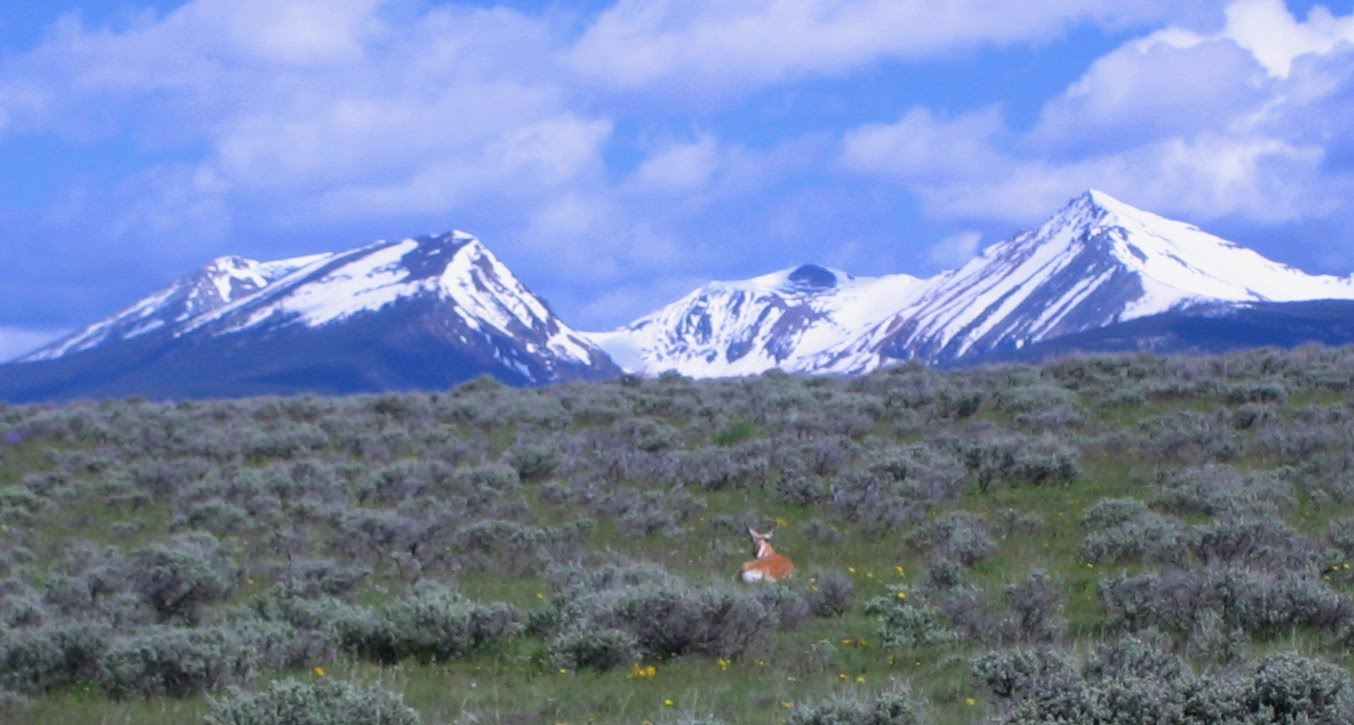
It's summer, time to get out on the high Montana prairie where the antelope play (or snooze):


Feel a mountain storm (thought for sure we'd get hail out of this bad boy, but it just blew over):


Enjoy an evening rainbow:


And sit by the fire watching the sun set:


Our summers are brief but perfect for the creatures that live here and those of us who enjoy living with them.

28 June 2010

Camping Where the Elk & Antelope Play

There's an old joke that Butte America is just 15 minutes from Montana. Environmental recovery has come along well in the old mining town, but there's still some truth in the statement. At our home in Walkerville, the poppies are lighting up the front yard:

And on the hill behind, the Bitterroots (Lewisia rediviva; aka "rock roses") are blooming:

With the clear skies, it was time to head over the Continental Divide for a few days camping in the Big Hole River valley. I drove up a little creek where the Chokecherry (Prunus virginiana) blooms, scenting the air heavy & sweet:

And then up along a two-track until I came to a spring with a nice view of West Goat Peak--a good campsite:

I set up the spotting scope outside my tent so I could watch this mother antelope with her two fawns (one is nursing):

And a herd of elk cows and calves:

Dave Carter joined me for a wildflower hike. The high prairie is blooming--we saw Blue Camas (Camassia quamash), its root a staple food for the Indians that frequented this area over the past 10,000 years or so:

Silky Lupine (Lupinus sericeus)--both blue and the occasional white variant:


Little Sunflower (Helianthella uniflora):

Parry's Lousewort (Pedicularis parryi purpurea; such an awful name for such a beautiful flower!):

Prairie Smoke (Geum triflorum):

Yellowish Paintbrush (Castilleja lutescens):

One of the many species of Biscuitroot (Lomatium spp):

And Little-flowered Penstemon (Penstemon procerus):

We also hiked over to Indian Rock, an overlook and prominent outcrop where indigenous peoples camped and hunted:

The old tipi rings are littered with tool flakes from the jasper that outcrops further up the valley, both yellow:

And red:

It's still a good hunting area, as the coyotes or wolves that killed this mule deer will attest:

Even antelope can be stalked closely at times when they think they are invisible in the sagebrush:

Dave left and MollyTheDog & I enjoyed the evening skies, including a passing shower that graced us with a rainbow:

Next morning, I caught a mess of brook trout for breakfast:

While two buck antelope played tag on a nearby hill:

The sandhill cranes strutted and hooted:

And a Wilson's snipe (western cousin of the woodcock) watched from a fencepost:

All too soon, it was time to pack up for home. Let's go, Molly:

Yep: Butte really is just 15 minutes from Montana.