Walking down to Tech this morning, there were a bunch of mulie does and fawns along the trail just north of Kennedy Elementary School. The cool fall weather stimulates all creatures to prepare for winter, and the mulies are seeking out the best forage while they can. I am so thankful for Kriss Douglass and the other local heroes that put an end to ATV traffic on Big Butte.
Yesterday I fished the Big Hole and came home with a sore arm. Usually I fish only a few hours and am content with two or three larger fish, but yesterday I was a glutton. With not another angler's boot track or a boat in sight all day long, it was as if these fish had never seen an artificial fly. It was a very windy day, blowing down canyon which made casting upstream difficult. Usually I adapt to those conditions by pitching the fly downstream with some slack line. For some reason, however, I kept missing the fish that were taking in this manner. And so I sucked it up, increased the line speed, and the combination of 5X tippet and #12 yellow humpy did OK when the gusts were not TOO strong. Sometimes the wind blew hard enough to lift spray from the river's surface and to push me off balance. Still, the warm sun made for a pleasant day.
I fished the swift waters of the canyon, carefully working back and forth across the river so as to hit all the good little pockets amid the boulders.
There were lots of smallish brown trout in the slack water along the edges, but the larger browns and rainbow trout were in pockets and surprisingly fast runs from one to two feet deep. The takes were very delicate, and most times I could not see an actual rise--just a head slurping the fly from slightly beneath the surface. The fish I caught were generally 10 to 15 inches long, but a few nicer ones came to hand. It is delightful and a little unusual (for me) to catch larger fish on dry flies, so I made the most of it--fishing from 9 in the morning until nearly 4 in the afternoon.
RolyTheDog had a great time, swimming back and forth across the swift waters, climbing out on the occasional boulder to bask like a seal in the sun, and trying to inspect every fish I caught. She is very good at staying behind me and swimming only in waters that I've already fished. Rarely does she get so excited while inspecting a fish about to be released that she gets her feet tangled in the line.
Several larger fish turned out from their station into fast water and headed down river. Usually I end up losing such fish even before they run me into the backing, as if they get much slack it is easy for them to shake a barbless hook. Also, a hook wears a bit in its hole, and the longer you play a fish the larger the hole wears and the easier the fish escapes--especially with no barb to hold the hook in place. But no matter, as I was not out to kill a lot of fish.
One of the last fish I caught was a strong rainbow of about 14 inches. It turned from its pocket and raced down the swiftest water toward a hole several hundred feet downstream. I wanted to land this fish, and so (foolishly) tried to move across the swift run to where I might land the fish against the gravelly shore. Alas I slipped on a slick boulder in three feet of water and took a good dunking. Surprisingly, though, when I found my footing the fish was still on; I landed it and killed it for supper.. This made for cold fishing, as the sky had clouded over, the wind continued to blow, and I was soaked. I fished for another half-hour or so, caught and killed one more fish of the same size, and called it a day. Both fish I killed were stuffed with nymphs, including several large, black salmonfly nymphs.
Well, as George Grant liked to say, "We don't catch fish because we are good anglers; we catch fish because they are there!"
Life is good, enjoying these lovely Indian summer days from my home in Butte, Montana.
27 September 2006


25 September 2006
Big Hole River Diversion Dams
Today, I sat in on the meeting of the Mile High Conservation District Meeting (Butte). Last week, the Beaverhead County Conservation District met in Dillon (I did not attend this meeting, and am relying primarily on notes from Mike Bias). Per Montana law, the Conservation Districts ruled on the alleged violations of the state’s Streambed Preservation Act. We should note that Butte conservationists George Grant and Tony Schoonen (both intimately connected with the founding of the Big Hole Foundation and our local Trout Unlimited chapter) helped create the Streambed Preservation Act in 1975. This law is enforced through local Conservation District committees. To do work in the streambed, an irrigator must first obtain a 310 Permit.
There were five alleged violations of the Streambed Preservation Act. They were made known to the Conservation District by individuals who filed the “Official Complaint Form 274.” The five included one large diversion dam built near the downstream end of Maiden Rock; two near the Meriwether Ranch access bridge above Melrose; one near the turn off to the Twin Bridges road just below Melrose; and one near the Burma Road by the public bridges at the turn-off from Glen to Notchbottom.
These diversion dams were large structures built primarily of gravel pushed up by operating heavy equipment in the river bed. Several included large trees and in some cases the trees were anchored into the bank. In at least one case, the diversion dam was impassable to boats. In all cases, the large dams were intended to divert more water into irrigation ditches.
It is important to note here that the legality of the dams themselves is the point in question. No one is questioning the alleged violators’ water rights, or whether the alleged violators are taking an amount of water exceeding their legal right.
The Conservation Districts ruled that in four of the five complaints, a violation had indeed occurred. When a Conservation District deems that a violation has occurred, it may require the violator to fix the problem and may fine the violator up to $500 for the initial violation, and up to $500 per day for an ongoing violation.
Although the Beaverhead County district agreed that the dam near the Burma Road had been “built too big—too high and wide, and with an added wing dam” not specified in the original 310 Permit, this structure was ruled “no violation” because it could be covered by a maintenance permit previously granted to the irrigator.
The Mile High district found that the Maiden Rock dam was built with an excessive amount of material that very likely violated the 25 cubic yard limit imposed by DEQ. To move more material than this, the irrigator is supposed to apply for a 318 Permit. No such permit was applied for. Despite the apparent violation, it seems that no action will be required of this irrigator—primarily because the dam was not extended in length beyond its historic endpoint. It was not at all clear how or why a violation of the 318 Permit should be overlooked, although as in the other dams cited in the complaints, this one was constructed by “a new contractor unfamiliar with the rules.”
Both Districts agreed that the two dams near the Meriwether Bridge were clear violations. Both dams were constructed by the same irrigator. The primary violations lay in blocking river travel (i.e. in extending a dam clear across the river channel) and in anchoring large trees into the bank to enhance the dam. The violator was notified to reduce the structure in accordance with their 310 Permit. To date, however, only one tree has been removed because the irrigator cannot get to the other one with the equipment that he has. “High water will take care of the other one,” according to the Mile High district. The violator had been asked to reduce the size of their structure well before the 274 Complaints were filed, but refused to do so. But once the complaints were received and the violator was notified by the Conservation Districts, he became contrite and so no fine will be levied.
The Beaverhead district ruled that the irrigator violated their 310 Permit in constructing the dam below Melrose. The permit specified that it was to be a wing dam extending ¼ of the width of the channel, but the dam had been built nearly the full width of the river. Also, the irrigator had illegally installed a tree into the diversion structure. Furthermore, the irrigator’s permit has been expired for 16 years. Because boats could still pass by this diversion, it was not seen as a serious problem. The violator will be ordered to reduce the size of the diversion and to remove the tree. No fine will be levied.
Prominent in both Conservation District meetings was a reprimand by the chair of those who had made the alleged violations a public issue by talking with newspaper reporters and writing editorial pieces. The committee chairs were seriously pissed about this because as a public issue “It makes agriculture look bad.” It seems hard for the agricultural community to fathom why such violations are a public issue. The State of Montana, however, manages the waters and fish as a Public Trust. This Public Trust is of great interest to thousands of anglers, hunters, and other outdoor recreationists. When we see large diversion dams that block travel on the river and harm the streambed and aquatic life, the conservationist public is upset. After all, it is the public’s natural resources that are being damaged.
The Conservation Districts would like aggrieved anglers, outfitters, and conservation groups to find ways to fund improved diversion structure rather than resorting to the hammer of law. It seems that there are several potential sources of funding – including Montana FWP, Big Hole Watershed Committee, and DNRC monies – and it is up to the complainants to help raise the needed funds. The idea is that if irrigators had lots of money to construct efficient diversion structures, then they would not need to resort to “emergency” actions that violate their 310 Permit. Efficient diversion structures include permanent dams, concrete road barriers, and large metal plates. Both the concrete barriers and metal plates must be installed and removed on a seasonal basis.
Two other options are available to anglers, outfitters, and conservation groups that would like to reduce 310 Permit violations that damage public resources.
The first option is to amend the Streambed Preservation Act. When the law was passed, the conservation community had to make many concessions. The Conservation Districts were given wide discretion in interpreting the nature of violations and the penalties for violations. Individual irrigators were given a loophole for “emergency actions” that “safeguard life or property, including growing crops.” A tighter law with less leeway and fewer loopholes would be more protective of the Public Trust. The best strategy here would be to work with a lawyer to draft the language for the amendment, and then to lobby local legislators to carry and support the bill.
The second option is to reinstate DNRC’s decision that the Big Hole River is chronically dewatered. As you will recall, this is the action (along with the pending ESA listing for grayling) that brought the Big Hole Watershed Committee into existence in 1995. Because the watershed committee has not dealt with irrigation problems on the lower and middle river, this situation led to the spasm of 310 Permit violations this year. Several agency personnel I have talked with are fed up with the low flows on the lower Big Hole River, and encourage reviving the “Chronically Dewatered” designation. Among other things, this would force irrigators to install measuring devices on their head gates. As explained to me by a state agency person, the DNRC has prepared for adjudication by calculating how much water irrigators actually need based on their crop acreage. Often times, irrigators take and use far more water than their crops need or can effectively use. In one case, an irrigator with an 8 cfs diversion and a 5 cfs water right reduced his usage to 1.4 cfs. I am having an ongoing conversation with some state agency folks, and can let you know more about this option in a few days.
The next step is up to the George Grant Chapter of Trout Unlimited and the Big Hole Foundation. Some conservation goals require conservationists to lead and not merely be led.
There were five alleged violations of the Streambed Preservation Act. They were made known to the Conservation District by individuals who filed the “Official Complaint Form 274.” The five included one large diversion dam built near the downstream end of Maiden Rock; two near the Meriwether Ranch access bridge above Melrose; one near the turn off to the Twin Bridges road just below Melrose; and one near the Burma Road by the public bridges at the turn-off from Glen to Notchbottom.
These diversion dams were large structures built primarily of gravel pushed up by operating heavy equipment in the river bed. Several included large trees and in some cases the trees were anchored into the bank. In at least one case, the diversion dam was impassable to boats. In all cases, the large dams were intended to divert more water into irrigation ditches.
It is important to note here that the legality of the dams themselves is the point in question. No one is questioning the alleged violators’ water rights, or whether the alleged violators are taking an amount of water exceeding their legal right.
The Conservation Districts ruled that in four of the five complaints, a violation had indeed occurred. When a Conservation District deems that a violation has occurred, it may require the violator to fix the problem and may fine the violator up to $500 for the initial violation, and up to $500 per day for an ongoing violation.
Although the Beaverhead County district agreed that the dam near the Burma Road had been “built too big—too high and wide, and with an added wing dam” not specified in the original 310 Permit, this structure was ruled “no violation” because it could be covered by a maintenance permit previously granted to the irrigator.
The Mile High district found that the Maiden Rock dam was built with an excessive amount of material that very likely violated the 25 cubic yard limit imposed by DEQ. To move more material than this, the irrigator is supposed to apply for a 318 Permit. No such permit was applied for. Despite the apparent violation, it seems that no action will be required of this irrigator—primarily because the dam was not extended in length beyond its historic endpoint. It was not at all clear how or why a violation of the 318 Permit should be overlooked, although as in the other dams cited in the complaints, this one was constructed by “a new contractor unfamiliar with the rules.”
Both Districts agreed that the two dams near the Meriwether Bridge were clear violations. Both dams were constructed by the same irrigator. The primary violations lay in blocking river travel (i.e. in extending a dam clear across the river channel) and in anchoring large trees into the bank to enhance the dam. The violator was notified to reduce the structure in accordance with their 310 Permit. To date, however, only one tree has been removed because the irrigator cannot get to the other one with the equipment that he has. “High water will take care of the other one,” according to the Mile High district. The violator had been asked to reduce the size of their structure well before the 274 Complaints were filed, but refused to do so. But once the complaints were received and the violator was notified by the Conservation Districts, he became contrite and so no fine will be levied.
The Beaverhead district ruled that the irrigator violated their 310 Permit in constructing the dam below Melrose. The permit specified that it was to be a wing dam extending ¼ of the width of the channel, but the dam had been built nearly the full width of the river. Also, the irrigator had illegally installed a tree into the diversion structure. Furthermore, the irrigator’s permit has been expired for 16 years. Because boats could still pass by this diversion, it was not seen as a serious problem. The violator will be ordered to reduce the size of the diversion and to remove the tree. No fine will be levied.
Prominent in both Conservation District meetings was a reprimand by the chair of those who had made the alleged violations a public issue by talking with newspaper reporters and writing editorial pieces. The committee chairs were seriously pissed about this because as a public issue “It makes agriculture look bad.” It seems hard for the agricultural community to fathom why such violations are a public issue. The State of Montana, however, manages the waters and fish as a Public Trust. This Public Trust is of great interest to thousands of anglers, hunters, and other outdoor recreationists. When we see large diversion dams that block travel on the river and harm the streambed and aquatic life, the conservationist public is upset. After all, it is the public’s natural resources that are being damaged.
The Conservation Districts would like aggrieved anglers, outfitters, and conservation groups to find ways to fund improved diversion structure rather than resorting to the hammer of law. It seems that there are several potential sources of funding – including Montana FWP, Big Hole Watershed Committee, and DNRC monies – and it is up to the complainants to help raise the needed funds. The idea is that if irrigators had lots of money to construct efficient diversion structures, then they would not need to resort to “emergency” actions that violate their 310 Permit. Efficient diversion structures include permanent dams, concrete road barriers, and large metal plates. Both the concrete barriers and metal plates must be installed and removed on a seasonal basis.
Two other options are available to anglers, outfitters, and conservation groups that would like to reduce 310 Permit violations that damage public resources.
The first option is to amend the Streambed Preservation Act. When the law was passed, the conservation community had to make many concessions. The Conservation Districts were given wide discretion in interpreting the nature of violations and the penalties for violations. Individual irrigators were given a loophole for “emergency actions” that “safeguard life or property, including growing crops.” A tighter law with less leeway and fewer loopholes would be more protective of the Public Trust. The best strategy here would be to work with a lawyer to draft the language for the amendment, and then to lobby local legislators to carry and support the bill.
The second option is to reinstate DNRC’s decision that the Big Hole River is chronically dewatered. As you will recall, this is the action (along with the pending ESA listing for grayling) that brought the Big Hole Watershed Committee into existence in 1995. Because the watershed committee has not dealt with irrigation problems on the lower and middle river, this situation led to the spasm of 310 Permit violations this year. Several agency personnel I have talked with are fed up with the low flows on the lower Big Hole River, and encourage reviving the “Chronically Dewatered” designation. Among other things, this would force irrigators to install measuring devices on their head gates. As explained to me by a state agency person, the DNRC has prepared for adjudication by calculating how much water irrigators actually need based on their crop acreage. Often times, irrigators take and use far more water than their crops need or can effectively use. In one case, an irrigator with an 8 cfs diversion and a 5 cfs water right reduced his usage to 1.4 cfs. I am having an ongoing conversation with some state agency folks, and can let you know more about this option in a few days.
The next step is up to the George Grant Chapter of Trout Unlimited and the Big Hole Foundation. Some conservation goals require conservationists to lead and not merely be led.
22 September 2006
Big Hole River, Dewatering, Big Hole Watershed Committee

The Big Hole Watershed Committee’s chair has taken me to task for publicly criticizing the group, stating that “cooperation is the key.”
Problem is, the lock is rusty.
For many years, I avidly supported the watershed committee. Some recent failings changed my opinion.
Conrad Burns has given the group more than $1 million in earmark appropriations. Because this is our tax money, the group deserves scrutiny for how well it lives up to its public responsibilities.
In 2004, spring weather made it look as if we were in for drought. The watershed committee reacted by suspending its Drought Management Plan. “Hmmm…” I thought, “We’re in a drought. And they suspended the Drought Management Plan. What’s wrong with this picture?”
Flows at Wisdom – a critical reach for grayling – plummeted to 7 cfs, far below the 160 recommended by fisheries biologists. An entire year class of fish was lost. When the Big Hole Foundation helped secure nearly a million dollars in drought relief, flows soared over 200.
This past June – despite normal rain and snowfall to that time – flows at Wisdom dove below 30 cfs. When front page headlines brought public attention to the issue, flows recovered to about 160. (There are outstanding instances of individual ranchers cooperating with Fish, Wildlife & Parks to save grayling. Last week I was on a tour that included a large diversion near Wisdom. There was just a trickle of water, barely enough for a cow to drink. Normally, this ditch takes half the river.)
There are also problems with the waterhshed committee’s governance structure. All real power currently rests with the watershed committee’s four officers. Of these four, only one represents conservation interests. As a group that ostensibly manages a public resource important to thousands of anglers, hunters, and other recreationists, this is surely a case of “taxation without representation.”
As a group with professional staff funded by hundreds of thousands of tax dollars, the watershed committee might do better if it were more inclusive of conservation interests. Stakeholders with a critical voice – such as the Montana Wildlife Federation and the Center for Biological Diversity – have been rigorously excluded. The group’s original facilitator, Matt McKinney, says this was a big mistake. So let’s get some oil on that rusty lock, and put the cooperation-key to work.
------------------
Note regarding illegal water diversions that triggered this thread: The photo above is of a diversion dam that was greatly enlarged by a landowner who did not have the requisite "310 Permit" required by the state of Montana. This is but one example of about six such projects by various irrigators. The Beaverhead County Conservation District met yesterday and generally agreed that the example in the photo (and several others) were violations. However, the CD assessed no real penalties and will require merely that the violators reduce the size of their diversion dams.
06 September 2006
Dewatering the Big Hole River - trout fishing; conservation

This summer, the Big Hole River has closed to angling. The trigger for this closure was low flows—for example, flows falling below 150 cubic feet per second at Melrose. When the river closes, anglers lose their sport while guides & outfitters lose their living.
Though we had good rainfall and snow pack coming into the summer, it has been very dry and hot since early June. Early on, the city of Butte mandated every-other-day watering since much of our water comes from the Big Hole River. Certainly, it behooves everyone to conserve water.
Yet it seems that some ranchers are not conserving water. In fact, recently several ranchers have constructed large irrigation diversion dams in the Melrose, Glen, and Notchbottom areas of the river. It requires large equipment to construct such dams, as you can see from the attached aerial photograph.
The two large diversion dams in the photograph are located just below Melrose. As you can see from the photo, these two diversions take a great measure of the river’s flow. The same is true of the new diversions constructed below Glen and near Notchbottom.
[In the photo, note that the main flow of the river is from the upper left to the lower left. The first diversion dam diverts water to the first irrigation ditch on the center right. The second diversion diverts water to the ditch on the lower right.]
To operate heavy equipment in the river requires a “310 Permit” – a permit granted by the local Conservation District. Complaints have been filed with the appropriate Conservation District regarding new diversion dams. So far, it appears that these dams were constructed without permits. If so, they are illegal.
If these diversion dams were permitted by the Conservation District, then shame on them for permitting projects so obviously harmful to the river and its fish. In a year when the river is closed to anglers and outfitters, and when the rare Big Hole grayling is edging toward extinction, everyone should be conserving water.
Where is the Big Hole Watershed Committee in this picture? Supposedly, this rancher-dominated group exists to “Foster the ability of local individuals and groups to create effective solutions to local problems; Seek long-term solutions based on sound information; and Serve as a responsible planning entity for developing a coordinated resource plan for the Watershed.” However, the watershed committee seems to be taking no action regarding these harmful and perhaps illegal diversion dams.
As we approach Butte conservationist George Grant’s 100th birthday, we should also remember that George – along with other local conservationists such as Tony Schoonen and Bob Lieneman – helped to create the Streambed Preservation Act in 1975. Let’s honor this legacy by maintaining the minimal flows that fish need and by halting the construction of harmful diversion dams.
31 August 2006
The View from "Mt Gibbons" - peak bagging

Fresh back from Sully basin/"Mt Gibbons." [The photo at left is the Mt G peak w/ RTD.]
I drove the Grizzly Trap Loop going in, got thoroughly shaken up. It's one of those roads where, after driving it, you want to be sure and get the wrenches out and tighten all the nuts & bolts on the truck. And the brush along the sides is tough on the paint.
Most of the hike in is along an old packer's trail at the base of "Mt ACM" scree. Bastardly ATVs seem to be pioneering a route into it. Highlight of the trip was walking up (60 feet) on cub playing with a whitebark pine cone. I yelled at and grabbed RolyTheDog, which spooked the little bear that then went crying to its mother. RTD was VERY excited. The sow -- quite small herself, perhaps 100 pounds -- was a little further back in the timber and I could just make her out. They took off one way, I guided RTD around them. Wish I'd kept quiet and grabbed the camera. But no, last thing I want is RTD chasing a terrified little bear.
Later, heard a bull elk thrashing a tree apart. The wind was wrong and he spooked before we could get a glimpse of him. Saw the tree and scraped up area. Must have been a big big bull. Tree ripped up to 8 feet high. RTD was very excited.
Made camp and napped, then hiked around a bit. Watched several goats way up on the ridge between Mts "G" & "ACM." No elk in sight, but the air stank of them, with lots of antler rubs. Also, some signs of bigger bears about.
In the photo below, you have a view of Mt G from camp.
 Tuesday morning up early and headed up "Mt G." Easy scramble up the big nose across from (south of) camp. Very windy but sunny and warm enough. No goats in sight on the way up, but lots of sign -- including many many clumps of shed hair. On the summit, someone from Idaho had left a plastic thermos as a peak note jar. I replaced it with the glass jar w/ metal lid that I carried up. Something wrong, it seems, with plastic on a mountain top. Mr Idaho had come up from the Seemore side -- not an easy route. The views to Goat Peaks, Goat Flat, and the Georgetown Lake side were outstanding. Big Hole valley was smoky, and clouds w/ virga moving my way.
[Photo below is toward Seemore basin, with Goat Peaks at left top background.]
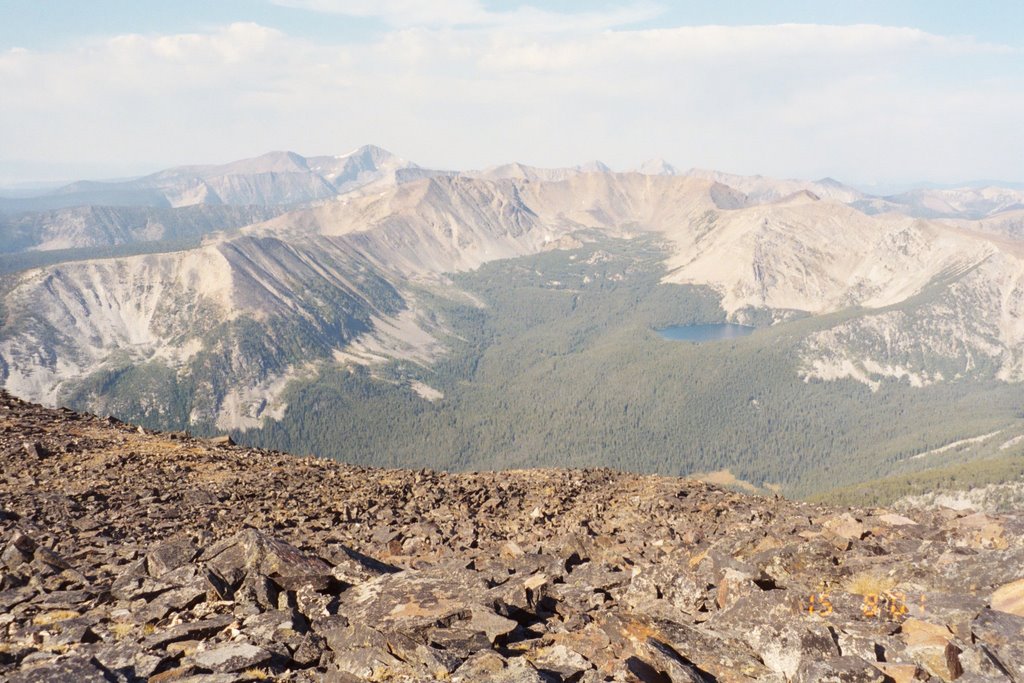
On the way down, RTD looked over to the "Mt ACM" connecting ridge, sat down, and whined. I looked and looked, finally saw what she was fussing about: a nannie and kid feeding along just below the top. Few things are cuter than a kid goat playing on the rocks. Except for, maybe, a cub bear rolling around with a pine cone.
Back to camp, a well deserved nap. Wakened to RTD playing peek-a-boo with a pine marten in a tree not 100 feet from my tarp. My they are quick. Oh well, time for a cup of hot tea. Then hiked over to the south side of basin to view the parks and larger lakes. Sure enough, spotted two decent (raghorns but 4 or 5 points) bull elk in a park just below largest lake. Just 100 yards or so away, sweet smell of elk filling the air, RTD was very excited. It rained a little on our stroll, but barely enough to wet the ground.
Finished reading Homer's Odyssey for about the 3rd time. Always a new detail: this time, the description of Odysseus' broach pin--a hound tearing a struggling deer fawn to pieces. Different times they was.
Up early the next day for the trek out. Jumped two bands of cows and calves down fairly low, in the meadows edging into lodgepole. Had another bunch cross in front of the truck on the jostling ride out. [Note to self: tighten the nuts & bolts.]
Well, tomorrow it's off to Boston w/ Emily, to get her started in college. I made her a little deer skin pouch of mementos: flicker feather, raspberry leaf, quartz crystal, elk ivory, tuft of goat fur, etc.
The View from Fish Peak (21Aug2006) - peak bagging
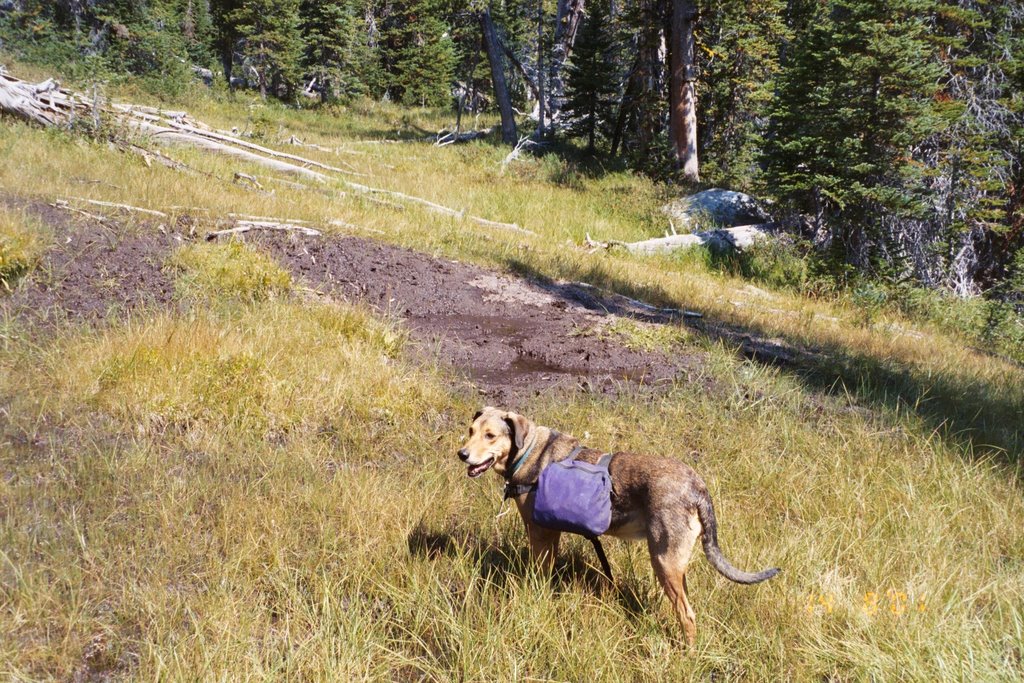
[Photo above: elk wallow on the way up to Hicks Lake.]
Well, in terms of difficulty, summer’s remaining backpack trips will be easy in comparison to last week’s destination: Hicks Lake and Fish Peak.
Fish Peak, especially if scrambled by way of Hicks Lake, is in my humble opinion the toughest peak in the Pintler. This is even more true when, as with last Thursday, the day includes rain, high winds, hail, sleet, snow, and visibility down to a few hundred feet. All began well, cruising up LaMarche Creek on the easy trail from the now-closed guest ranch (note that because the dude ranch is closed with a locked gate, it adds a half-mile or so to the hike). Roly-The-Dog & I made the approximate 10 mile trek in just a few hours. We got an early start and the weather was pleasantly cool but clear. There is a great deal of bear sign everywhere along the trail, we saw some wolf sign too, and treat of treats we were visited along the way by a pileated woodpecker. We did not see any elk or bear in the marvelous avalanche slides coming off the high ridges along the south side of the creek, but I’ll bet they are full of critters early and late in the day.

[Little Hicks Lake; Hickie? Hiccup?]
At the right spot, we turned up onto the old CCC trail for the 2,000 foot and 2 miles as-the-raven-flies climb to Hicks Lake. We lost the old trail as we approached Little Hicks Lake (Hickie Lake? Hiccup Lake?) in steep country filled with deadfall and bogs. RolyTD gave out on me about this time. She simply lay down and refused to take another step. Once I removed her panniers and loaded them onto the top of my pack, she was ready to hike again. Just what I needed at that point—another 8 or 10 pounds.
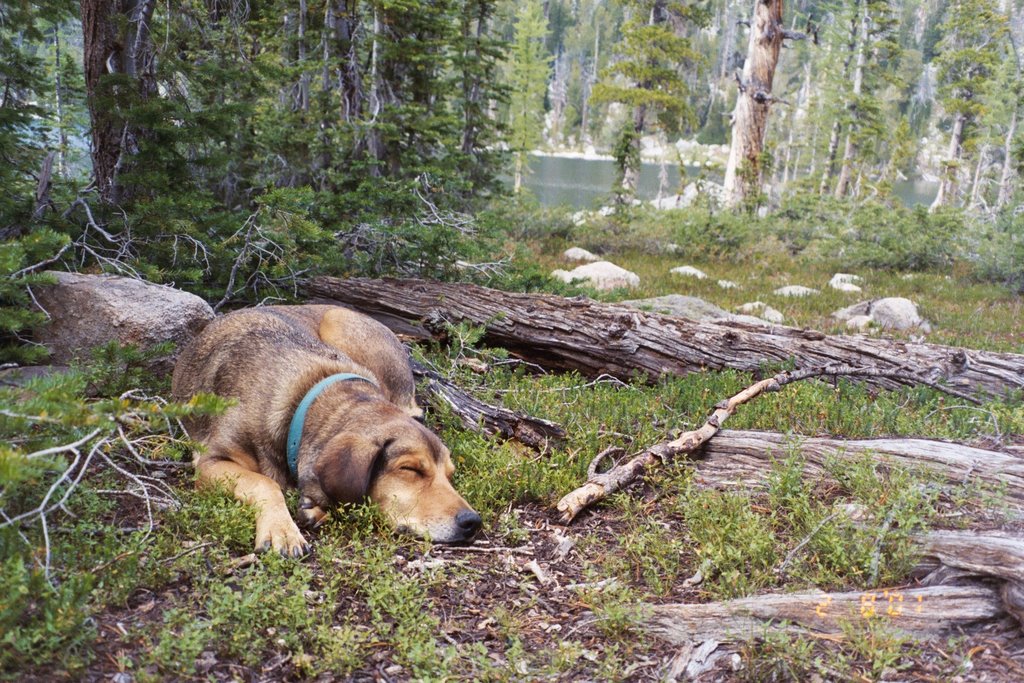
[Photo above: dog tired upon arrival at Hicks Lake.]
But we arrived at Hicks with no real difficulties, although I did get a little turned by the steep ridge and we popped into the cirque just east of the lake. The lake never looked so good, with the stark Fish Peak ridge looming over us. The gathering clouds helped me speed the location of a campsite and setup of my little rain fly. We slept to the sound of distant thunder and the pattering of raindrops on the tarp. Then woke to build a quick fire, enjoy a cup of steaming tea, and then dinner of Ramen + jerky followed by instant pudding. The air cooled and the on-and-off showers forced me to don full rain gear. Part of our meal was eaten under the fly. Sleep came early, and just before drifting off a fierce storm dropped an inch or so of popcorn like sleet/hail with lightening (mostly cloud to cloud) booming over us.
Morning I slept in a bit, waiting for the sun to rise over the Fish Peak ridge. The day looked “iffy” for bagging a difficult peak, but the brief sunholes and patches of blue sky were enough encouragement, and we set off around the lake and up the western end of the ridge. Though a long route, this looked much friendlier than the steep, sheer rock closer to the peak. Much of the rock strata is tilted near the peak, forming “slick rock.” We said hello to a goat after we reached the ridge and turned toward the peak. There were several elk grazing in a distant meadow near Cut-away pass. Walking the ridge was difficult, with lots of scree, unstable scree on side-slopes, and only the occasional flat spot or bit of vegetation to ease our way. The closer we got to the peak, the more the weather closed in. By the time we reached the cairn marking the peak, clouds had closed in around the ridge and first rain and then sleet pelted us. I have never found a peak note jar or can at the Fish Peak cairn, so I brought a jar and wrote a hurried note before starting down—as I was writing the note, the sleet turned to snow, which was incredibly beautiful and made pleasant because the wind died down. But the rocks were made loose and the lichen slippery by the rain. Though steep, I chose a descent near the peak. I just could not stand the thought of hiking a mile or two back through the scree along the ridge. RolyTD showed great fear of crossing any areas of slick rock, and I obeyed her intuition and we found better places to cross these slick rock slides even when it meant going back uphill. On the way down, the sky cleared long enough for a pleasant lunch and well deserved rest. Again, the lake was a welcome sight and we napped to the sound of rain.
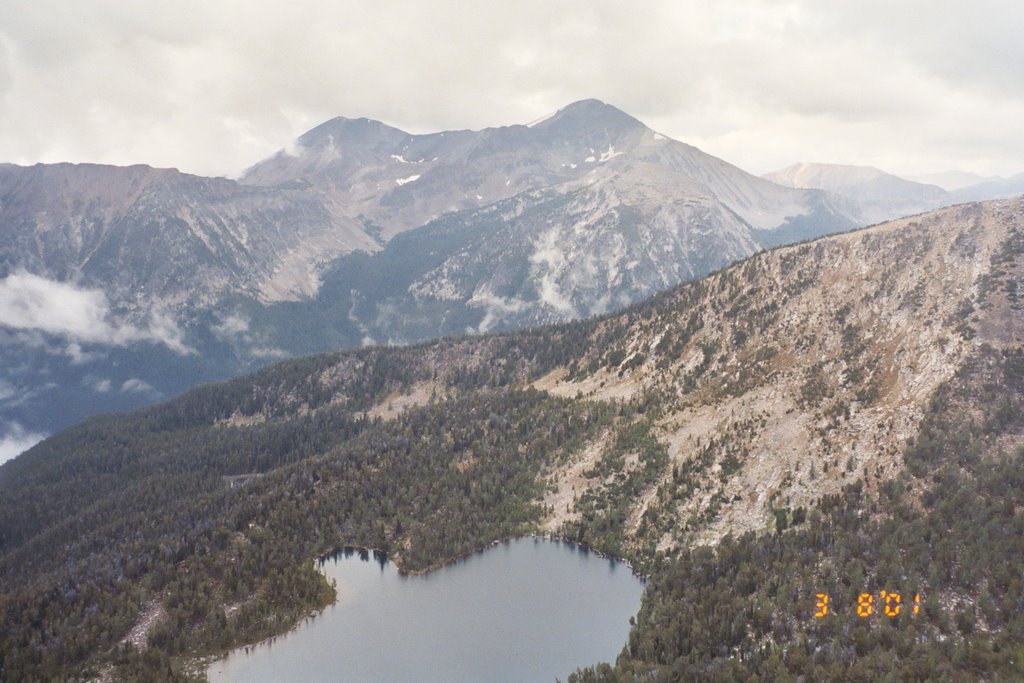
[Photo above: Hicks Lake from Fish Peak ridge.]
The rest of the day was filled with intermittent showers, though it never rained so hard that I could not keep my little fire going to heat water and make supper. After supper, we fished a bit and caught 4 larger trout and quite a lot of smaller ones. Temperatures hovered in the low 40s. During the night the sky cleared, temps dipped below freezing, and a crescent moon lit the sky toward morning. I was up at dawn, and enjoyed watching light fill the cirque while I drank my coffee and ate my oatmeal. With sun up I aired my sleeping bag and bivvy sack before packing and starting down the ridge toward the trail. The route was good, and the morning cool. I did not change my long underwear and wool shirt until we hit the main trail, when I also removed the panniers from my pack and strapped them on RolyTD where they belong. With a light load, I set a fast pace for the trailhead. The clock in the truck read 2 pm as we climbed in for the drive home. Thankfully, no one had bothered the 3 beers that I had stashed in the creek.
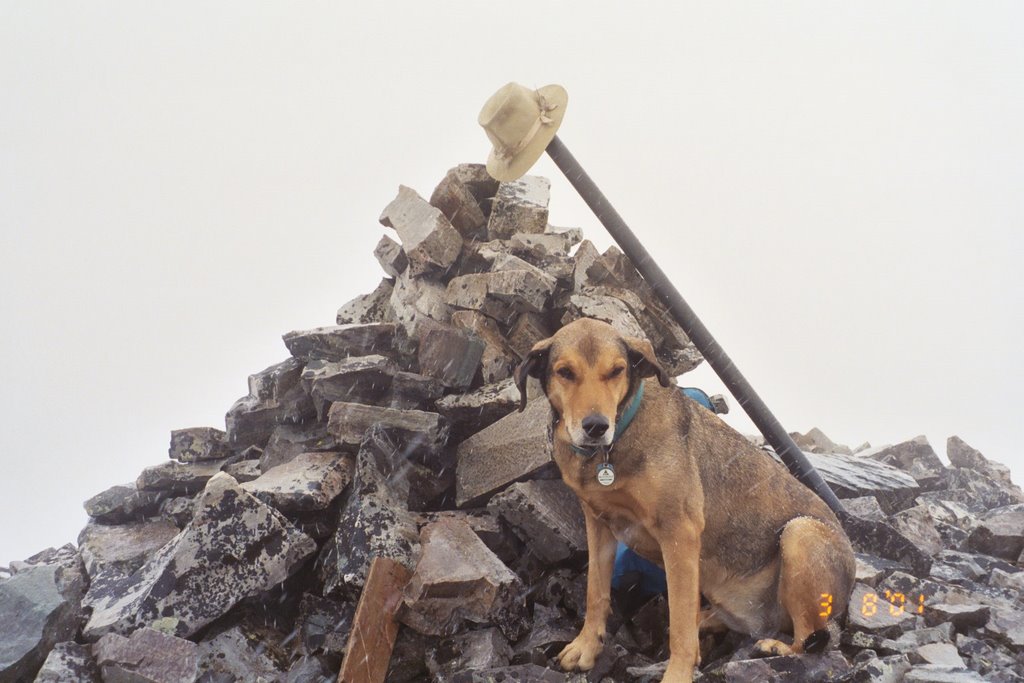
[Photo above: RTD in a snow squall on Fish Peak.]
During much of every Hicks Lake trip I think “never again.” But miraculously, upon reaching the truck, each time I find myself planning the next trip.
15 August 2006
The View from West Goat Peak - peak bagging
Emily & got a late start for a long hike on a hot day. We reached the Fishtrap Creek trailhead after 8:30 am, and began the 7-mile trail portion of the hike. The first 1/3 begins with a fairly steep uphill, the middle 1/3 is fairly level but with a boggy trail where it is easy to miss the blazes, and then the last 1/3 is very steep and rocky. It was nearly noon when we reached the saddle that marked the end of trail for us. We ate, hydrated, and rested while the sky clouded over and the air cooled. Then it was up at ‘em, leaving the trail for a mile or so of bushwhacking along a finger ridge that leads to the base of E Goat Peak and the outlet from Lost Lakes.
It was good to drop the packs, set up the tent, visit with the pika and marmots, and take a nap. The sky cleared while we cooked and ate supper, and then it was time for another nap while a thunderstorm swept through. We got little rain from it, however, with most of the activity out over the foothills and Big Hole valley. The camp site was cool with some leftover snow drifts nearby, but there were just a few pesky flies and no skeeters.
Bright and early we woke, ate, and climbed the little scree headwall to Lost Lakes. They are so beautiful, and while we watched a large block of ice calved off the glacier and set off a tidal wave across the upper lake. Emily spotted a big billy way up near the crest of W Goat Peak. As we began to climb and the ridge grew ever steeper, the wary billy moved up and across the large snow cornice that you can see from Butte, and over the top and out of sight. We worked our way up the nose along the steep north chute, and again Emily spotted the goat—this one a young goat that at one point literally ran down a steep but smooth area of scree. We slowed some near the top, taking care in scrambling over the rough rock and large boulders. Once on top, we were surprised to find the cairn knocked down and the old peak jar gone. But someone – descendents of the old time Big Hole Christian/Paddock families – had visited late last summer and left a new peak jar (in the form of a metal tea can with screw top). We left our obligatory note, took some photos, and climbed back down to the upper lake where we enjoyed a well-deserved nap.
Back at camp, all was quiet save for the whistling of marmots and the occasional clatter of rock coming off the steep south face of E Goat Peak. There was a lot of elk smell in the air, and much evidence of activity. Several small whitebark pines had been destroyed by a bull or bulls rubbing their velvet away. On our hike out the next morning, RolyTheDog jumped and briefly chased a bunch of elk from the sparse larch stand just below camp. We saw only glimpses of the elk, and knew not whether they were bulls or cows. Damned dog anyway. Next time I’ll load her pack with rocks for the trek out to insure that she slows down.
Sadly, someone stole our precious few beers that I had stashed in the creek. Probably the same someone who violated the trail with an ATV and tore down the “No ATVs” Forest Service sign. Asshole. Next time, I’ll piss in a beer bottle, cap it back up, and leave it for any taker. Did that once to someone who used to filch my beer from Sugar Run on the Allegheny National Forest (probably someone from the nearby Steinhauser family camp). No one ever bothered my beer after that.
Back in town, Jan & I enjoyed a marvelous weekend of music at the annual An Ri Ra Irish fest in Butte. Lots of good beer, lots of good listening & singing along, lots of meeting up with old friends and acquaintances. My favorites were the kids fiddler group from Dillon and a contemporary jazz/rock/folk band called The Prodigals. Great stuff. Yesterday, we capped off the weekend with a party at Georgetown Lake, hosted at a cottage for the kids that Emily hangs out with and their parents. It was fun watching Emily water ski and enjoy herself with great peers. I found another Dad to elk talk with.
This week, it’s the big trip of the year—the grueling long hike and difficult climb to Hicks Lake. In the coming weeks, there will be some easier trips to Mounts Howe and Evans.
It was good to drop the packs, set up the tent, visit with the pika and marmots, and take a nap. The sky cleared while we cooked and ate supper, and then it was time for another nap while a thunderstorm swept through. We got little rain from it, however, with most of the activity out over the foothills and Big Hole valley. The camp site was cool with some leftover snow drifts nearby, but there were just a few pesky flies and no skeeters.
Bright and early we woke, ate, and climbed the little scree headwall to Lost Lakes. They are so beautiful, and while we watched a large block of ice calved off the glacier and set off a tidal wave across the upper lake. Emily spotted a big billy way up near the crest of W Goat Peak. As we began to climb and the ridge grew ever steeper, the wary billy moved up and across the large snow cornice that you can see from Butte, and over the top and out of sight. We worked our way up the nose along the steep north chute, and again Emily spotted the goat—this one a young goat that at one point literally ran down a steep but smooth area of scree. We slowed some near the top, taking care in scrambling over the rough rock and large boulders. Once on top, we were surprised to find the cairn knocked down and the old peak jar gone. But someone – descendents of the old time Big Hole Christian/Paddock families – had visited late last summer and left a new peak jar (in the form of a metal tea can with screw top). We left our obligatory note, took some photos, and climbed back down to the upper lake where we enjoyed a well-deserved nap.
Back at camp, all was quiet save for the whistling of marmots and the occasional clatter of rock coming off the steep south face of E Goat Peak. There was a lot of elk smell in the air, and much evidence of activity. Several small whitebark pines had been destroyed by a bull or bulls rubbing their velvet away. On our hike out the next morning, RolyTheDog jumped and briefly chased a bunch of elk from the sparse larch stand just below camp. We saw only glimpses of the elk, and knew not whether they were bulls or cows. Damned dog anyway. Next time I’ll load her pack with rocks for the trek out to insure that she slows down.
Sadly, someone stole our precious few beers that I had stashed in the creek. Probably the same someone who violated the trail with an ATV and tore down the “No ATVs” Forest Service sign. Asshole. Next time, I’ll piss in a beer bottle, cap it back up, and leave it for any taker. Did that once to someone who used to filch my beer from Sugar Run on the Allegheny National Forest (probably someone from the nearby Steinhauser family camp). No one ever bothered my beer after that.
Back in town, Jan & I enjoyed a marvelous weekend of music at the annual An Ri Ra Irish fest in Butte. Lots of good beer, lots of good listening & singing along, lots of meeting up with old friends and acquaintances. My favorites were the kids fiddler group from Dillon and a contemporary jazz/rock/folk band called The Prodigals. Great stuff. Yesterday, we capped off the weekend with a party at Georgetown Lake, hosted at a cottage for the kids that Emily hangs out with and their parents. It was fun watching Emily water ski and enjoy herself with great peers. I found another Dad to elk talk with.
This week, it’s the big trip of the year—the grueling long hike and difficult climb to Hicks Lake. In the coming weeks, there will be some easier trips to Mounts Howe and Evans.
National Parks and Mussigbrod Lake
07.August.2006
A friend called to invite us to Yellowstone, but not in August. The parks are always nice. We especially like to catch Yellowstone on the “shoulders” of the busy season—in May and October. There’s nothing like seeing large charismatic fauna up close because they are so well habituated to human presence. Mammoth is a favorite. There is a good campground there, and it’s a nice hike up to the “boiling river” where the hot springs enter the Gardiner River. That’s a nice October campout, with golden aspens and bull elk bugling as they lead their harems through the campground at dawn. We camped in Arches several years during spring break, and might start doing that again once Emily is away (there’s been a big swim meet that week for the past 5 years). The Moab area is usually a welcome respite from the Butte winter, though we did get wake to about 6 inches of heavy wet snow there one year. Good memories, those parks.
If you want to hike the backcountry to see grizzlies, I recommend Glacier. The bear density seems higher there (MUCH better carrying capacity) and the mountainous geography means that you can sit in one place and view a lot more terrain. Keep that pepper spray on your belt or backpack strap, and know how to use it. Hikers have been mauled while they fumbled with the trigger lock. The pass above the Granite Chalet (I forget the name of the pass—maybe Swiftcurrent?) is a short hike from the highway, and it’s good bear country. For a real adventure, hike the trail into Granite Chalet that comes off the pass at the top—it’s the so-called “Garden Wall” trail. Very narrow ledges that you must sometimes share with goats. Those rapier sharp horns right at crotch height give you something to think about! Don’t look them in the eye. Good memories, those parks.
I’ll probably get started on research come September. For now, it’s summertime in Montana and I begrudge every day lost to office or to yard work.
Mussigbrod Lake campout was wonderful, the lake warmer than I ever remember it. We played for hours with the Tahiti boats, including swimming from them out in the middle of the lake (past the weed beds that clot the shorelines). They are a little hard to get in and out of in deep water (much harder than a canoe—which is easy once you get the technique down), and once I inadvertently flipped Roly-The-Dog out of my boat. I was worried for her, but she nonchalantly swam the ¼ mile or so back to shore, and was ready to go in the boat with me next time I went out. Little Adler is just 6-years old and yet he is totally comfortable with paddling way out into the lake. I also fished with Adler, and he caught a bunch of grayling—including 4 completely on his own. Adler is getting to be a good shot with the BB gun, with no can safe at 20 feet or so. Brent & I made my annual hike through the 2000 burn Saturday morning, leaving camp after a quick cup of instant coffee at 6 a.m. We saw and kicked out several bunches of elk, including one confused spike that jumped out of his bed, ran a short ways, then stopped and came back toward us before taking off again. Of course, while we were gone, Jan had a mulie doe parade her 3 fawns right past the tent as she was drinking her brewed coffee. Some trees are beginning to blow over, but for the most part it’s still easy to travel cross country. This might be the last year for that, as my forester friend tells me it is inevitable that the trees will soon blow over creating an impassable landscape of pickup sticks.
A friend called to invite us to Yellowstone, but not in August. The parks are always nice. We especially like to catch Yellowstone on the “shoulders” of the busy season—in May and October. There’s nothing like seeing large charismatic fauna up close because they are so well habituated to human presence. Mammoth is a favorite. There is a good campground there, and it’s a nice hike up to the “boiling river” where the hot springs enter the Gardiner River. That’s a nice October campout, with golden aspens and bull elk bugling as they lead their harems through the campground at dawn. We camped in Arches several years during spring break, and might start doing that again once Emily is away (there’s been a big swim meet that week for the past 5 years). The Moab area is usually a welcome respite from the Butte winter, though we did get wake to about 6 inches of heavy wet snow there one year. Good memories, those parks.
If you want to hike the backcountry to see grizzlies, I recommend Glacier. The bear density seems higher there (MUCH better carrying capacity) and the mountainous geography means that you can sit in one place and view a lot more terrain. Keep that pepper spray on your belt or backpack strap, and know how to use it. Hikers have been mauled while they fumbled with the trigger lock. The pass above the Granite Chalet (I forget the name of the pass—maybe Swiftcurrent?) is a short hike from the highway, and it’s good bear country. For a real adventure, hike the trail into Granite Chalet that comes off the pass at the top—it’s the so-called “Garden Wall” trail. Very narrow ledges that you must sometimes share with goats. Those rapier sharp horns right at crotch height give you something to think about! Don’t look them in the eye. Good memories, those parks.
I’ll probably get started on research come September. For now, it’s summertime in Montana and I begrudge every day lost to office or to yard work.
Mussigbrod Lake campout was wonderful, the lake warmer than I ever remember it. We played for hours with the Tahiti boats, including swimming from them out in the middle of the lake (past the weed beds that clot the shorelines). They are a little hard to get in and out of in deep water (much harder than a canoe—which is easy once you get the technique down), and once I inadvertently flipped Roly-The-Dog out of my boat. I was worried for her, but she nonchalantly swam the ¼ mile or so back to shore, and was ready to go in the boat with me next time I went out. Little Adler is just 6-years old and yet he is totally comfortable with paddling way out into the lake. I also fished with Adler, and he caught a bunch of grayling—including 4 completely on his own. Adler is getting to be a good shot with the BB gun, with no can safe at 20 feet or so. Brent & I made my annual hike through the 2000 burn Saturday morning, leaving camp after a quick cup of instant coffee at 6 a.m. We saw and kicked out several bunches of elk, including one confused spike that jumped out of his bed, ran a short ways, then stopped and came back toward us before taking off again. Of course, while we were gone, Jan had a mulie doe parade her 3 fawns right past the tent as she was drinking her brewed coffee. Some trees are beginning to blow over, but for the most part it’s still easy to travel cross country. This might be the last year for that, as my forester friend tells me it is inevitable that the trees will soon blow over creating an impassable landscape of pickup sticks.
Brook Trout, Raspberries, Beer, and Grayling
03.August.2006
Fished way past dark and stumbled my way out of lower German Gulch last night, 'bout shit my britches when RolyTheDog and I walked up on a moose in the half moon light. Being out at night is magical. Owl hooting. Coyote singing. Strange rustling noises. I was so inspired I drove the old RR grade in the dark with the headlights off until I hit the blacktop. Once upon a time I'd have to use drugs to get into that kind of state. Thrills come easier with age, I think.
Felt the same way nestled into the brambles and picking raspberries yesterday. Watching the little spiders that look like raspberry blossoms perched and waiting for their prey. Examining each shoot from several angles to find the ripe fruit hidden beneath the glossy green leaves. Admiring the beauty of our native humble bees as they worked the blossoms, unrolling their tongues to sip the nectar. Moving slowly so the thorns ride over my hide instead of digging in. Wow. Life is good.
As for beer, I believe in the aphorism, "Moderation in all things. Including moderation." I'm usually happy with one or two 12-ounce American Budweisers. But with the right group and inspiring conversation/celebration, I have a thirst for 3 or 4 pints of IPA. The combination of high-alcohol and mildly psychotropic hops is marvelous. I guess I'm more careful about eating too much than drinking too much!
Back at work today, trying to wrap up a letter from scientists to the US Fish & Wildlife Service re: fluvial Arctic grayling (i.e. "Big Hole grayling"). Bush regime has sent word down that there shall be no more ESA listings. This means the lackeys at FWS have to figure out a way to remove "Distinct Population Segment" status away BH grayling. DPS status is overwhelmingly supported by the genetics and field studies. If some prominent grayling biologists weigh in, it might prevent FWS from tying itself into a pretzel to deny the science.
Fished way past dark and stumbled my way out of lower German Gulch last night, 'bout shit my britches when RolyTheDog and I walked up on a moose in the half moon light. Being out at night is magical. Owl hooting. Coyote singing. Strange rustling noises. I was so inspired I drove the old RR grade in the dark with the headlights off until I hit the blacktop. Once upon a time I'd have to use drugs to get into that kind of state. Thrills come easier with age, I think.
Felt the same way nestled into the brambles and picking raspberries yesterday. Watching the little spiders that look like raspberry blossoms perched and waiting for their prey. Examining each shoot from several angles to find the ripe fruit hidden beneath the glossy green leaves. Admiring the beauty of our native humble bees as they worked the blossoms, unrolling their tongues to sip the nectar. Moving slowly so the thorns ride over my hide instead of digging in. Wow. Life is good.
As for beer, I believe in the aphorism, "Moderation in all things. Including moderation." I'm usually happy with one or two 12-ounce American Budweisers. But with the right group and inspiring conversation/celebration, I have a thirst for 3 or 4 pints of IPA. The combination of high-alcohol and mildly psychotropic hops is marvelous. I guess I'm more careful about eating too much than drinking too much!
Back at work today, trying to wrap up a letter from scientists to the US Fish & Wildlife Service re: fluvial Arctic grayling (i.e. "Big Hole grayling"). Bush regime has sent word down that there shall be no more ESA listings. This means the lackeys at FWS have to figure out a way to remove "Distinct Population Segment" status away BH grayling. DPS status is overwhelmingly supported by the genetics and field studies. If some prominent grayling biologists weigh in, it might prevent FWS from tying itself into a pretzel to deny the science.
Spring Weddings and Hikes
15.June.2006
Jan & I will be at Josie Youderian's wedding at the 320 Ranch in the Gallatin this weekend. Josie graduated from our program last year. She is marrying a fellow named Chad--it's a good story how I met him: we nearly had a head-on collision as I was driving out too fast from Bear Mtn with pieces of a bull elk in the back, (exhausted having shot him first thing that morning (it was one of the few elk I've gotten out of the woods in the same day), while Chad was driving in too fast with a cow elk tag in his pocket. I suggested he walk past the gate on the road and hunt the parks, he did, and he shot a cow that evening (as he told me when I saw him on campus the next day).
Anyway, an offer to hike LaMarche Creek trail brought back good memories. That is a lovely trail, and I have hiked it in and out many times. It gets a lot of horse use, as you will see by the ruts. There are usually elk and moose in the willows and meadows along the creek. The creek is full of trout. It's a long way in to the divide, but if you do get that far there will be lots of snow in June. The woods are very wet this time of year. The skeeters are also emerging in force now.
I had a largely uneventful but beautiful hike yesterday up along the ridge north of Moose Cr and then back down through the creek bottom. I was hoping to find some sort of old logging road or trail, since elk use that area a lot but I've hesitated to follow them not knowing how I might get a dead one out. Many times I have had elk bail off the top of Bear Mtn and run into the upper valley (which is a sort of a big bowl). What I found was a lot of scrambling over rocks and deadfall on the ridge, and a lot of scrambling over deadfall and through woody brush (tag alders, alpine laurel, and some other species I did not recognize) through the bottom. For the most part, the whole basin seems to be a hellish jungle full of elk, moose, and bear sign. Lots of fresh bear sign, so I was not surprised to see a tawny-golden colored little bear flipping rocks in a slide area at the very head of Moose Cr as I watched through binoculars from a steep rocky point a half mile away. Later, down in the bottom, a calf moose heard RolyTheDog and I crashing through the brush and came crying over to investigate us. I pleaded with it to please go away while Roly and I hurried off in the opposite direction. I am terrified of moose in thick brush. It rained much of the day, but did clear around noon so it was delightful to shed my raincoat, build a fire, and enjoy a hot cup of tea. I kept adding punky wood to the fire to discourage the skeeters. I will stick with my judgment of not following elk into the upper reaches of the Moose Cr valley. It's a pleasant enough hike, but nowhere you'd want to haul an elk from.
I have seen several mule deer bucks in the velvet. Their antlers are very noticeable now. Some elk bulls already have antlers two feet long.
We had a late crowd at daughter Emily's graduation party. Some of the hunters and I got into a nice beery conversation about elk racks. The following morning, Brent & I took a nice long hike along upper California Cr in the rain as Brent was interested in seeing some Indian stuff. He was amazed at how many antelope were in that area. They were seldom seen there when he lived here 10 years ago.
We have the last (I hope!) of the graduation parties tonight -- for Emily's friend Keith who has been admitted to the Air Force Academy. The party is at their family's place up in the Highlands, so I hope to learn a little about the elk there. Leroy (he teaches here at Tech) and others consistently kill bulls there, but though Dave & I hunted it hard for a few years we never figured it out.
Jan & I will be at Josie Youderian's wedding at the 320 Ranch in the Gallatin this weekend. Josie graduated from our program last year. She is marrying a fellow named Chad--it's a good story how I met him: we nearly had a head-on collision as I was driving out too fast from Bear Mtn with pieces of a bull elk in the back, (exhausted having shot him first thing that morning (it was one of the few elk I've gotten out of the woods in the same day), while Chad was driving in too fast with a cow elk tag in his pocket. I suggested he walk past the gate on the road and hunt the parks, he did, and he shot a cow that evening (as he told me when I saw him on campus the next day).
Anyway, an offer to hike LaMarche Creek trail brought back good memories. That is a lovely trail, and I have hiked it in and out many times. It gets a lot of horse use, as you will see by the ruts. There are usually elk and moose in the willows and meadows along the creek. The creek is full of trout. It's a long way in to the divide, but if you do get that far there will be lots of snow in June. The woods are very wet this time of year. The skeeters are also emerging in force now.
I had a largely uneventful but beautiful hike yesterday up along the ridge north of Moose Cr and then back down through the creek bottom. I was hoping to find some sort of old logging road or trail, since elk use that area a lot but I've hesitated to follow them not knowing how I might get a dead one out. Many times I have had elk bail off the top of Bear Mtn and run into the upper valley (which is a sort of a big bowl). What I found was a lot of scrambling over rocks and deadfall on the ridge, and a lot of scrambling over deadfall and through woody brush (tag alders, alpine laurel, and some other species I did not recognize) through the bottom. For the most part, the whole basin seems to be a hellish jungle full of elk, moose, and bear sign. Lots of fresh bear sign, so I was not surprised to see a tawny-golden colored little bear flipping rocks in a slide area at the very head of Moose Cr as I watched through binoculars from a steep rocky point a half mile away. Later, down in the bottom, a calf moose heard RolyTheDog and I crashing through the brush and came crying over to investigate us. I pleaded with it to please go away while Roly and I hurried off in the opposite direction. I am terrified of moose in thick brush. It rained much of the day, but did clear around noon so it was delightful to shed my raincoat, build a fire, and enjoy a hot cup of tea. I kept adding punky wood to the fire to discourage the skeeters. I will stick with my judgment of not following elk into the upper reaches of the Moose Cr valley. It's a pleasant enough hike, but nowhere you'd want to haul an elk from.
I have seen several mule deer bucks in the velvet. Their antlers are very noticeable now. Some elk bulls already have antlers two feet long.
We had a late crowd at daughter Emily's graduation party. Some of the hunters and I got into a nice beery conversation about elk racks. The following morning, Brent & I took a nice long hike along upper California Cr in the rain as Brent was interested in seeing some Indian stuff. He was amazed at how many antelope were in that area. They were seldom seen there when he lived here 10 years ago.
We have the last (I hope!) of the graduation parties tonight -- for Emily's friend Keith who has been admitted to the Air Force Academy. The party is at their family's place up in the Highlands, so I hope to learn a little about the elk there. Leroy (he teaches here at Tech) and others consistently kill bulls there, but though Dave & I hunted it hard for a few years we never figured it out.
Subscribe to:
Posts (Atom)


