Showing posts with label hunting. Show all posts

14 December 2007

Venison Sausage

Like many people I have known in my life, the longer I live the more I appreciate them. So it is with Grandma Beryl (nee Fitzgibbons) Munday. She was a tough old Scot-Irish Presbyter. When I was a child, I thought she was the meanest woman on earth. After Gramps died, however, and she no longer got up each morning at the butt-crack of dawn to cook him breakfast, she really mellowed.

Gram liked staying up late at night watching horror movies and reading, and for 50-some years of marriage she had been seriously sleep deprived. After Gramps died, she often sat in her chair with a cat on her lap reading until 1 or 2 in the morning, and then slept until 10 or sometimes later. When Jan & I lived nearby, we'd sometimes stop in after an evening on the town, and Gram was always ready for a glass of beer.

Gram didn't waste much. She cooked deer kidneys, picked a chicken carcass down to the bones, and made wonderful venison sausage. Here's the recipe.

You'll need a grinder. An old "armstrong" manual grinder like the one she left to me will work just fine:

For this batch, we'll use about 10 pounds of scraps left over from butchering a whitetail. Strips cut from the ribs, 1" - 2" chunks cut from the shanks, and anything else that didn't go into steaks, roasts, stewmeat, or stir-fry meat:

Add to that about 5 pounds of fatty pork scraps. Cheap bacon (our supermarket sells bags of bacon scraps) works well, and if you use salt pork you can use somewhat less:

Mix in a slew of spices and flavorings. Amounts are about 2 teaspoons for each of the spices, about a cup of dark brown sugar, and several (or more) hot peppers if you'd like:

Not shown are fennel seeds, about 4 tablespoons of which get added and mixed in before the second grind. Mix the spices, venison, and pork together and run through the grinder on a coarse setting. Gram's grinder has a single "plate" (cutter wheel) that reverses for fine and coarse grinding. Depending upon how sinewy and tough your venison scraps are and how efficient your grinder is, you might have to pause after every few pounds of meat, remove the plate, and clean out the sinews that are clogging things up. Here we are after mixing in the fennel seeds and switching the plate for the second (and final) grind:

This bulk or pan sausage is good for breakfast patties, and Jan likes it for dishes such as lasagna. Enjoy!

27 November 2007

Going Elkless (Almost): Elk Hunting near Butte, Montana

There I was, combing the hills several miles from the road on the last day of elk season. I had grown entirely too smug about elk hunting, having shot bull elk four-out-of-five years that I hunted them, and having shot several cows within a mile or so of the highway. Not this year.

Season began with me at a conference in Washington, DC. Of course, conditions were perfect with cold weather and eight inches of fresh snow. The second week, I was complacent. My friend Don was coming to hunt the following week, and so I roamed the hills and even passed up a shot at a cow. Well, it wasn't a good shot, and as my friend and now-retired colleague Dennis Haley counseled, "Hunting elk in timber is a percentage thing. If you are patient and get into them six or seven times, then you will get the good shot you want. There's no need to take those "iffy" shots."

Here's AJ, crashed for a nap in the warm noonday sun after we climbed into a remote (and elkless) Pintler basin:


Meanwhile, I ate my lunch and waited for the tea to boil:

Don Kieffer arrived from upstate New York the first week of November. The weather was beautiful: warm, sunny, and lousy for elk hunting. Up high, the old snow metamorphosed, turning icy and crunchy. Down low, the snow melted away. But we had a great time hiking the hills:

Visiting some of my favorite elk haunts:

And of course enjoying a hot cup of tea come noontime:

As my old friend BAT (aka Bob Thomas) likes to remind me, hunting is a lot more than killing. Especially on those blue sky days when the weather is just too damned good for serious elk hunting, you can lie back and listen to the serenade of migrating flocks of snow geese:

And swans:

Don & I also saw a peregrine falcon, and visited the spot where indigenous peoples mined jasper for tools:

After Don left, I tried to get more serious about elk hunting, but still the weather was not conducive to it. Hunting at such times becomes a good excuse for hiking into spots that need to be visited from time to time, such as these logging-era cabins, probably built to feed the flume that sluiced cord wood from the Big Hole valley to the Anaconda smelter:

And when the elk are hard to find, there is the occasional moose; here, a cow and calf on a remote, windswept ridge along the Continental Divide (folks don't think of moose as mountain animals, but they are in Montana!):

And the occasional fool hen (this one, felled with a rock, made a welcome and savory supper that night):

Finally, though, right at the end of season, conditions turned favorable with new, quiet snow and consistently cold temperatures. I spent a day or two hunting a spot that I had hunted many times over the years with Brent Patch and Dave Carter. In those years, I had not learned the lessons of a good "black timber" hunter, and wasted a lot of time peeking into parks and coursing through open stands of lodge pole pine.

In the timber, you keep your nose to the wind, move slowly and quietly, and check out all those stumps and rocks that look very much like elk:

Two Butte boys, hunting a park along the ridge line, flushed a bunch of elk from the north-side timber just below the ridge. I smelled them out ahead of me, found their tracks, began repeating my mantra ("I will honor your spirit and use your flesh well."), and began still hunting. One mile into the chase, they passed through a stand of dense Douglas fir, meandered about, and I thought sure they would bed down. It took me an hour to track them slowly and carefully through a half-mile wide thicket, sometimes crawling on my hands & knees to be quiet and stay below the branches. I could smell them and knew they were not far ahead. They continued through and fed in a small park. This told me they were relaxed and not worried about a predator on their heels. Very encouraging.

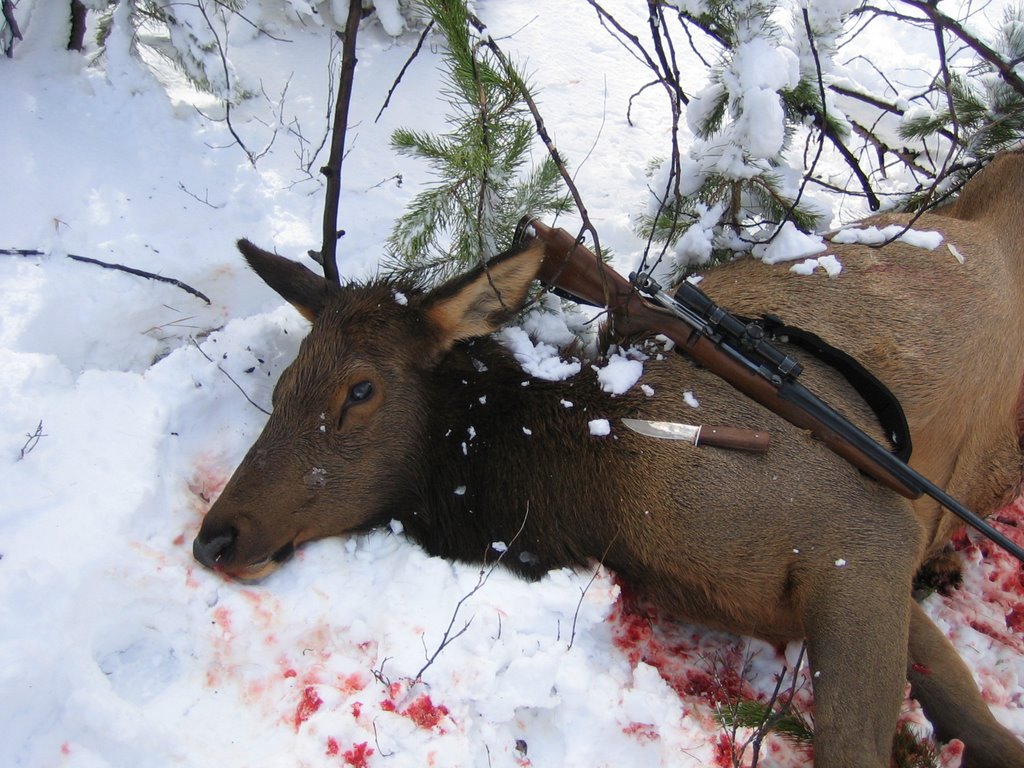
And then there they were, heads tilting and ears twitching, bedded in some thick, snow-covered firs at the park's edge. In timber, one seldom sees a whole elk. Because of the roll of the slope, I could not see any elk shoulders or ribs, my preferred shot. I usually avoid neck shots, since if you don't hit the spine there is not a quick death. But the elk were just seventy yards or so away, and I had a good rest on a tree limb. She never moved from her bed:

An hour or so later, I had the carcass split into two halves, dragged well away from the gut pile where the coyotes and ravens would be less likely to feed on it, and covered with pine branches until I could return:

The heart, liver, tenderloins, back straps, and tongue I laid out on the snow to cool:

Together, they made a forty pound load in my little rucksack. By the time I reached the road, three miles distant, the load felt like one hundred and forty pounds.

At the Check Station, I learned from the nice biologist that there was a Forest Service road within a half-mile of where I killed the cow. The next morning AJ came along to help me, and his good company and a sled made for a pleasant down-hill drag:

"I will honor your spirit and use your flesh well." This promise began with a supper of elk liver and onions last night, the heart is ready for pickling, and there are already plans for barbecued ribs, grilled tenderloin, back strap schnitzel, and roasted tongue with huckleberry glaze. Elk are great animals, and deserve the honor of a great (and arduous) hunt.

11 October 2007

Is THAT all there is... (to an antelope hunt), my friend?

An old friend from Pennsylvania (thanks, Bob!) emailed me about the previous "Pronghorn Antelope Hunt" entry. I'll exagerrate for effect, but the message went something like "What's this bullshit about a hunting story where it's all about what you bring home in the back of the truck. Have you lost your ethics?"

Well, no, I haven't. Now don't get me wrong: my hunter role models are the San "Bushmen" hunters of the Kalahari. They'll shoot a giraffe with a little poison-tipped arrow and then track the beast for five days if that's what it takes to bring home the meat. Even with unwounded game, they get on a track and will not say quit (see the marvelous documentary films by John Marshall).

Still -- whether for the San or me -- there is a lot more to it. Hunting is life. Hunting is a deep relationship and bond with nature. Hunting is learning to see and feel the rhythm of life. On the recent antelope hunt, hunting was:

  • Meeting the curious jackrabbit that hopped over to within six feet of me in the dawn twilight.
  • Seeing the coyote hunt its way up the coulee, and then jump out of its hide as its nose scented my backtrail.
  • Wondering how those large slabs of volcanic rock along the ridges became so waterworn and smooth.
  • Pausing occasionally to sit down (watch out for the cactus), feel the warm sun, keep my nose into the cool breeze, and take in a vast landscape without another human in sight.
  • Wondering how sorry I might be for leaving my knapsack with water, food, and rain gear in the truck on a warm afternoon as I made the stalk.
  • Watching a mule deer doe and her two fawns nonchalantly feed as they wondered what those high-strung, flighty antelope were so excited about.
  • Knowing that the ravens, whose excited croaking and flying back and forth between me and the butte, were telling me that antelope were there.
  • Carefully gutting the antelope doe to keep the meat clean and sweet.
  • Feeling the weight of the doe slung across my shoulders, smelling her strong antelope scent, and picking a good route to the nearest road.
  • Being VERY sorry that I had not brought the water bottle as I draped the doe over a sagebrush and began the hike back to the truck.

Yes, there is a lot more to hunting than what comes home in the back of the truck.

10 October 2007

Pronghorn Antelope Hunt: Big Hole River Valley, Montana

As I put the rifle case in the pickup bed, I looked up through the frosty predawn darkness at Orion, the hunter's constellation. Pausing a moment to gaze, I hoped to see an Orionid meteor or two, but did not. A minute later, ice scraped off the windshield and coffee in hand, I was ready to roll.

Driving from Butte to the Big Hole, I reflected on why I don't like to hunt opening day of antelope season. Pronghorn antelope are odd creatures compared with newcomers to the North American continent such as elk or white tailed deer. As a creature that evolved at a time when cheetahs, short faced bears, sabre tooth lions, and other large, fast predators roamed the North American plains, antelope use their amazingly large eyes and incredibly fleet feet to keep them safe. But the pre-Pleistocene predators did not have rifles capable of shooting accurately at 200 yards. The antelope's 8-power vision and 60 mph speed can make them far too complacent about human hunters within rifle range--as the pre-hunting season photo attests:

Opening day hunters take advantage of this by road hunting. They blast away at every pronghorn within range--and often far out of range of their shooting ability, which results in many wounded antelope. I get so aggravated by the lousy ethics of these hunters that I avoid hunting opening day, rather than be tempted to put a bullet through some moron's engine block. After opening day, antelope fear, flee, and hide from the mere sound of motor vehicles.

I parked down the valley from Old Charlie's place. Although I heard Old Charlie had been sent to a nursing home, it's hard to shake a feeling that the 90-year old codger still, somehow, inhabits the place. But as I climb the steep glacial till of the hillside, I get high enough to look up the valley at the old homesteader's log shack. No smoke curling from the chimney. No lights. He really is gone.

The rancher who was kind enough to give Old Charlie a place for the old boy, his dogs, and his one good horse to live has replaced that distinguished lot with about two hundred head of stinking cattle. It's been a hot, dry summer, and it looks as if they've spent the entire last few months along the spring in the old hay field below the shack. The meadow ground is churned into cowshit-laden mud, the uplands are hammered into dust, and there's not a sign of antelope anywhere in the mile-wide ridgeline radius I swing around Old Charlie's place.

So much for the first hunt of the morning. For the past five years or so I shot my antelope in this area, spent some time talking (well, listening really--the old boy was deaf as a post) with Charlie, and made it home by 10 a.m. This year would require a little more hunting.

The sun is well up on these antelope hills, and it's a vast landscape from which to choose a place to hunt:

For the second hunt of the day I drove up the valley and to the east, and park near a prominent butte where Dave Carter, Rick Douglass, and I occasionally hunted. The butte's outer rim forms a more or less circular steep wall of rock, and in the center lies a hidden depression where antelope often hide after opening day madness. Here I find three buck antelope, none of which I am interested in shooting. I hunt primarily for meat, and have found that buck antelope are too gamy tasting even for me. Furthermore, I'll need to carry this antelope a quarter mile or more to the nearest road, and does will weigh 60 to 80 pounds field dressed, whereas bucks are 20 pounds or so heavier.

Discouraged, I hike back to the truck and drive several miles of low range, rocky, ass-pounding Bureau of Land Management road. My plan is to stop at another spot where Dave and I used to hunt, in some hills and hidy-holes above a rancher's alfalfa field. Though adjacent to a blacktop highway, oddly enough other hunters don't seem aware that there are antelope there--perhaps because you must walk to get to them. Upon reaching the main access road, I drive a mile or so and -- on a whim -- decide to turn back up onto the BLM land.

I drive two miles up the valley, park the truck, and step out to glass the ridgeline to the east. Sure enough, a mile away, I see a herd of eighteen or so antelope feeding along the side ridge. And amazingly enough, several of them are looking right at me. The whole herd becomes nervous and follows the lead doe on a line up and over the ridge, but angling back toward the butte I hunted earlier.

I park as closely as I can--perhaps a half mile from the ridge and a mile from the butte. Hiking up and over, I watch the last few antelope, barely within rifle range, as they top the next ridge leading to the butte. One more hike, I tell my feet that have been pounding all day over this rocky, cactus-strewn desert. And sure enough, they are here in the bowl, some already beginning to bed down. I watch them several minutes, though one young doe notices my silhouette peaking through a sage brush and is coughing nervously. The others gather round, trying to see or smell or hear this reported threat.

The range is only about two hundred yards, but there is no handy rock for a rest and I hate to sprawl prone among all this cactus. I'm thankful for my shooting sticks -- two arrows tied together to form a "V" -- a simple innovation taught me by now-retired professor Jack McGuire. I choose a young doe (I do not want to shoot either the lead doe or a fawn), hold the crosshairs low behind the shoulder, take a deep breath, exhale a bit, and squeeze the trigger on the little 25 Roberts:

Now the work begins. It is 3 p.m. By the time I field dress the doe, hike down to the truck, drive around and up nearer to the butte, hike back to the kill, and carry her 65 pound carcass to the truck, it is 6 p.m. Thank you, Orion.

06 February 2007

Antlers

Well, another spate of warm weather has wrecked the skiing, so instead of skiing today I walked to work. I've been sawing out buttons from a deer antler to restore an old Woolrich coat, so along the way (it's about a mile and a half, so I have some quality thinking time) I thought about the whole "antler thing." That is, why do we save and treasure antlers? Is it a mere acquisitiveness, like rats hording useless items or children collecting baseball cards? Well, I like to think it's a little more than that.

Maybe it's more like scars. Get a bunch of men & beer together, and they (the men) will start talking about their scars. The thumb they split with a wood chisel, the stitches where the chainsaw kicked back and split their scalp, the band of scar tissue where they nearly cut off a thumb while reaching up inside an elk's chest cavity while wielding a sharp knife in the other hand... Antlers, like scars, are a material reminder of memorable events.

Certainly, many antlers just end up a debris in the corner of the basement. At my house, most antlers do not get saved anymore.

But some do. Rarely, I might use them for something quasi-practical--like buttons.

In Pennsylvania, I grew up in a deer hunting family that did not treasure antlers. Usually, they ended up "recycled" back to nature along with the offal, feet, bones, and other inedibles. Or they ended up in the yard, gradually reduced to oblivion as the hounds chewing on them. In my twenties, though, I worked at an oil refinery and got to know fellow chemist Bill King. Nailed up in his garage, Bill had the rack from every deer he'd ever killed . Because in most years he killed a buck in both New York State and Pennsylvania (we lived very close to the state line, and it was common to hunt in both states), there were more than fifty of them. So I began saving mine, nailing them up on various posts around a now-gone family oil property.

I left the refinery and went back to school for my PhD. In central New York State, I shot a classic "8-point" (eastern count) whitetail and mounted it on a nice hickory board slabbed out of firewood. This deer was all-the-more-special because as we were skinning and quartering it, my friend Andy Wilson found an arrow shaft with point embedded between the shoulder blades. The deer had healed completely. It makes a good hat rack and catchall for things like Great-Grandpa's M97 Winchester.

When I moved to Montana 17 years ago, I began to adorn the interior of our home with antlers. The first to go up was the rack from my first elk bull. As I look at these antlers, I recall it all seemed so easy: I just went out the first day of season, hunted elk like I had always hunted whitetails, found a big track, followed it all day, and late in the afternoon shot the bull. Wow. Sometimes it is just that easy.

Having grown up seeing small whitetail antlers, I am still amazed by the size of mule deer antlers. Even young bucks sometimes carry a rack that won't fit in a broom closet. So another hat rack made it inside the house.

My wife was feeling a little crowded by this time, so the next memorable buck I shot had its rack go to the office. It's not a big rack by any means, but it's a bit unusaul: a biologist told me the deer was a mulie-whitetail hybrid (not uncommon, I've found).

Since then, memorable racks go up on the back of the house on the outside wall to the mudroom. Oh yes, you can also see a buffalo skull with horns on the upper right (on the roof). I shot a couple of buffalo for a high school history outing when my daughter was in the history club; sent one skull to my friend Don for his barn (he has a nice elk rack I sent him, too).

What makes a memorable rack? Something about the hunt, usually. I must admit, I cannot recall most of my mule deer hunts. They all blend together into one universal, Platonic hunt that ended up with a 125 pound forkhorn providing good meat.

But I do remember every successful elk hunt--whether I took a cow or a bull. These two racks -- a mulie and bull -- are especially memorable because I shot the two within minutes of each other, and I shot them with my old hunting buddy Dave Carter. Though Dave had given up hunting, he joined me one day for a deer hunt in one of our favorite mulie haunts ("Dave's Deer Mine"). And for the first time, we saw an elk there, too. Also, the bull's left antler is deformed --it never grew out much, and part of the base split off and a brow tine grew down the elk's head between its eye and ear.


Speaking of Dave's Deer Mine, this is from the first buck I shot there. I learned that, to get these deer to the nearest road, you have to wade across an icy river. I've since learned to quit shooting big mulie bucks. Frequently -- if they are in rut -- the meat is so strong as to be nearly inedible. People will deny this, but then they start describing the strong seasonings and other cooking methods...

When I shot this bull, it was a long haul out through very deep snow. I left the head in a tree and hiked back up the mountain to retrieve it the following July. A porcupine found it first, as you can see by the nearly-chewed-through spot on the main beam of the left antler.

These two bulls were shot from opposite sides of the same bedding area in two consecutive years. The bull that carried the upper rack was a sort of dwarf: its body size was more-or-less normal, but its legs were abnormally short and it had only half a liver.
Well, I'm no trophy hunter, and certainly none of the racks I've taken over the years are trophies. But they are memories. By the way, ask me sometime to tell you about that scar on the inside of my left forearm...

05 January 2007

Get the Lead Out!

There is no need for condors to be dying of lead poisoning (HCN, 2/18/02: Condor program laden with lead). This is a problem that is also increasingly documented for other birds -- such as bald and golden eagles -- that scavenge hunter's kills. There are already several alternatives to lead bullets on the market. For more than a decade, solid copper bullets have proven effective on all game. Though currently expensive for shooters who do a lot of target shooting, the cost to hunt with copper bullets is negligible when compared with what hunters pay for rifles, four-wheel-drive vehicles, a tank of gas, and other gear.

Once they understood the harm done to waterfowl, hunters readily abandoned lead shot. Conservation organizations such as Ducks Unlimited have done a great job in publicizing the harm done by lead shot. Groups such as the Rocky Mountain Elk Foundation could effectively do the same for the move away from lead bullets.

Few hunters and conservationists, myself included, want to be responsible for poisoning condors, golden eagles and other scavengers. Hunters such as Teddy Roosevelt, William Hornaday and Aldo Leopold were leaders in the conservation movement. The National Rifle Association has been fighting any curbs on lead bullets, but the NRA is plumb crazy on this issue, and should either lead or get out of the way.

30 December 2006

Elk Ivories

Once upon a time North American elk (aka wapiti) had ivory tusks. Today, these vestigal tusks (found in the upper jaw, toward the back of the mouth) are fond memories of the hunt. Some hunters have jewelry made of them. Native peoples often decorated their robes with them. Here are a few from my stash.
The smaller, narrower ivories are from cow elk. Note how the color varies greatly, depending upon what the elk fed on. Also, note the cavity in the lower right center tooth.

28 November 2006

Rifles and Hunting Memories

A note from a friend set me to thinking about the subject of cartridge selection. For those of us whose lives revolve around the out-of-doors, it is an interesting subject that also connects with the selection of gear & style for fishing, skiing, camping, hiking, etc. But because research shows that nearly all hunters are shaped by childhood experiences of hunting, I’ll bet that rifle/cartridge selection is more conditioned in this way than is the selection of other outdoor gear.

In my own case, I was fortunate to have been raised by my grandfather and to have experienced hunting with him and many of his friends. They were a dedicated lot who hunted everything they legally could (well, and sometimes some things they legally could NOT): white tailed deer & black bear, turkeys & pheasant & ruffed grouse & woodcock, squirrels & cottontail rabbits & snowshoe hares, and ‘coon & fox.

Gramps worked with Bernard Dutka, who owned a truck garage. During hunting season most anytime and throughout the year at lunchtime men gathered around the big coal-fired potbelly stove. They argued cartridges and rifle & shotgun actions and philosophical questions such as, “Who owns the deer?” and “What does it mean to be a good hunter?”

Gramps hunted deer and bear with a Winchester M55 takedown 30-30 with open sights (ivory bead front) and Mr. D used a Savage M99 300 with scope. I could never shoot Gramps’ 30-30 well, in part because I found the narrow steel butt plate and sharp comb punishing. He was deadly with it, however, up to about 200 yards. The M99 was by far the most popular rifle model, with a few in 250-3000. Other choices ranged from the Courteau family’s proclivity for 410 shotgun slugs (they didn’t kill many deer) to my uncle’s 270. One guy who always killed his buck swore by his Savage bolt action 22 Hornet. For some reason there were very few military surplus rifles (“sporterized” or otherwise), which seem to be fairly common in Montana. I began with a lightweight Sako in 308. It was my Dad’s new rifle and he foolishly boasted that if I killed a buck my first year (I was 12) the rifle was mine. Mr. D helped insure that I did indeed kill a buck, and he also insured that Dad kept his word. I still have this rifle, and I’ve killed a bunch of elk with it since moving to Montana in 1990.

Bernie’s Truck Garage also functioned as a sort of butcher shop, especially in the evening on the first day or two of deer season, and on the weekends. By the age of 11 I was skinning and quartering deer in exchange for the hide—which usually sold for about three dollars. It seemed like a lot of money at the time. On a busy evening I might skin and quarter six or so deer, but in those days a buck was hard to come by and there were usually just two or three. The two-day long doe season could be very busy, and my grandmother got angry because I would be at the garage until nearly midnight. I needed help with the meat saw but handled the skinning myself. The experience was especially rewarding because I could also take in the hunting talk of the men, and because I could observe the various ways deer were shot. Single shots through the ribs or to the neck; multiple wounds with gut shots, broken legs, and bloodshot haunches; and tales of wounded deer never found. I like to think this experience (along with my own mistakes, truth be told) made me a little choosy about how and where I shoot deer.

At the same time I was reading every magazine article about hunting and rifle/cartridge selection that I could get my hands on, which is how I learned of Ned Roberts .257 wildcat based on 7 X 57 Mauser. We also had a renowned custom rifle shop – Clare Taylor & Don Robbins -- near my town. They built mostly bench rest competition rifles, but were advocates of small bore high velocity cartridges, and I absorbed some of their enthusiasm. Somehow, all of this culminated in my buying the Winchester M70 Featherweight—the only new rifle I’ve ever bought. For some reason, I have always been skeptical of new commercial calibers (though I esteem wildcats), especially the so-called magnums. I’ve had four friends and hunting partners who used magnums (two 300 Winchester fans, one 7mm Remington, and one 338 Winchester). Three were lousy-to-mediocre shots, and at least one of them has come to terms with the problem and given up the magnum. My dear deceased friend Ray Ott shot the 7 mm, and he shot it as comfortably and as accurately as I shoot my little 25 Roberts.

As for bullets, until recently I used Hornaday’s 100-gr soft point and was happy enough with their two inches at 100-yards accuracy. Several years ago I switched to Nosler’s 100-br boat tail “ballistic tip”—primarily because a friend gave me a few to try out, and they proved to be phenomenally accurate (sub moa) in my rifle. A dozen or so deer and three antelope later, and I am a little uncertain about their performance—they seem to be more “explosive” than the Hornaday, especially at close range. I’ll give them another year or two on deer and antelope before switching back.

Just this year, because I anticipated my hunting apprentice using the 25 Roberts for elk, I tried some 100-gr Barnes all-copper X bullets. They are very accurate, also, and did a very good job on AJ’s cow elk. He shot her high through the lungs at long range (well over 200 yards) and the bullet made a big hole, taking a rib on the way out. Elk can go a long ways on a high lung shot, and this cow did (well over a half-mile)—but she also ran only downhill and was pretty well bled out when AJ & I got to her. I decided against the heavier (115-gr or 120-gr) Barnes because they are a very long bullet (copper density being lower than lead) and the heavier bullet would have to be seated very deeply, cutting into powder capacity. Also, I have shot Nosler and other 115-120 gr bullets in this rifle, and they never shot particularly well. 87-gr bullets shoot about as well as 100-gr, but I quit killing ‘chucks and coyotes and foxes a long time ago.

27 November 2006

The "25 Roberts" rifle (aka .257 Remington Roberts)

Lying awake and trying to find my way into sleep one night during this past hunting season, like pearls on a string I began sliding along the memories of deer killed by my 25 Roberts. I lost count and fell into sleep somewhere past sixty. More important to me were the seven individuals whom I could recall having used the rifle. Though it is a mere material fetish, it gives me great pleasure to connect the lives of these friends and family members through an elegant piece of wood and steel.
When I was a kid, I read an essay by Jack O'Connor about the 257 Roberts--probably on the pages of Outdoor Life magazine. A few oldtimer friends of my grandfather hunted with the 250-3000 Savage M99 lever action, and that cartridge carried quite a mystique. When O'Connor declared the 25 Roberts to be far superior to the 250-3000, I knew I had to have one.

It took awhile. After dozens of deer shot with everything including a 222 Remington, 20 ga shotgun slugs, and a 308 Winchester, I was working at an oil refinery in Bradford, Pennsylvania, and had a little folding money to spare. It was the late 1970s, and Winchester had reintroduced its M70 Featherweight. A local gunshop ordered me one in 25 Roberts.

It proved to shoot accurately with 50 grains of IMR 4350 pushing 100 grain Hornaday softpoints. I've since reduced that load to 48 gr, since occasionally with warm weather the load has proved a little too hot--leading to cratered primers and sticky ejection. For bullets, I've switched to 100-gr Nosler "blue tip" boattail softpoints, a super accurate bullet suggested by my friend Don Kieffer (from whom I recently re-acquired a 25-06 Browning, after having traded him the rifle some years prior to that). I also like the 100-gr Barnes all copper bullet--it is accurate, holds together on elk, and has not caused the copper fouling problems reported by some.

The 25 Roberts is a low recoil round that kills deer and antelope very well. I do not like shooting big magnum rifles and the flinching (bad shooting) habits they induce in most users. The 25 Roberts is also light to carry, something I appreciate when stalking mule deer up and down the rugged canyons of the lower Big Hole River valley. While the 25 Roberts is not the best choice for an elk rifle, it did kill a nice bull elk (1 shot) last year that happened to be feeding with a bunch of mule deer. Also, my hunting apprentice AJ used the little rifle to kill his elk cow this year. The first shot was at rather long range (well over 200 yards), and the second shot (delivered after the cow made it to the bottom of a steep walled valley and lay down, where AJ caught up with it) was probably superfluous.

On many deer hunts over the years, hunting partners have used my 25 Roberts to kill their deer. Sometimes, this has been after they missed a deer with their own rifle. I think some people are just careless about working up a good load in their own rifle and shooting it enough to have confidence in it (and to KNOW it’s sighted in!) but this has lent my rifle an almost magical reputation.

17 November 2006

Ruby Valley deer hunt


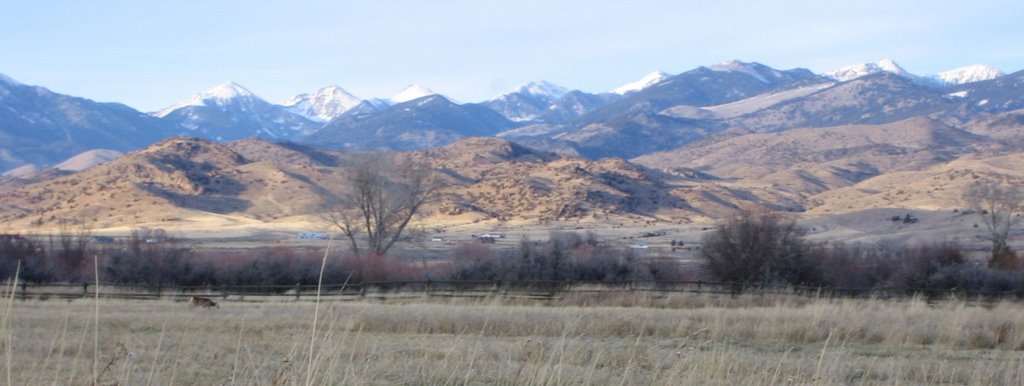
I am privileged to sometimes receive permission to hunt on a beautiful, well-managed ranch in the Ruby River valley (pic above). The place is full of whitetailed deer, sandhill cranes, turkey, pheasant, etc. As a restoration project, it was planned by a friend of mine -- Chris Boyer -- and it is a wonderful example of a how a cow-hammered property can be remade so that it functions both as a cattle ranch and as a nature preserve.


The ranch is an easy hunt (almost just shooting and not hunting really), but is an especially good experience for novice hunters. The ranch is laid out into large blocks with hunter access carefully controlled. You do not need to worry about moronic road hunters, careless shooters wandering through "your" area, or too many hunters chasing the critters off to neighboring properties.


I drove over for a late afternoon hunt last week, and shot two whitetailed does after watching many deer (including seven bucks, two of which were trophy-size) for an hour. Interestingly, after I shot the first it took only 5 minutes or so for the deer to calm down. If they do not see or smell you, then the noise of shooting and act of killing does not seem to disturb them.


AJ wanted to hunt a whitetail, and though I had hoped hunting season was over I agreed to show him this marvelous place. Saturday pre-dawn found us sneaking along a fenceline into our hunting block, watching dozens of deer, and having our hearts stopped by pheasant flushing at our feet. We sat at field edge in unmown hay, but the deer within shooting range were either bucks or fawns. The does get hunted hard in the Ruby, and they can be a little scarce toward the end of hunting season.


With sunup most deer retreated from the fields, and so I sent AJ to a hunting stand just inside a brushy wood bordering the field. Because he has sometimes shot unnecessarily and because I thought he was ready for it, I gave him only a single cartridge for the rifle. Then I walked a wide circle and approached the hunting stand along another brushy border. As I neared the stand, I heard the bark of my little 25 Roberts.


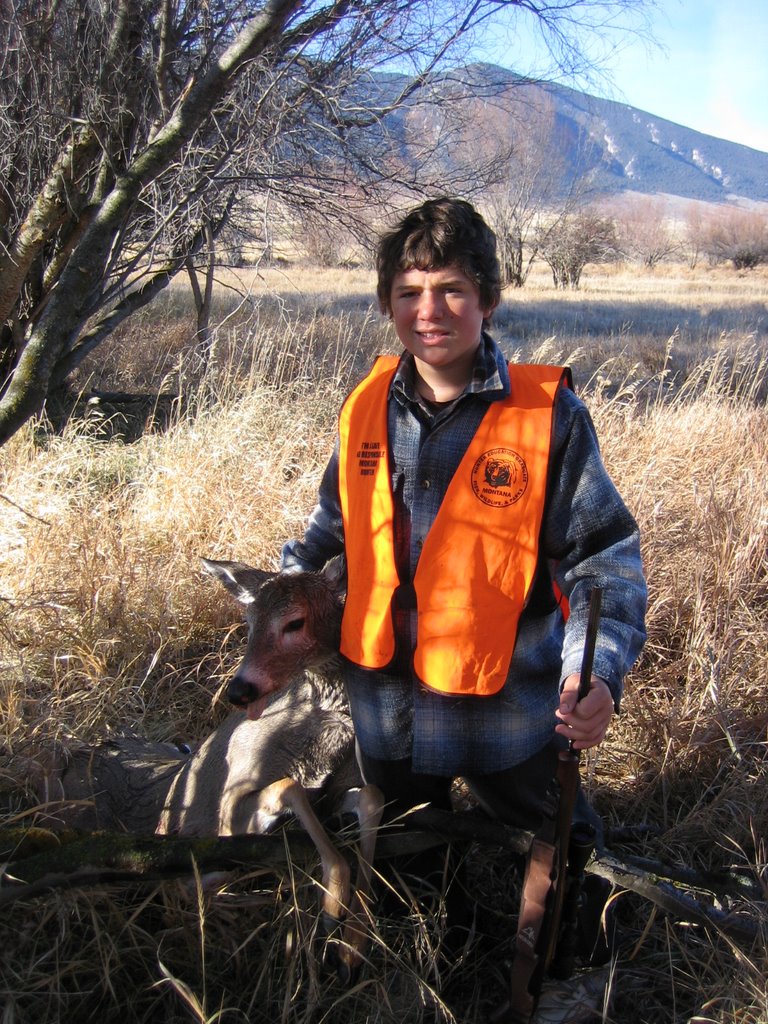
AJ was bending over as I approached and he said to me, "Every animal you kill is a gift." Good student, this lad. And he now has enough meat to feed his family for the entire year.


[Below is a little poem I wrote about my daughter Emily's hunt in this same place. Pat Munday
© 2005]

Tsik, Tsik, Tsa

Kalahari hunters listen to the stars, they sing “Tsik, Tsik, Tsa.”

Late afternoon in Montana’s most beautiful river valley,
In a state full of beautiful river valleys,
Full of people thinking they live in Montana’s most beautiful river valley.

But there we were, Papa and Daughter,
Sprawled behind a fallen cottonwood,
Examining dried raccoon turds for fur, seeds, small bits of bone.

Peeking over now and then,
Surveying the field,
Willing a white-tailed deer into being.

Turkeys on the jackleg fence
Hop down to feed in wheat stubble,
Clucking soft, contented, confident chatter.

Pheasants too: Cackling; Miffed; Muscled out.

Sandhill cranes along the wood line,
Hooting and hollering on hallowed ground,
Pterodactyls on native soil.

The sun touches the western ridge,
Flocks of blackbirds fly to roost,
Pleasant distractions.

Then from thin air a young deer,
Innocent in the ways of the world,
Feeds ten feet away.

New coat fuzzy in soft light of dusk,
Harbinger preparing the way,
More muzzles peak from brush yon side of jackleg fence.

Daughter watches, memory of flesh recalls a dark clear night,
Just a baby Mother held her up arms outstretched,
“The stars are the greatest hunters, “Tsik, Tsik, Tsa.””

Mother doe and fawn leap the fence,
Six feet high touch softly down look around,
Surveying the field.

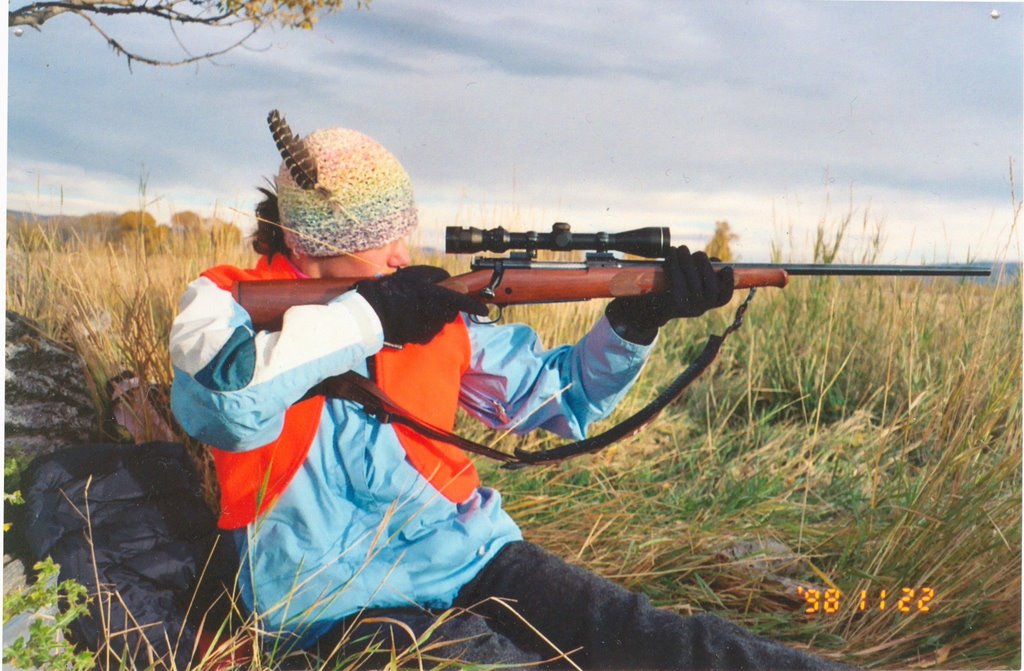
Daughter rests rifle on fallen tree,
Sights, breathes deep, squeezes,
Will she release this trigger?

At dawn stars faded fast,
She aimed and pondered, pondered and aimed,
Declined to kill a deer whose time had not come.

Rifle crack marks the time,
Child comes of age,
Star destiny fulfilled.

Papa watches the doe,
Hears the bullet smack,
Three leaps bring doe to ground.

One hundred and fifty steps later
Daughter bows to death,
Reaches out to earth’s gift.

The knife’s work is done,
Entrails pulled into a neat pile,
Liver and heart laid carefully aside.

Meat for the table,
We are blessed, “Tsik, Tsik, Tsa.”


Successful Elk Hunt


I hunted elk hard this year, but it just did not seem to be happening. So the other night I took stock of myself and decided to just be the predator and quit thinking about it so much. I thought about my little .308 Sako, the rifle Dad bought in the early 1960s, and boasted he would give to me if I shot a buck the year I turned 12. I don't believe he thought I would do it. It shot out of its first stock and is cracking the replacement (no nearly 20 years old) at the rear of the receiver. It eroded around the muzzle (don't leave the muzzle taped between hunts) and had to be shortened a bit and recrowned. But it's a wonderful, lightweight woods rifle and it shoots true.
Well, early morning next day found me walking up a low ridge along a small valley tight to the Continental Divide, six inches of heavy wet snow on the ground and more coming by the moment. I repeated my simple mantra "Elk, I will use you well and honor your memory."

Passing along the familiar path of Allen's flume (a 14-mile long conduit to float logs from the east to the west slope of the Continental Divide c. 1900 for the Anaconda smelter), I came upon one of the few braces left standing (see pic).

Just past sunup I cut the track of a young wolf (or, at least, a small one). A lone track, unlike a hunt along a ridge further down the valley earlier this week when I cut the tracks of big wolf and pup. I was tracking a big band of elk moving from open park to northside bedding grounds when the wolves cut in on my hunt. The tracks told the story: just as the elk were starting to bed, the pup rushed headlong into them. The wolf just ambled along at some distance, letting the pup have its head. The pup was of course no threat to the elk (and I doubt the lone adult wolf was, either) but it certainly made them scatter. I tracked another two miles but gave up when they headed through a valley and toward another ridge.

So this morning I let the wolf go its way, loping toward the open parks along the ridge top where the elk might still be feeding. Toward the place I intended to go. Perhaps the wolf would move the elk down to me if I stayed between the parks and thicker bedding grounds. And perhaps it did, for shortly after two elk passed just below me. I did not see them in the small, thickly growing trees and tag alders but heard their heavy hooves as they passed behind me, caught my scent, and fled. From the way that they passed through the low hanging branches without knocking much snow away, I was sure they were cows. And where there are two there are often more.

Swinging a wide circle from where the two cows had bolted I could feel that familiar tapping in my chest and kneeling down saw elk. Everywhere. All around. Several below me were already moving away, probably having cut my track or picked up my scent. A big cow just above me was bedded in a treewell. Though just 40 yards distant, I could barely make out her form. When she stood I shot her (just above and behind the heart, as it turned out). She ran down the hillside 100 or 200 yards, slumped into the snow, and I approached and shot once again. Before I had knelt to thank her and the mountain, the whiskey jacks (gray jays) were squawking for their share.

I field dressed the cow and hung some belly meat in an aspen for the hungry whiskey jacks. I like to keep on the good side of them, since occasionally they tell me where the elk are. After removing the tenderloins, I rolled the cow over, split along the spine, removed the backstraps, snicker-snacked the ribs with my vorpal hatchet, removed the spine, and finished splitting the elk. I dragged the two halves a hundred yards or so from the butchering site, covered each half with branches, pissed to marke the area and fend off coyotes (or this young wolf), and packed out the tenderloins and backstraps and heart and liver.

It was less than two miles in, and I hoped to return home, fetch the game sled, and have both halves out by dark. By the time I patched up the game sled (AJ's elk took its toll) and returned, it was nearly 3 pm. After setting a path with the first half, I was bushed and the sun was touching the Pintler ridges. I'll return today for the second half.

Thank you, Elk. I will use you well, and honor your memory.