Showing posts with label whitetailed deer. Show all posts

14 December 2007

Venison Sausage

Like many people I have known in my life, the longer I live the more I appreciate them. So it is with Grandma Beryl (nee Fitzgibbons) Munday. She was a tough old Scot-Irish Presbyter. When I was a child, I thought she was the meanest woman on earth. After Gramps died, however, and she no longer got up each morning at the butt-crack of dawn to cook him breakfast, she really mellowed.

Gram liked staying up late at night watching horror movies and reading, and for 50-some years of marriage she had been seriously sleep deprived. After Gramps died, she often sat in her chair with a cat on her lap reading until 1 or 2 in the morning, and then slept until 10 or sometimes later. When Jan & I lived nearby, we'd sometimes stop in after an evening on the town, and Gram was always ready for a glass of beer.

Gram didn't waste much. She cooked deer kidneys, picked a chicken carcass down to the bones, and made wonderful venison sausage. Here's the recipe.

You'll need a grinder. An old "armstrong" manual grinder like the one she left to me will work just fine:

For this batch, we'll use about 10 pounds of scraps left over from butchering a whitetail. Strips cut from the ribs, 1" - 2" chunks cut from the shanks, and anything else that didn't go into steaks, roasts, stewmeat, or stir-fry meat:

Add to that about 5 pounds of fatty pork scraps. Cheap bacon (our supermarket sells bags of bacon scraps) works well, and if you use salt pork you can use somewhat less:

Mix in a slew of spices and flavorings. Amounts are about 2 teaspoons for each of the spices, about a cup of dark brown sugar, and several (or more) hot peppers if you'd like:

Not shown are fennel seeds, about 4 tablespoons of which get added and mixed in before the second grind. Mix the spices, venison, and pork together and run through the grinder on a coarse setting. Gram's grinder has a single "plate" (cutter wheel) that reverses for fine and coarse grinding. Depending upon how sinewy and tough your venison scraps are and how efficient your grinder is, you might have to pause after every few pounds of meat, remove the plate, and clean out the sinews that are clogging things up. Here we are after mixing in the fennel seeds and switching the plate for the second (and final) grind:

This bulk or pan sausage is good for breakfast patties, and Jan likes it for dishes such as lasagna. Enjoy!

22 March 2007

White-tailed Deer in southwest Montana

I read an article in the Montana Standard newspaper last week. While interesting, Nick Gevock’s article about white-tailed deer “taking over” contains serious historical inaccuracies and omissions. [See http://www.mtstandard.com/articles/2007/03/22/outdoors_top/20070322_outdoors_top.txt]
White-tailed deer are not “recent migrants” to southwest and western Montana. Think of Deer Lodge, Montana, a town along the Clark Fork River just downstream of Butte. Deer Lodge got its name from, and was historically referred to by Native Americans as, “the lodge of the white-tailed deer.”

When Lewis and Clark led their infamous expedition through what is now southwest Montana, they saw many, many white-tailed deer—and relatively few mule deer. For example, consider Meriwether Lewis’ journal entry from 14 August 1805, made at the Three Forks of the Missouri River: “We have killed no mule deer since we lay here, they are all of the longtailed red deer [i.e. white-tailed deer] which appear quite as large as those of the United States.” The preponderance of white-tailed deer over mule deer continued as the expedition made its way up the Beaverhead River and over the Continental Divide to the Salmon River valley.

We must keep in mind that Lewis and Clark traveled primarily along rivers, and that white-tailed deer favor riparian habitat.

So why do old-timers tell us that white-tailed deer were scarce in southwest Montana until recently? It is because white-tailed deer were exterminated on the Montana frontier of the late nineteenth century. Ranchers’ cattle overgrazed the river bottoms, while miners and homesteaders shot everything in sight for food. For example, by 1871 Granville Stuart (located at what is now the Grant-Kohrs historic ranch near Deer Lodge) was outraged by the widespread slaughter of white-tailed deer and other native species, and he introduced legislation aimed at conserving wildlife. Despite Stuart’s efforts, the slaughter continued. By the 1890s, sportsmen’s groups petitioned the legislature to set hunting seasons and halt the sale of wild game. By 1900, there were virtually no deer or other game left in southwest Montana.

By the late1930s, thanks to the activism of groups such as the Montana Wildlife Federation and professional Fish & Game biologists, white-tailed deer and other game began to recover. Today, the alfalfa, wheat, and grass hay fields of our river bottoms provide abundant forage for white-tailed deer. Combined with the dearth of predators and the reluctance of some landowners to allow public hunting, this assures that the overpopulation of white-tails will continue—at least until something like Chronic Wasting Disease finds its way from game farms into our wild herds.

The article is an example of our tendency to see the world at the moment as if that is the way it has always been--irrespective of the huge changes that we have wrought even over very short time periods of a few human generations.

06 February 2007

Antlers

Well, another spate of warm weather has wrecked the skiing, so instead of skiing today I walked to work. I've been sawing out buttons from a deer antler to restore an old Woolrich coat, so along the way (it's about a mile and a half, so I have some quality thinking time) I thought about the whole "antler thing." That is, why do we save and treasure antlers? Is it a mere acquisitiveness, like rats hording useless items or children collecting baseball cards? Well, I like to think it's a little more than that.

Maybe it's more like scars. Get a bunch of men & beer together, and they (the men) will start talking about their scars. The thumb they split with a wood chisel, the stitches where the chainsaw kicked back and split their scalp, the band of scar tissue where they nearly cut off a thumb while reaching up inside an elk's chest cavity while wielding a sharp knife in the other hand... Antlers, like scars, are a material reminder of memorable events.

Certainly, many antlers just end up a debris in the corner of the basement. At my house, most antlers do not get saved anymore.

But some do. Rarely, I might use them for something quasi-practical--like buttons.

In Pennsylvania, I grew up in a deer hunting family that did not treasure antlers. Usually, they ended up "recycled" back to nature along with the offal, feet, bones, and other inedibles. Or they ended up in the yard, gradually reduced to oblivion as the hounds chewing on them. In my twenties, though, I worked at an oil refinery and got to know fellow chemist Bill King. Nailed up in his garage, Bill had the rack from every deer he'd ever killed . Because in most years he killed a buck in both New York State and Pennsylvania (we lived very close to the state line, and it was common to hunt in both states), there were more than fifty of them. So I began saving mine, nailing them up on various posts around a now-gone family oil property.

I left the refinery and went back to school for my PhD. In central New York State, I shot a classic "8-point" (eastern count) whitetail and mounted it on a nice hickory board slabbed out of firewood. This deer was all-the-more-special because as we were skinning and quartering it, my friend Andy Wilson found an arrow shaft with point embedded between the shoulder blades. The deer had healed completely. It makes a good hat rack and catchall for things like Great-Grandpa's M97 Winchester.

When I moved to Montana 17 years ago, I began to adorn the interior of our home with antlers. The first to go up was the rack from my first elk bull. As I look at these antlers, I recall it all seemed so easy: I just went out the first day of season, hunted elk like I had always hunted whitetails, found a big track, followed it all day, and late in the afternoon shot the bull. Wow. Sometimes it is just that easy.

Having grown up seeing small whitetail antlers, I am still amazed by the size of mule deer antlers. Even young bucks sometimes carry a rack that won't fit in a broom closet. So another hat rack made it inside the house.

My wife was feeling a little crowded by this time, so the next memorable buck I shot had its rack go to the office. It's not a big rack by any means, but it's a bit unusaul: a biologist told me the deer was a mulie-whitetail hybrid (not uncommon, I've found).

Since then, memorable racks go up on the back of the house on the outside wall to the mudroom. Oh yes, you can also see a buffalo skull with horns on the upper right (on the roof). I shot a couple of buffalo for a high school history outing when my daughter was in the history club; sent one skull to my friend Don for his barn (he has a nice elk rack I sent him, too).

What makes a memorable rack? Something about the hunt, usually. I must admit, I cannot recall most of my mule deer hunts. They all blend together into one universal, Platonic hunt that ended up with a 125 pound forkhorn providing good meat.

But I do remember every successful elk hunt--whether I took a cow or a bull. These two racks -- a mulie and bull -- are especially memorable because I shot the two within minutes of each other, and I shot them with my old hunting buddy Dave Carter. Though Dave had given up hunting, he joined me one day for a deer hunt in one of our favorite mulie haunts ("Dave's Deer Mine"). And for the first time, we saw an elk there, too. Also, the bull's left antler is deformed --it never grew out much, and part of the base split off and a brow tine grew down the elk's head between its eye and ear.


Speaking of Dave's Deer Mine, this is from the first buck I shot there. I learned that, to get these deer to the nearest road, you have to wade across an icy river. I've since learned to quit shooting big mulie bucks. Frequently -- if they are in rut -- the meat is so strong as to be nearly inedible. People will deny this, but then they start describing the strong seasonings and other cooking methods...

When I shot this bull, it was a long haul out through very deep snow. I left the head in a tree and hiked back up the mountain to retrieve it the following July. A porcupine found it first, as you can see by the nearly-chewed-through spot on the main beam of the left antler.

These two bulls were shot from opposite sides of the same bedding area in two consecutive years. The bull that carried the upper rack was a sort of dwarf: its body size was more-or-less normal, but its legs were abnormally short and it had only half a liver.
Well, I'm no trophy hunter, and certainly none of the racks I've taken over the years are trophies. But they are memories. By the way, ask me sometime to tell you about that scar on the inside of my left forearm...

27 November 2006

The "25 Roberts" rifle (aka .257 Remington Roberts)

Lying awake and trying to find my way into sleep one night during this past hunting season, like pearls on a string I began sliding along the memories of deer killed by my 25 Roberts. I lost count and fell into sleep somewhere past sixty. More important to me were the seven individuals whom I could recall having used the rifle. Though it is a mere material fetish, it gives me great pleasure to connect the lives of these friends and family members through an elegant piece of wood and steel.
When I was a kid, I read an essay by Jack O'Connor about the 257 Roberts--probably on the pages of Outdoor Life magazine. A few oldtimer friends of my grandfather hunted with the 250-3000 Savage M99 lever action, and that cartridge carried quite a mystique. When O'Connor declared the 25 Roberts to be far superior to the 250-3000, I knew I had to have one.

It took awhile. After dozens of deer shot with everything including a 222 Remington, 20 ga shotgun slugs, and a 308 Winchester, I was working at an oil refinery in Bradford, Pennsylvania, and had a little folding money to spare. It was the late 1970s, and Winchester had reintroduced its M70 Featherweight. A local gunshop ordered me one in 25 Roberts.

It proved to shoot accurately with 50 grains of IMR 4350 pushing 100 grain Hornaday softpoints. I've since reduced that load to 48 gr, since occasionally with warm weather the load has proved a little too hot--leading to cratered primers and sticky ejection. For bullets, I've switched to 100-gr Nosler "blue tip" boattail softpoints, a super accurate bullet suggested by my friend Don Kieffer (from whom I recently re-acquired a 25-06 Browning, after having traded him the rifle some years prior to that). I also like the 100-gr Barnes all copper bullet--it is accurate, holds together on elk, and has not caused the copper fouling problems reported by some.

The 25 Roberts is a low recoil round that kills deer and antelope very well. I do not like shooting big magnum rifles and the flinching (bad shooting) habits they induce in most users. The 25 Roberts is also light to carry, something I appreciate when stalking mule deer up and down the rugged canyons of the lower Big Hole River valley. While the 25 Roberts is not the best choice for an elk rifle, it did kill a nice bull elk (1 shot) last year that happened to be feeding with a bunch of mule deer. Also, my hunting apprentice AJ used the little rifle to kill his elk cow this year. The first shot was at rather long range (well over 200 yards), and the second shot (delivered after the cow made it to the bottom of a steep walled valley and lay down, where AJ caught up with it) was probably superfluous.

On many deer hunts over the years, hunting partners have used my 25 Roberts to kill their deer. Sometimes, this has been after they missed a deer with their own rifle. I think some people are just careless about working up a good load in their own rifle and shooting it enough to have confidence in it (and to KNOW it’s sighted in!) but this has lent my rifle an almost magical reputation.

17 November 2006

Ruby Valley deer hunt


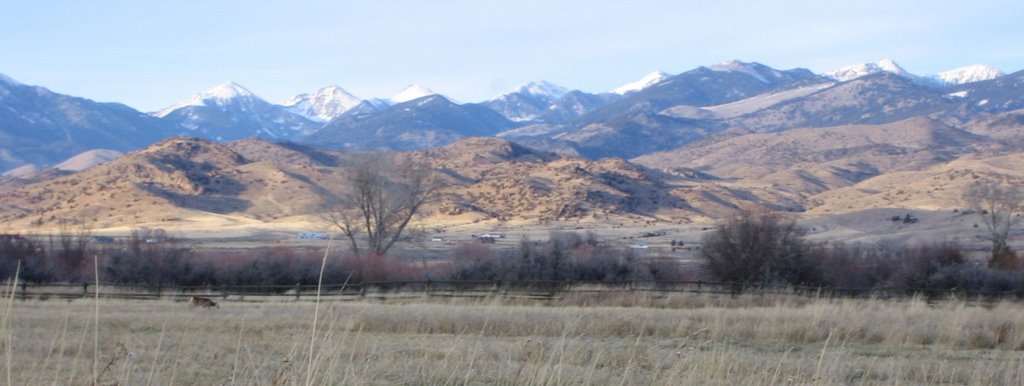
I am privileged to sometimes receive permission to hunt on a beautiful, well-managed ranch in the Ruby River valley (pic above). The place is full of whitetailed deer, sandhill cranes, turkey, pheasant, etc. As a restoration project, it was planned by a friend of mine -- Chris Boyer -- and it is a wonderful example of a how a cow-hammered property can be remade so that it functions both as a cattle ranch and as a nature preserve.


The ranch is an easy hunt (almost just shooting and not hunting really), but is an especially good experience for novice hunters. The ranch is laid out into large blocks with hunter access carefully controlled. You do not need to worry about moronic road hunters, careless shooters wandering through "your" area, or too many hunters chasing the critters off to neighboring properties.


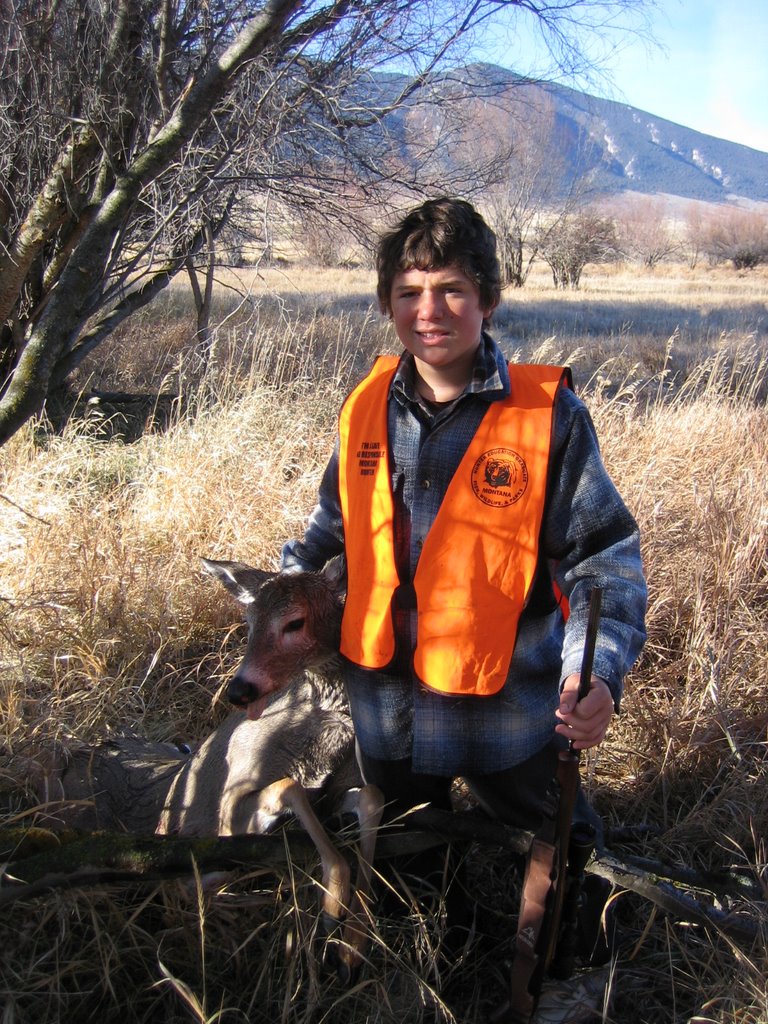
I drove over for a late afternoon hunt last week, and shot two whitetailed does after watching many deer (including seven bucks, two of which were trophy-size) for an hour. Interestingly, after I shot the first it took only 5 minutes or so for the deer to calm down. If they do not see or smell you, then the noise of shooting and act of killing does not seem to disturb them.


AJ wanted to hunt a whitetail, and though I had hoped hunting season was over I agreed to show him this marvelous place. Saturday pre-dawn found us sneaking along a fenceline into our hunting block, watching dozens of deer, and having our hearts stopped by pheasant flushing at our feet. We sat at field edge in unmown hay, but the deer within shooting range were either bucks or fawns. The does get hunted hard in the Ruby, and they can be a little scarce toward the end of hunting season.


With sunup most deer retreated from the fields, and so I sent AJ to a hunting stand just inside a brushy wood bordering the field. Because he has sometimes shot unnecessarily and because I thought he was ready for it, I gave him only a single cartridge for the rifle. Then I walked a wide circle and approached the hunting stand along another brushy border. As I neared the stand, I heard the bark of my little 25 Roberts.


AJ was bending over as I approached and he said to me, "Every animal you kill is a gift." Good student, this lad. And he now has enough meat to feed his family for the entire year.


[Below is a little poem I wrote about my daughter Emily's hunt in this same place. Pat Munday
© 2005]

Tsik, Tsik, Tsa

Kalahari hunters listen to the stars, they sing “Tsik, Tsik, Tsa.”

Late afternoon in Montana’s most beautiful river valley,
In a state full of beautiful river valleys,
Full of people thinking they live in Montana’s most beautiful river valley.

But there we were, Papa and Daughter,
Sprawled behind a fallen cottonwood,
Examining dried raccoon turds for fur, seeds, small bits of bone.

Peeking over now and then,
Surveying the field,
Willing a white-tailed deer into being.

Turkeys on the jackleg fence
Hop down to feed in wheat stubble,
Clucking soft, contented, confident chatter.

Pheasants too: Cackling; Miffed; Muscled out.

Sandhill cranes along the wood line,
Hooting and hollering on hallowed ground,
Pterodactyls on native soil.

The sun touches the western ridge,
Flocks of blackbirds fly to roost,
Pleasant distractions.

Then from thin air a young deer,
Innocent in the ways of the world,
Feeds ten feet away.

New coat fuzzy in soft light of dusk,
Harbinger preparing the way,
More muzzles peak from brush yon side of jackleg fence.

Daughter watches, memory of flesh recalls a dark clear night,
Just a baby Mother held her up arms outstretched,
“The stars are the greatest hunters, “Tsik, Tsik, Tsa.””

Mother doe and fawn leap the fence,
Six feet high touch softly down look around,
Surveying the field.

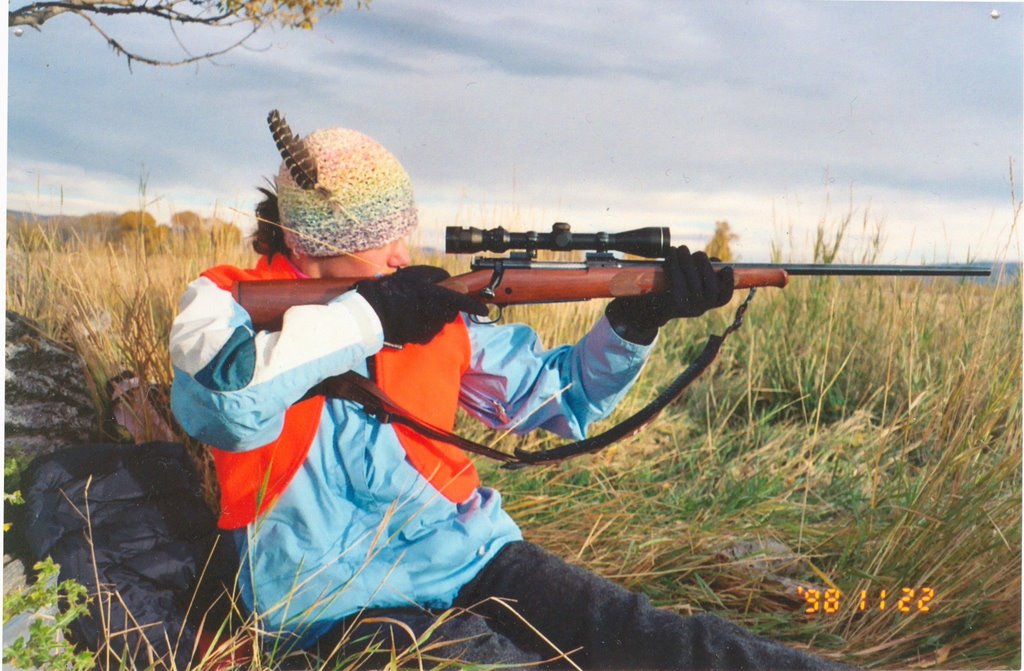
Daughter rests rifle on fallen tree,
Sights, breathes deep, squeezes,
Will she release this trigger?

At dawn stars faded fast,
She aimed and pondered, pondered and aimed,
Declined to kill a deer whose time had not come.

Rifle crack marks the time,
Child comes of age,
Star destiny fulfilled.

Papa watches the doe,
Hears the bullet smack,
Three leaps bring doe to ground.

One hundred and fifty steps later
Daughter bows to death,
Reaches out to earth’s gift.

The knife’s work is done,
Entrails pulled into a neat pile,
Liver and heart laid carefully aside.

Meat for the table,
We are blessed, “Tsik, Tsik, Tsa.”