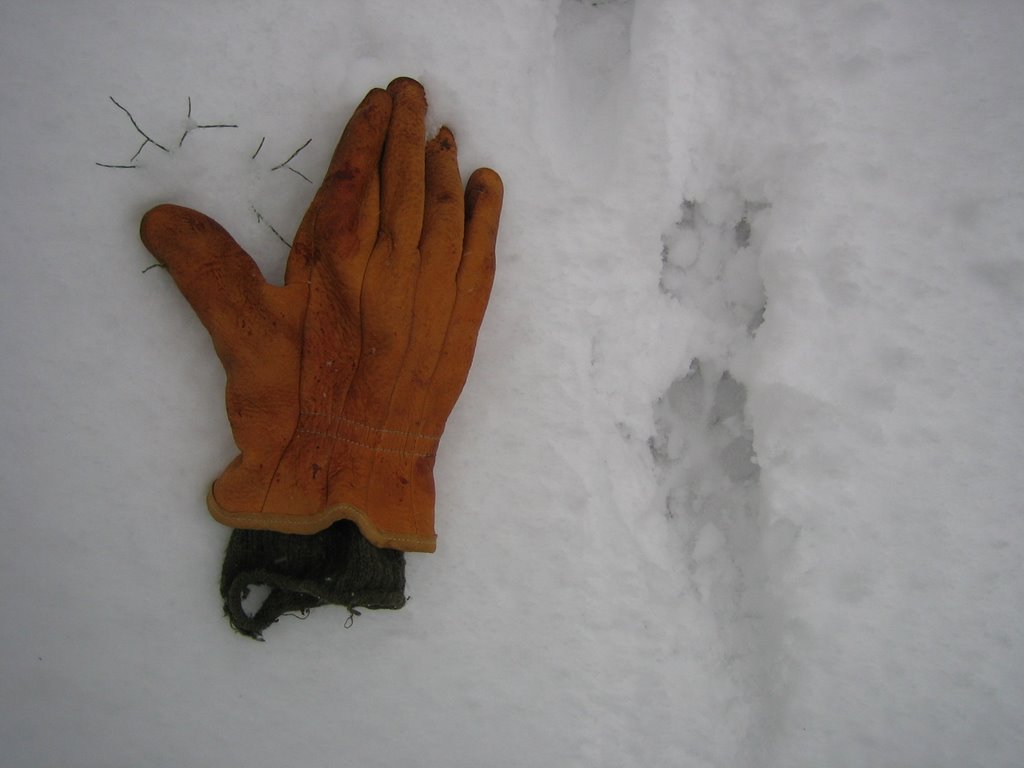
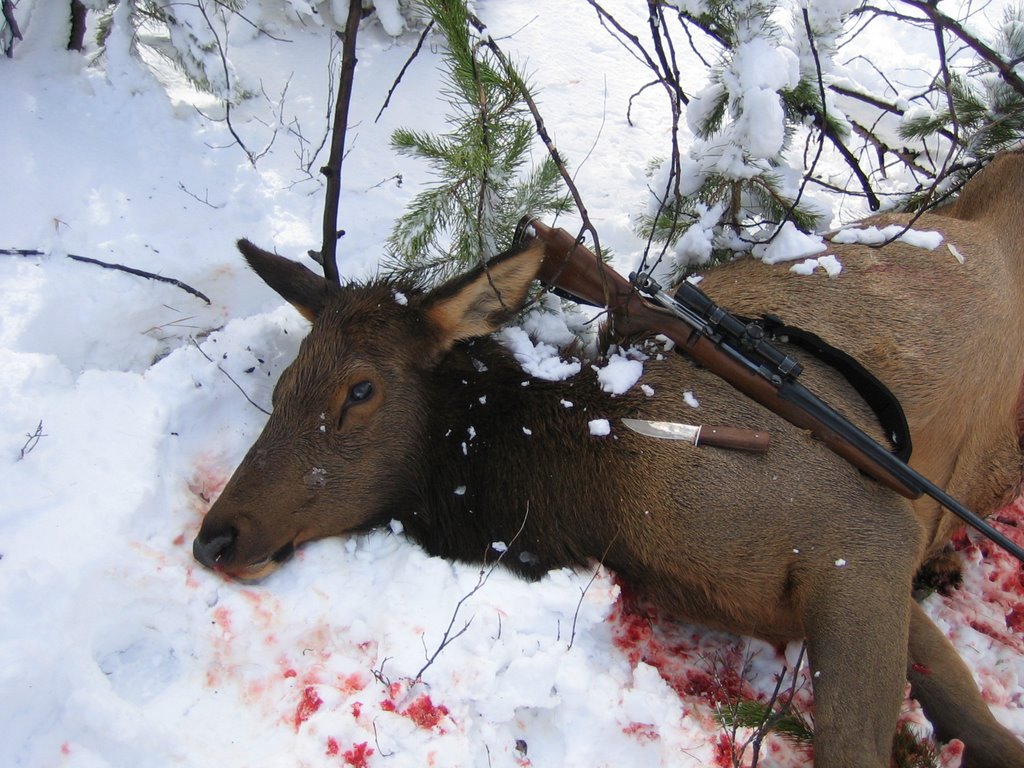
The morning we were to leave for a weekend in Yellowstone National Park, the local newspaper headline read, "Area wolf pack exterminated."
[
http://www.mtstandard.com/articles/2007/09/27/butte/hjjcjahcjhijij.txt]
Mount Fleecer, visible from Butte and a popular local elk hunting spot, will be "wolfless" for the time being. It won't take long for another pack to move in, given that the area serves as winter range for hundreds and sometimes thousands of elk and that it's heavily grazed by cattle. And it won't take long for the new wolves to kill their first cow calf, after which they will again be exterminated like the mice that inhabit a kitchen.
How strange, then, to cross the magical boundary into Yellowstone. Just a line on a map and meaningless to wolves, but to humans it is more like prison walls. Escaping prisoners -- especially when they are buffalo or wolves -- will be shot on sight.*
We joined a big group of friends to camp in the park and listen to the bull elk whistle as they form and defend their harems in competition with other bulls. Our first night in the park, we were not disappointed. From dusk to dawn, elk music filled the air. The dominant campground bull -- we quickly learned to recognize his distinctive, full bellied 5-note whistle followed by deep grunts -- kept his cows in the woods during the day, allowing them to graze in the open only at night:

A lessor bull hung around closer to camp. Though we heard his whiny, croaking, whistle throughout the night, we never saw him approach or challenge the big bull. No wonder it is the big dominant bulls that often die in late winter, starved to death while floundering in deep snow or eaten alive by wolves. While the dominant bull spends all his time (and energy, and fat reserves) chasing and breeding cows, the lessor bull spends the time filling his belly with grass and putting on more weight for winter:

Of course, the really big bull herds his harem around the green grass at the park offices in Mammoth:

Our second night in the park, something happened that brought a long silence to the early morning. Up until 3 a.m., the bull elk whistled, the cows and calves barked, and the song-dogs (coyotes) trilled and yipped and howled. Then, a single booming howl reverberated across the hillsides. After that, all was silent as the coyotes and elk feared letting the wolf (or, more likely, wolves) know just where they were. This didn't prevent the coyotes from making pests of themselves during the day, however, as they scrounged from campsite to campsite for human food:

Brent and his kids, Kenia and Adler, and I spent our first morning on a firewood-gathering expedition outside the park. On Forest Service land, we stumbled upon a former cabin site that entertained the kids with curious items such as a curtain rod and baseball bat, and provided Brent & I with a fine pile of fence posts for use as firewood. Meanwhile, Jan and some of the other folks hiked to Steamboat and some of the other sites in the Geyser Basin:
 Back at camp with the firewood cut, split, and stacked, we headed down the hill for a soak:

Nothing like "taking the waters" to soothe sore muscles, melt away worries, and prepare our apetites for Karina's pozole:

Next morning, a group of us left in the predawn chill (low 30s deg F) to spend a few hours wolf watching. On the way to the Lamar Valley, this black bear was along the road eating rose hips:

After a false start with a group of folks at Slough Creek with their spotting scopes all set up expecting to see the pack they watched the previous day, we joined another group just west of Druid Peak. They had spotted a pack with their pups nearby. Alas, we just missed them as the pack had split and the pups went into hiding after some over-zealous photographers got between the pack and the cub. But not to worry: "Alpha Dog" directed everyone to move down the road one mile. Most did so, with just one or two persons per super-sized SUV or RV rig.
I', m not sure how far it was, but we pulled over the next place where a big gang of folks were set up with spotting scopes. Sure enough, the wolves were just across the Lamar River, maybe a quarter-mile away. They were howling and generally putting on a good show for the tourists. Again, some knuckle-head photographers moved too close to them, and the wolves trotted off. Once a half-mile or so away, they relaxed and re-grouped. We could count at least 4 blacks and 5 grays, thanks to Dave's good spotting scope. Even with compact binoculars, they were great fun to watch, especially as they began stalking and surrounding a buffalo cow with two calves. The buffalo wisely moved away and toward a bigger herd, and the wolves moved downriver until they came to a high, sunny bench above the river.
Watching wolf watchers is nearly as much fun as watching wolves.** Just at there was an Alpha Dog in the group that others took their cues from, so was there an Alpha Bitch. Never mind that she didn't seem to know her ass from a hole in the ground, she liked to exert dominance, especally if others were talking. "Shhh... they're howling and we don't want to disturb them." (Never mind that the wolves were easily a mile away.) "Shhh... they're howling." (Never mind that it turned out to be a flock of geese she was hearing.) "Shhh... they're howling." (Never mind that there was a diesel RV backing out of the parking area and all you could hear was the clatter of its engine valves.) "Shhh... they're howling." (Never mind that the guy she was "shushing" was a Vietnam Vet with a hearing disability who (A) could not hear her, and (B) didn't care if she was shushing him or not. At that point, I could no longer contain myself and burst out laughing. After a few shushes directed at me (which triggered yet another round of laughing), I quieted down, fearing that she might clobber me with her spotting scope that's worth more than my old pickup truck:

On the way back to camp we watched some bighorn sheep on a cliff:

And had to pause for the usual buffalo roadblock or two:

All of this is good fun, but also raises a serious point. To what extent does the ease of viewing wildlife in Yellowstone National Park undermine our appreciation for wildlife? Normally, wild animals fear humans as predators and as competitors. Normally, even in wilderness areas (where hunting is allowed), you must work very hard and have good stalking technique to see big bull elk or wolves. In Yellowstone, all these critters are right there along the road--you merely need to drive up to them. Occasionally, as with the wolves, you might need to walk through the sagebrush for a hundred yards or so in order to set up at a good location. Park "wildlife security guards" are there (sometimes) in their fluorescent green and orange vests to keep tourists from getting to close to the critters. But, other than a few gallons of gasoline and the willingness to rise early, it doesn't take much effort.
Given the abundance of and ease of viewing wolves in Yellowstone, most people simply will not care whether or not the Fleecer pack -- or any other wolf pack outside of Yellowstone -- is exterminated. But perhaps I am wrong, and Park wildlife help people appreciate nature
more. Perhaps the abundance of and ease of viewing wildlife in Yellowstone National Park will help them demand better management, less wildland development, and more diversity everywhere--including their own back yard.
---------------------------------------------------
* I owe this metaphor of national parks as prisons to Thomas Birch, "The Incarceration of Wilderness,"
Environmental Ethics 12 (1990).
** Cf. Montag et al, "The wolf viewing experience in the Lamar Valley of Yellowstone National Park,"
Human Dimensions of Wildlife 10 (2005).


 Though the weather has been seasonal of late with 80 deg F days and 40 deg F nights at 6,000 feet elevation in Butte, we still opted for an early morning start. It's not a long (c. 8 miles) nor especially steep (c. 2500 foot elevation gain) hike, but it is nice to travel in the cool of the day. While stashing a few beers in the creek near the Fishtrap Creek trailhead for the ride home, I discovered this Pine Marten set constructed by some fur trapper:
 Mornings are also active critter time, and we busted some elk from where the trail crosses a big wet meadow, and the dogs nosed into several spruce grouse (aka fool hens, for their habit of sitting in a tree just a few feet away). The grouse were feeding on grouse whortleberry and grasshoppers--both are numerous this year:
 We also came across a lot of "doodlebug" or antlion pits, including this exceptional colony:
 If I were an ant living in this area, I'd want to be named Daniel. Even in the wilderness, there are some historical tracks of a working landscape, such as this irrigation ditch that moves water many miles from the headwater diversion:
 Our first day in, we rested through the heat of the afternoon and then hiked above treeline to Lost Lakes where Don spotted a group of 6 or 7 goats working their way along the ridge to the left of the lower lake, and we took in the fantastic view:
 The area's height and location help in capturing a lot of snow. Even in the driest and hottest of summers, the big snow cornice along Saddle Ridge lasts all summer long, as does the glacier along the upper lake. Yes, it is a true glacier, and the only one in the Pintler, according to Don Nyquist, a National Weather Service observer, meteorologist, and Anaconda resident. Don says a key characteristic that makes this a glacier is the formation of firn--"the metamorphic layer of dense, granular snow between the accumulation area (new snow) and glacial land ice." Here's a photo of the upper lake and its glacier (West Goat Peak is on the far right of the snow cornice just below the ridge):
 The approach to West Goat Peak is very pleasant with very little scree (as Pintler peak bagging goes). Here's Don picking his way along the ridge, with the fantastic vertical goat cliffs on his right:
 Chooka and RTD did a lot of goat- & pika-sniffing on the way up, and once on the summit they were content to rest. Here's the pup, with Warren Peak in the background (easily bagged from Edith Lake):
 The morning haze from our numerous local forest fires thickened throughout the day. With clear air, the distant views from W Goat are tremendous, but even the "close" view of the alpine meadow leading down to Lost Lakes is pretty sweet:
 Just as we finished supper that evening, a big thunderstorm swept through. This is why I prefer to camp down in the timber, and not on the barren ground around Lost Lakes. As RTD and I lay in the tent watching through the vestibule door as lightning flashed and crashed, I took a moment to appreciate the difference between Pink Mountain Heath (Phyllodoce empetriformis):
 And Merten's Mountain Heather (Cassiope mertensiana):
 These lovely evergreen species carpet much of the Pintler high country, along with other familiar species such as Alpine Gentians (Gentiana calycosa), the leaves of which make a tasty and mildly psychotropic tonic:
 Though the flowers have faded, I also like the Elk Thistle (Cirsium foliosum):
 From home today, I took a morning walk to Big Butte before spending a few hours laying rock on the new retaining wall in the backyard. The smoke was not too bad, and I could just make out East Goat Peak, Saddle Mountain, and West Goat Peak through the fire haze. Already, the good memory of West Goat Peak is getting me through another year.